
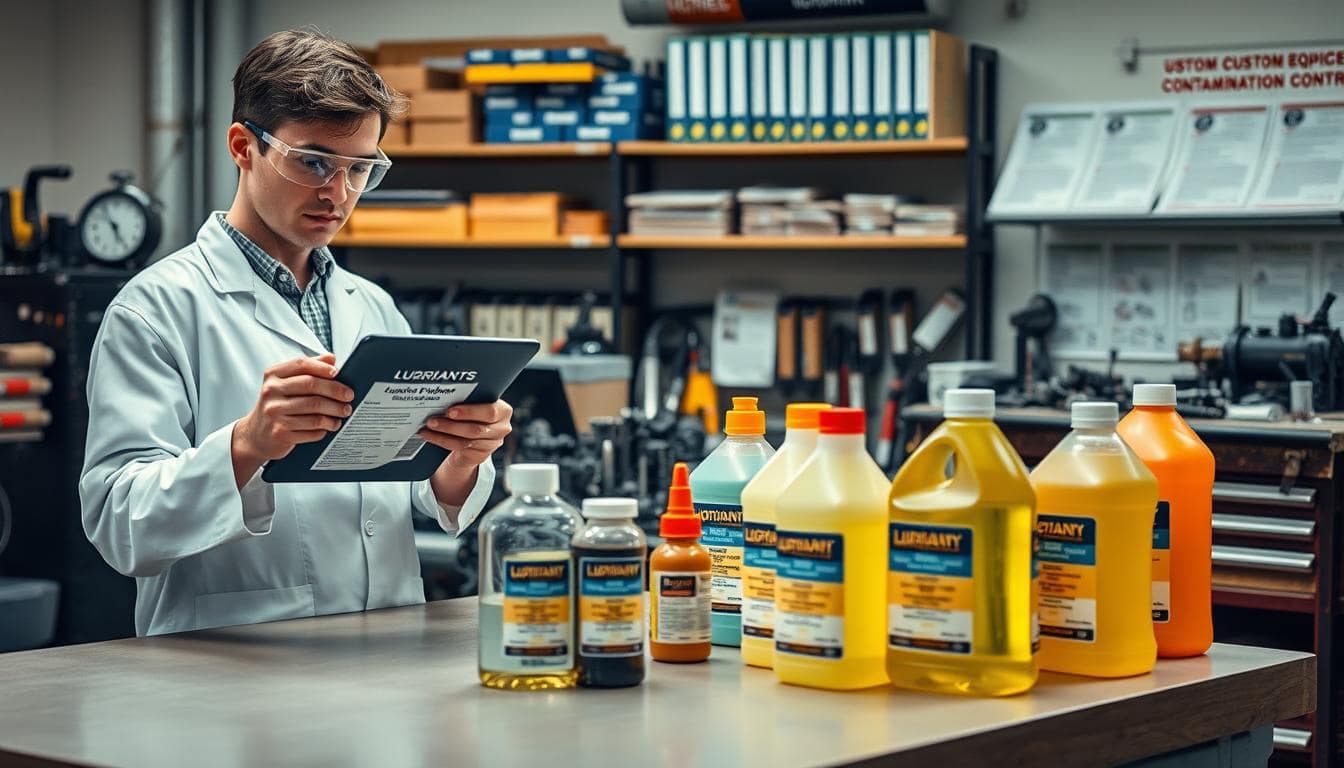
For custom machinery, reliability is key. A shift in mindset is needed. The goal is now to prevent contamination, not just control it.
Controlling contamination is a reactive step. Preventing it is the goal to reduce risk. It involves looking at the whole process, from start to finish.
This approach helps equipment last longer. It turns maintenance into a precise science. The aim is to keep assets running smoothly for custom needs.
Success begins with a detailed plan. This plan maps out all lubrication points and their needs. Scientific lubricant selection and set service times are essential. This ensures every action supports long-term reliability and performance.
Choose oils/greases by speed, load, temp, food‑grade needs
Choosing the right lubricant starts with looking at speed, load, temperature, and any rules that must be followed. For custom equipment, this is not just a simple task. It’s a detailed engineering choice that affects how well the machine works and how long it lasts.
What the machine does affects what kind of lubricant it needs. Fast-moving parts need oil that’s not too thick to cut down on friction. Heavy loads need oil or grease that can handle high pressure. Extreme temperatures require lubricants that keep their viscosity stable.
There are also rules to follow, like in food, drink, or medicine making. Here, food-grade lubricants with NSF H1 or similar certification are a must. Other places might need lubricants that can handle water, dust, or chemicals.
It’s not just about what’s in the lubricant. It also has to meet ISO cleanliness codes. These codes help everyone understand how clean the lubricant is, making sure suppliers meet standards.
A key fact is that new lubricants can actually be dirty. They can have solid particles and water from how they’re made, stored, or moved. Using dirty lubricants can ruin the whole system from the start.
So, it’s important to have rules for checking lubricants before they’re used. These rules should check if the lubricant is what was ordered and if it’s clean enough according to ISO cleanliness codes. Make sure suppliers have the right certifications and test results. Don’t let in bulk shipments without checking them first.
| Operational Factor | Impact on Lubricant Choice | Key Specification Consideration |
|---|---|---|
| Speed | High speed requires low viscosity to minimize friction and heat. | ISO Viscosity Grade (VG); base oil type. |
| Load | Heavy load demands high viscosity or EP additives for film strength. | Additive package (e.g., Anti-wear, EP); grease consistency (NLGI Grade). |
| Temperature | Extreme heat or cold affects viscosity stability and oxidation rate. | Viscosity Index; oxidation inhibitors; synthetic vs. mineral base oil. |
| Environment (e.g., Food-Grade) | Prevents product contamination and meets health regulations. | NSF H1, 3H, or other relevant certification; inertness. |
| Cleanliness | Particle contamination accelerates wear and component failure. | Mandated ISO cleanliness codes for incoming oil. |
The right lubricant is one that works well in its job and is clean when it arrives. Choosing the right one and making sure it’s clean are both important. If the lubricant is not clean, no matter how good it is, it won’t work right. A careful selection process and strict checks ensure that custom equipment gets the clean, correct lubricant it needs from the start.
Keep it clean: breathers, filtration, transfer carts, color‑coding
The quality of lubricant depends on the cleanliness of its environment. Water, dust, and metal particles can harm it. Keeping equipment clean is essential to avoid damage.
Desiccant breathers are a key defense. They replace standard caps on reservoirs and gearboxes. They control moisture, keeping water out of the lubricant.
Removing particles is vital. Portable filtration carts and offline systems are key. They clean the oil, removing harmful particles. This keeps the lubricant clean and extends its life.
Transferring lubricants is risky. Sealed transfer carts are needed. They keep the lubricant clean by preventing dirt and moisture. Each cart is color-coded to avoid mixing lubricants.
The table below summarizes these critical physical controls:
| Control Method | Primary Function | Key Benefit |
|---|---|---|
| Desiccant Breathers | Control moisture ingress from air | Prevents corrosion and additive depletion |
| Portable Filtration Carts | Remove solid particles from oil | Maintains target ISO cleanliness, extends oil life |
| Sealed Transfer Carts | Move lubricant without environmental exposure | Eliminates introduction of new contaminants |
| Color-Coding | Visual identification of lubricant type | Prevents cross-contamination and misapplication |
These measures create a strong defense. They protect lubricant quality from start to finish. This approach makes keeping equipment clean a standard for success.
Condition checks: sight glass, ferrography, particle counts; when to sample
Condition-based lubrication uses science to find the best relube intervals. It moves maintenance from guesswork to a precise science. This method checks lubricant health and equipment condition with real data.
Experts say oil analysis is key for good condition monitoring. They aim to change oil and filters only when needed, not by a set schedule. This way, lubricant lasts longer and downtime is less.

Three main methods give us the data we need. A sight glass lets us see oil level, color, and clarity. If it’s cloudy or milky, it might mean water or additives are gone.
Ferrography is a detailed test. It looks at wear debris in the oil. This tells us about mechanical wear inside the equipment.
Particle counting shows how clean the oil is. It counts and sizes particles in the oil. This is important for systems that can’t handle dirt, like hydraulic or high-speed bearings.
Getting a good oil sample is key. Bad sampling can ruin even the best analysis. We must follow best practices to get a sample that shows the oil’s true condition.
Here are some sampling tips:
- Use dedicated, clean sampling ports or valves.
- Sample when the equipment is running and the oil is warm and mixed well.
- Don’t sample from drain points where debris settles.
- Use clean bottles for each sample.
Choosing the right sampling frequency is also important. For important equipment, you might need to sample monthly or every three months. Less critical machines might only need it every six months or a year. The right frequency depends on the machine’s importance, its environment, and past data.
This method helps adjust relube intervals more accurately. Instead of changing grease every three months, analysis might show it’s good for five. This saves components, reduces lubricant use, and cuts waste.
The data from sight glasses, ferrography, and particle counts gives a full health report. Maintenance teams can then decide when to add oil, change filters, or flush systems. This proactive approach stops small problems from becoming big ones.
Condition monitoring creates a loop that keeps improving the lubrication program. It moves from scheduled tasks to necessary actions. This is the essence of a well-run and cost-effective reliability program.
Automate safely: single‑point and manifold systems for hard‑to‑reach points
Single-point lubricators and manifold systems change how we maintain hard-to-reach machine parts. They remove the need for manual greasing in dangerous spots. This ensures precise lubrication and boosts worker safety.
Automation is more than just making things easier. It’s a key way to make equipment more reliable. For unique equipment shapes, these systems offer a clean, consistent lubrication solution.
Precision with Single-Point Lubricators
A single-point lubricator is a self-contained device for one lubrication point. It dispenses grease or oil at set times, either by timer or mechanical action.
This tech is perfect for hard-to-reach bearings, gears, or chains. It’s a closed system that keeps dirt and moisture out. It also keeps technicians safe from climbing or reaching into machinery.
The main advantage is precise, consistent lubrication. It prevents wear from too little lubrication and attracts contaminants from too much. This is a set-and-forget solution.
For equipment with many fittings in dangerous areas, manifold systems are better. These systems use a central pump and lines to reach many points from one safe spot.
Manifolds are great for big, custom machines. They can handle dozens of points from one control panel. This means technicians don’t have to grease each spot individually, avoiding dangerous areas.
Like advanced transfer carts, these systems often have positive-lock connections. This design helps prevent contamination during lubrication. It’s a key part of keeping equipment running smoothly.
Integration and Design Considerations
Adding automation needs careful planning. The lubrication system should be part of the machine’s design. Consider lubricant type, pressure needs, and the environment.
Safety is key. Systems should have pressure relief valves and clear indicators. For places that need to be cleaned, the materials must be able to handle it.
Proper setup is vital for long-term reliability. Lines should be safe from damage. Central systems should have easy test points for flow checks.
| Feature | Single-Point Lubricators | Manifold Systems |
|---|---|---|
| Primary Function | Deliver lubricant to one specific point | Centralize delivery to multiple points |
| Best Application | Isolated, hard-to-access individual bearings | Groups of fittings in hazardous or remote zones |
| Installation Complexity | Low to Moderate | Moderate to High |
| Contamination Risk | Very Low (closed system) | Low (sealed distribution lines) |
| Maintenance Action | Replace cartridge or battery on site | Monitor central reservoir and pump health |
The choice between these technologies depends on the machine and risk level. Many places use a mix. They use single-point lubricators for key points and manifolds for larger areas.
Automated lubrication brings clear benefits. It cuts down on manual work and injury risks. It ensures every part gets the right lubricant at the right time. This is key for longer equipment life and less downtime.
KPIs: lube‑related failures, sample pass rate
Without measurable metrics, lubrication efforts are just costs without proof of value. A formal lubrication program needs key performance indicators to show its success. Tracking KPIs gives the evidence needed to link maintenance to asset health and financial results.
Two main metrics are key. The first is the rate of lubrication-related failures. This KPI tracks equipment breakdowns caused by bad lubricant selection or contamination. High failure rates mean hidden costs, like extra labor for repairs and shorter asset life.
The second metric is the oil analysis sample pass rate. It shows the percentage of samples that meet cleanliness and wear debris limits. A low pass rate means contamination issues that can lead to expensive repairs and downtime. This metric acts as an early warning for possible failures.

Together, these KPIs show how well the program is doing. They turn lubrication from a routine task to a strategic function. The data supports more investment in advanced tools, training, and premium lubricant selection.
| Key Performance Indicator | Calculation Method | Target Benchmark | Impact on Operations |
|---|---|---|---|
| Lubrication-Related Failure Rate | (Number of lube-caused failures / Total operational hours) x 1000 | Directly links to maintenance costs and asset availability. | |
| Oil Sample Pass Rate | (Number of passing samples / Total samples taken) x 100 | > 95% pass rate | Indicates contamination control effectiveness and predicts machine life. |
| Mean Time Between Lube Failures (MTBLF) | Total operational hours / Number of lube-caused failures | Steadily increasing trend | Shows long-term reliability improvement from proper lubrication. |
Regularly checking these metrics makes lubrication a measurable value driver. It changes the view from just an expense to a total cost of ownership. Management can make informed decisions on spending on filtration systems, desiccant breathers, and high-performance lubricants.
A high sample pass rate shows the success of the contamination control strategy. It proves that spending on proper transfer carts and filtration is worth it. A falling failure rate also shows the value of expert lubricant selection and consistent application.
These KPIs create a loop for ongoing improvement. They give the data needed to improve procedures and training. This objective approach ensures the lubrication program keeps contributing to reliability goals.
Templates: lube route + labels
A lubrication program needs precise tools to move from plan to practice. Detailed lubrication route sheets and a labeling system are key.
Route sheets clear up vague work orders. Each sheet lists the machine point, the right lubricant, how much, and when. They also show how to apply it. This makes sure everyone knows what to do.
Labels add more clarity to the lubrication process. They use colors to show which containers are for what. Machine labels also show the lubricant’s viscosity and ISO cleanliness codes. This makes it easy to pick the right lubricant every time.
These templates help keep things consistent. They reduce the need for guesswork. They also make it easy to track progress and improve the program.
Using standardized routes and labels makes the lubrication program strong. It ensures equipment stays reliable for a long time.


