
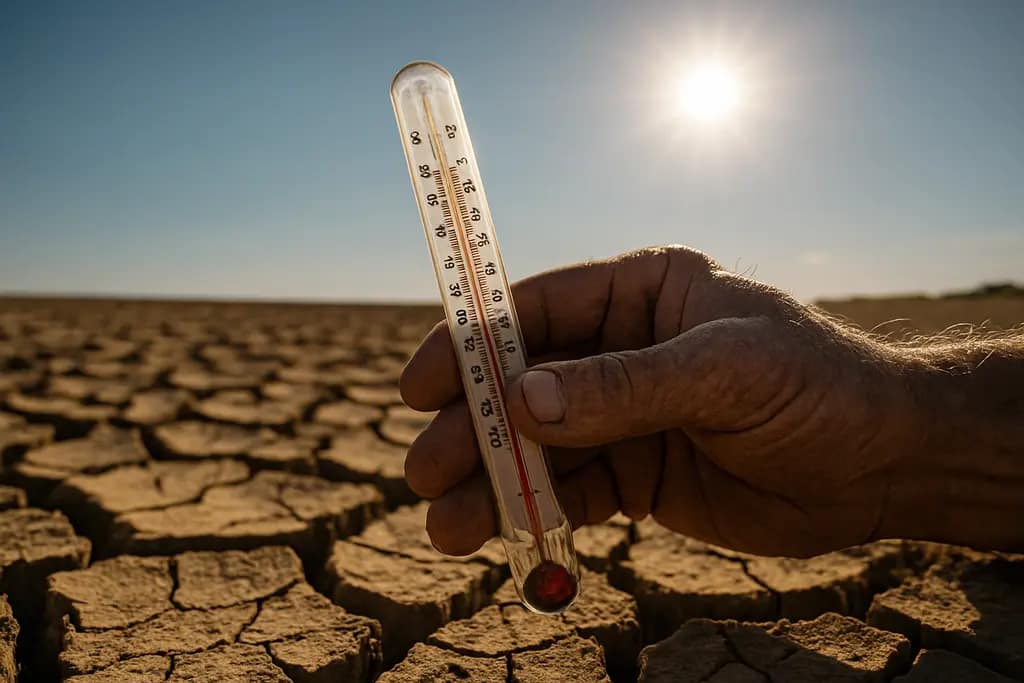
Summer heat data from June 1 through August 31, 2026, showed that the continental United States averaged 74.4°F, making it the hottest meteorological summer in the 132-year record and 0.4°F above the prior records set in 1936 and 2021, according to the September 16, 2026 review from Drought.gov. The result was not only a climate statistic. It framed a set of practical risks for water supply, agriculture, grid demand, worker safety, and local emergency planning.
The evidence supports a cautious reading. A national seasonal average does not describe every county, crop field, warehouse, or substation. It does, however, confirm that the summer of 2026 sat outside prior U.S. experience in the instrumental record. For industry, municipalities, and energy planners, the implication is not that one dataset can predict every impact. The implication is that heat planning based on older seasonal norms may understate exposure when high daytime temperatures, warmer nights, drought, and stagnant air overlap.
What Summer Heat Data Shows
Why Summer Heat Data Is Not Just A Ranking
The record ranking matters because it places the 2026 summer alongside prior benchmark years, including 1936 during the Dust Bowl era and 2021. Surpassing both by 0.4°F may appear modest in a daily weather sense, but it is significant across the contiguous United States for a full three-month period. Seasonal averages smooth out local variation, so a record national value implies broad and persistent warmth rather than a brief isolated spike.
July and August strengthened that signal in the research record. July 2026 was reported as the hottest month recorded in the contiguous United States from 1895 onward, with an average of 76.9°F, about 3.3°F above the 20th-century norm. August 2026 averaged 75.6°F, or 3.5°F above its 20th-century average, and was reported as the warmest August in that historical period. Those values indicate that the summer record was not produced by a single hot week. Heat was sustained through the core of the season.
Nighttime Heat And Human Exposure
The nighttime component deserves attention because it changes recovery conditions. In July 2026, the national average overnight low was reported at 64.2°F, the highest average nightly minimum on record and 0.7°F warmer than the previous July 2022 record. Warm nights affect people, livestock, cooling systems, and buildings differently than daytime highs. They reduce the hours when indoor spaces, materials, and outdoor surfaces can cool without mechanical assistance.
For facility operators, this can matter even where daytime operations appear manageable. Warehouses, food processing sites, machine shops, and distribution centers may begin the morning with higher baseline indoor temperatures. For public health agencies, warmer nights can increase risk for people without reliable cooling. The data do not quantify local illness rates or equipment failures, so those impacts should not be inferred directly from the temperature record. The record does identify conditions that can increase exposure if local systems were not prepared.
Drought, Fire, And Agricultural Stress
Flash Drought Risk
Heat and drought reinforced each other across large areas during summer 2026. By September 1, 2026, about 59.1% of the contiguous United States was reported under drought conditions, an increase of roughly 10.5 percentage points since early August. The research identifies worsening hot and dry conditions in the Plains, Upper Midwest, Lower Mississippi Valley, and the Deep South. That spread is relevant for crop stress, pasture conditions, irrigation demand, barge movement, and rural water systems.
In the Southern Plains and Lower Mississippi River Basin, rapid-onset drought developed by mid-August 2026. Flash drought is especially difficult for agriculture because it can develop faster than many planning cycles. Producers may have less time to adjust irrigation, forage supply, or harvest timing. The available evidence here identifies the hazard and the affected broad regions; it does not provide field-level yield losses or farm income impacts. Those outcomes would require crop reports, insurance data, and local agronomic assessment.
Western Reservoir And Fire Signals
Several western states, including California, Nevada, Arizona, Utah, New Mexico, and Colorado, were reported to have recorded their warmest or tied-warmest summers, including both daytime highs and overnight minimums. The same research notes record-low water levels at key reservoirs, including Lake Mead and Lake Powell, combined with widespread drought. Those conditions raised wildfire concerns and contributed to air quality impacts where smoke moved across regions.
The wildfire connection should be stated carefully. Heat and drought can increase fuel dryness and fire danger, but individual fire behavior also depends on ignition sources, wind, vegetation, terrain, and suppression conditions. The summer heat record should be treated as an environmental stressor rather than a full explanation for each fire. Related analysis of western heat dome impacts is useful because it connects heat exposure with smoke, ecosystem stress, and infrastructure risk without assuming that every outcome has the same cause.
Heat Dome Safety And Infrastructure Limits

Dangerous Heat Dome Conditions
During summer 2026, public health concerns rose as heat domes affected regions of the United States. These high-pressure systems can trap heat and hold it in place. The Associated Press reported conditions with temperatures 10 to 15°F above normal and dangerous exposure for millions during a central U.S. heat dome, citing risks tied to heat-related illness in affected areas AP heat dome report.
Heat dome risk is not only a matter of peak afternoon readings. Duration, nighttime lows, humidity, shade, indoor cooling access, and work schedules all affect exposure. For manufacturing and logistics sites, the relevant question is whether heat controls match the actual pattern of risk. A plan based only on a maximum temperature trigger may miss warm nights, consecutive hot shifts, or outdoor loading work that continues after the official daily peak.
Energy And Facility Planning
High heat can increase demand for cooling, especially where nighttime temperatures remain elevated. The research supplied for this analysis does not quantify electric load, outage rates, or cooling costs during summer 2026, so those figures should not be invented. Still, the temperature and heat dome data point to a practical planning issue: energy systems, building envelopes, and operational schedules need to be assessed against longer periods of heat stress, not only rare daily extremes. For readers interested in related energy-sector insights, Illinois Energy is a valuable resource offering coverage within the same network.
Organizations can use the 2026 record as a prompt for evidence-based review rather than as proof of a single needed investment. The most defensible reviews would compare local temperature records, worker exposure, cooling capacity, water constraints, equipment derating, maintenance calls, and emergency response data. A short checklist can help separate climate signal from site-specific vulnerability:
- Compare facility heat policies with both daytime highs and overnight minimum temperatures.
- Review drought exposure for water-intensive operations, landscaping, cooling, and agriculture-linked supply chains.
- Assess smoke and air quality procedures where wildfire risk can affect outdoor work or ventilation decisions.
- Document where data are missing before assigning costs or causes to the 2026 heat record.
What Summer Heat Data Means For 2026 Planning
Evidence Boundaries For Decisions
Summer heat data should be used as a planning input, not as a substitute for local engineering, public health, or agricultural analysis. The 2026 record confirms unusually widespread and persistent heat. It also coincided with expanded drought, reported flash drought in key agricultural regions, reservoir stress in the West, wildfire and smoke concerns, and heat dome exposure. Those findings support stronger review of heat-related assumptions across sectors.
The limits are equally clear. The available research does not assign a dollar cost to the summer, does not quantify every health outcome, and does not prove that any single fire, crop loss, or equipment problem was caused only by heat. It also cannot tell a factory, city, farm, or utility exactly which investment should come first. That requires local data and risk ranking.
For 2026 planning after the record summer, the strongest implication is procedural: treat heat as a compounding condition. Drought can narrow water options. Warm nights can reduce recovery time. Smoke can change ventilation choices. Heat domes can turn a short safety concern into a multi-day operating constraint. Used carefully, summer heat data can help planners test whether their assumptions still match measured conditions, while avoiding claims that the climate record alone answers every operational question.


