

The corporate world is filled with failed projects. Each one aimed to change things but often ended in disappointment.
Continuous improvement is a way to break this cycle. It’s not a quick fix. It’s like a daily vitamin for your company’s health.
The idea is simple yet deep. No process is perfect. Perfection is like a goal you can always get closer to but never reach.
This way of thinking changes leaders. They stop being afraid of change and start to see its value. They notice waste everywhere. Like that weekly meeting that could be an email, or the extra approval step.
The PDCA cycle—Plan, Do, Check, Act—gives this work a rhythm. It turns dreams into real progress.
The real magic is in the people. This philosophy isn’t just about better tools or faster work. It’s about changing people. It makes getting better a part of your company’s nature.
This is the difference between wanting to improve and making it a part of your company’s DNA.
Lean & Kaizen Basics
Think of Continuous Improvement as a grand political philosophy. Now, meet its two most effective—and often misunderstood—political parties: Lean and Kaizen. They’re in the same coalition, but they have very different platforms and campaign strategies.
Confusing them is like calling a libertarian a socialist. It misses the point entirely.
Kaizen is the cultural revolution. Born in post-war Japan, its core belief is radical in its simplicity: every single person in the organization has the right, and the duty, to suggest a small improvement. It’s the ultimate democratic ideal applied to work. The CEO and the intern have an equal voice at this town hall.
Its focus is three-fold: improving the tools you use, the relationships you have, and the environment you work in. The goal isn’t a Nobel Prize-winning innovation. It’s finding a better way to store the pens so you don’t waste 30 seconds searching every morning. Kaizen believes that a thousand of these tiny, one-percent gains will outpace a single, flashy moonshot that crashes and burns.
Lean, on the other hand, is the ruthless policy wonk. Originally forged in Toyota’s factories, it’s the analytical framework obsessed with one thing: cutting waste. It views every process as a value stream—the path a product or service takes from concept to customer.
Lean’s job is to be the miser, scrutinizing every step. It hunts the seven deadly wastes with a detective’s cold eye:
- Transport: Unnecessary movement of products.
- Inventory: Excess stock sitting idle.
- Motion: Unnecessary movements by people.
- Waiting: Idle time between steps.
- Overproduction: Making more than is needed.
- Overprocessing: Adding features or work that provides no value.
- Defects: The effort spent correcting mistakes.
Imagine your workflow is a party guest navigating a crowded room. Lean is the team that removes the awkward coffee table everyone keeps bumping into. Kaizen is the culture that trains every other guest to politely say, “Hey, there’s a clearer path over here.”
This is the beautiful, necessary marriage. Kaizen provides the soft power—the cultural permission to critique a process without it being seen as treason. Lean provides the hard metrics—the data to prove which critique is worth pursuing.
One cultivates the mindset. The other provides the scalpel. You need both to govern effectively.
Setting Goals and KPIs
If continuous improvement were a sport, goals would be the scoreboard. Most companies track activity, not outcomes. They measure effort, not impact.
You need a clear vision with specific objectives. Will you attack productivity, quality, or customer satisfaction? Choose your battlefield wisely. This isn’t about vague “do better” platitudes.
Enter Key Performance Indicators, or KPIs. These are your dashboard lights, your early warning system, your proof of concept. Without them, continuous improvement is just a philosophical discussion. With the wrong ones, it’s actively harmful theater.

The “Plan” in PDCA starts here. You must agree on a vision and identify the steps. But here’s the rub: most plans fail at the first gate. They measure the wrong thing with surgical precision.
Think of it this way. Measuring the number of screws a factory worker turns per hour is an activity metric. Measuring the percentage of products that don’t wobble because the screws were properly torqued is an outcome metric. One keeps people busy. The other keeps customers happy.
This is where SMART goals earn their keep. A goal should be Specific, Measurable, Achievable, Relevant, and Time-bound. “Improve quality” is a wish. “Reduce customer-reported defects by 15% within the next fiscal quarter” is a SMART goal.
So what should you actually measure? Focus on outcomes that move the needle:
- Cost Reduction: Not just cutting budgets, but increasing value per dollar spent.
- Time Efficiency: Shrinking cycle times without sacrificing quality.
- Safety Incidents: Fewer accidents mean better processes and happier teams.
- ROI: The cold, hard return on your improvement investments.
- Product Quality: Defect rates, customer satisfaction scores, warranty claims.
Beware the tyranny of vanity metrics. These are numbers that look impressive in reports but don’t correlate with real success. Social media likes for a B2B company. Pages of documentation no one reads. Meetings held about holding meetings.
Instead, champion leading indicators. These predict future performance. Employee engagement scores often predict turnover. Process adherence rates often predict quality. First-pass yield often predicts customer satisfaction.
The most successful continuous improvement programs ask uncomfortable questions upfront. Is this goal actually SMART, or does it just sound smart? Are we tracking the gain, or just the pain? Will this metric tell us if we’re winning, or just if we’re busy?
Your KPIs should create a feedback loop, not a blame loop. They should illuminate the path forward, not just highlight past failures. When chosen well, they transform continuous improvement from a feel-good exercise into a strategic engine.
Remember: you can’t improve what you don’t measure. But you’ll definitely fail if you measure the wrong things. Choose metrics that matter, not just metrics that count.
Getting Team Buy-In
The law of change in organizations is simple: people support what they help create. Many “initiatives” fail because they don’t involve the team. The key to success is understanding people’s psychology.
Announcing “We’re doing Lean!” in a meeting is just a show. Everyone plays their part, but the team doesn’t really buy in. This approach doesn’t build a culture of change.
Real lean transformation starts with a problem, not a presentation. It’s about inviting people to solve problems, not just persuading them.
Think about when you were excited to change how you work. Was it because of a memo, or because you solved a problem? That’s the kind of energy we’re looking for.
Managers often make the mistake of seeing improvement as extra work. But framing it as problem-solving changes everything. It’s about wasting less, not doing more.
To turn a skeptical manager into a Kaizen advocate, give them a marker. Make them the designer of their own efficiency. Lean principles respect people by trusting them to redesign their work.
Leaders should get involved in the work, not just give orders. When they do, the message changes. It becomes “We’re in this together.”
| Approach | What It Looks Like | The Result |
|---|---|---|
| Command | Top-down mandates, standardized training, compliance tracking | Surface-level compliance, quiet resistance, initiative fatigue |
| Co-create | Problem-solving workshops, employee-led teams, open idea boards | Ownership, creative solutions, sustainable change |
| Hybrid (The Sweet Spot) | Leadership sets direction, teams design solutions, shared credit for wins | Aligned autonomy, engaged employees, measurable improvements |
Good communication is key. It’s not about telling people what to do. It’s about creating a space where ideas can flow freely.
I once saw a plant manager post every idea on the wall. Good, bad, and silly ideas were all welcome. This created a safe space for everyone to share.
Seeing the impact of your work motivates you. Celebrate every small win. Lean thinking thrives on these quick successes.
Training should be about building skills, not just teaching. Teach people to spot waste and give them tools to try new things. Then, let them do it.
Feedback should be a daily conversation, not a quarterly survey. Ask your team what’s frustrating them and listen. Create rituals for improving work in real time.
Building a team of willing participants is better than forcing people to change. Start with your early supporters. Their success will inspire others.
The goal isn’t to make everyone love lean methodology. It’s to create a work environment where people love solving problems. When that happens, you naturally get buy-in.
Turning skeptics into advocates takes participation, not just persuasion. Give people control over their work. Value their ideas and share the credit. Your process maps will only work if the team wants to use them.
This is how you create lasting change. Not with orders, but with teamwork. Not with rules, but with collaboration. That’s the heart of a successful lean journey.
Common Pitfalls
If failure had a yearbook, the ‘Most Likely to Repeat’ award would go to the same continuous improvement pitfalls, generation after generation. We’re not here to shame the fallen. Think of this as intellectual archaeology—excavating the ruins of well-intentioned initiatives to understand why they collapsed. The patterns are depressingly familiar, which means they’re also gloriously avoidable.
Let’s start with the classic: The Boil the Ocean Syndrome. This is the managerial equivalent of deciding to remodel your entire house in one weekend while also learning Portuguese. The kaizen philosophy is built on incremental change, yet we constantly see teams trying to overhaul supply chains, revamp CRM systems, and reinvent company culture simultaneously. The result? Exhaustion, confusion, and zero meaningful progress.
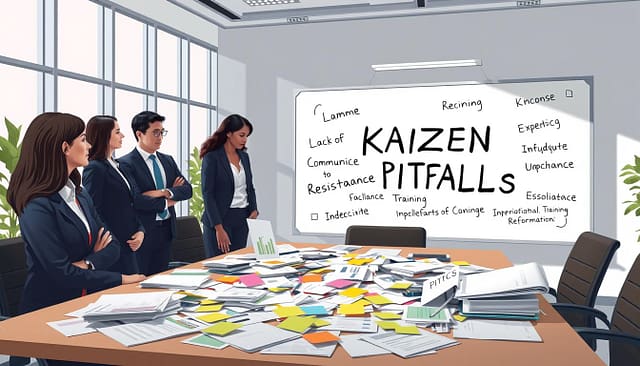
Then there’s the Flavor of the Month Problem. Leadership announces a bold new continuous improvement program with fanfare rivaling a product launch. Resources flow. Meetings multiply. Then, quarterly earnings dip, or a shiny new corporate initiative emerges. Attention evaporates. The team is left holding the bag, wondering if their efforts were ever serious. This isn’t just wasted effort; it actively erodes trust in any future change.
My personal favorite failure mode is Metric Myopia. A team laser-focuses on improving one Key Performance Indicator—say, ‘customer call handle time.’ They slash it dramatically! Celebration! Until they realize customer satisfaction scores have plummeted because agents are now rushing people off the phone. In optimizing one number, they destroyed three others. This is kaizen without the ‘zen’—all action, no reflection.
Underlying these visible failures is often an invisible one: a lack of psychological safety. Kaizen demands that people speak up about problems without fear. If your culture punishes messengers or values flawless execution over honest experimentation, your feedback loops are broken before they start. People will quietly watch a project veer off a cliff, fearing the consequences of speaking up.
The final, most seductive trap is rigid adherence to The Plan. The ‘Check’ phase of PDCA exists for a reason. When data screams that an initiative is failing, the mature response isn’t to double down on effort. It’s to pause, learn, and adapt. Treating a pilot project like a marriage—’til death do us part—instead of a first date guarantees you’ll waste resources on a doomed relationship.
So what’s the antidote? Start small. Choose one process, one team, one measurable goal. Listen aggressively to feedback, even the uncomfortable kind. Measure outcomes, not just outputs. And most importantly, frame every setback not as a failure, but as the cost of tuition in the school of continuous improvement. The only real mistake is making the same one twice.
Tracking Gains
The moment of truth for any CI initiative arrives when you open the data dashboard and ask: ‘Did any of this actually work?’ This is where philosophy gets forensic. Without tracking, continuous improvement is just corporate storytelling—a nice narrative with no supporting evidence.
The ‘Check’ phase of PDCA isn’t a casual glance. It’s a crime scene investigation of your processes. You’re looking for the smoking gun that proves your changes mattered. Was it the new workflow that cut production time, or just a slow Tuesday?
Take Thermo Fisher Scientific. They didn’t just feel more efficient. Their data showed a 17% Overall Equipment Effectiveness boost in six weeks. Revenue jumped 20%. Those aren’t feelings. They’re fingerprints left at the scene by a successful CI program.
Good tracking moves you from anecdote to evidence. Instead of “The team seems happier,” you get “Safety incidents dropped 40%.” Instead of “Things feel smoother,” you document “Cycle time reduced by 22%.” This shift requires the right metrics and the courage to face what they tell you.
The table below breaks down the essential metrics that separate real gains from wishful thinking.
| Metric Category | What It Measures | Common Tracking Method | Typical Goal/Benchmark |
|---|---|---|---|
| Process Efficiency | Cycle time, throughput, OEE | Time studies, production software | 10-25% reduction in cycle time |
| Quality Control | Defect rates, rework, scrap | Quality audits, customer returns | |
| Financial Impact | Cost reduction, ROI, revenue | Budget analysis, P&L statements | 5-15% cost savings; positive ROI within 12 months |
| Safety & Engagement | Incident rates, employee feedback | Safety logs, survey scores | Zero lost-time incidents; 20% boost in engagement scores |
But data alone isn’t enough. You need to understand its story. Did quality improve because of your new protocol, or because orders dipped seasonally? Correlation isn’t causation. This is where continuous improvement becomes a detective novel, not a spreadsheet.
The ‘Act’ phase is where most programs fumble. A gain that isn’t locked down is just a temporary glitch. This means creating Standard Operating Procedures (SOPs). Document the new, better way. Train everyone on it. Make it the new normal.
Think of SOPs as the constitution for your improved process. They prevent backsliding into old, inefficient habits. They turn a one-team win into an institutional capability. Without this step, your gains will evaporate faster than you can say “But we used to do it this way.”
Creating effective feedback loops is key. The data from your tracking should flow directly back to the team. This closes the PDCA circle and fuels the next round of improvement. For a deep dive on selecting the right metrics, explore this guide on continuous improvement metrics and how to track.
Ultimately, tracking gains transforms continuous improvement from a philosophy into a proven business practice. It’s the difference between hoping you’re getting better and knowing you are. It turns effort into evidence, and change into lasting competitive advantage.
Conclusion
We started with big ideas and ended with real actions. The shift from just talking to actually doing is key. Continuous improvement is not just a team effort. It’s how an organization grows and changes.
Let’s look at some examples. Toyota made big savings thanks to employee ideas. Harley-Davidson and Boeing also made huge improvements. These changes came from small, smart steps, known as kaizen and lean thinking.
The aim is not to be perfect. That’s too hard. Instead, we aim to get a little better every day. It’s about making small, smart changes that add up over time.
So, where do you start? Begin with a simple question. What can you do better tomorrow? Choose one area, gather your team, and use the tools we’ve talked about. Studies show that these efforts can lead to better margins, up to 5%.


