
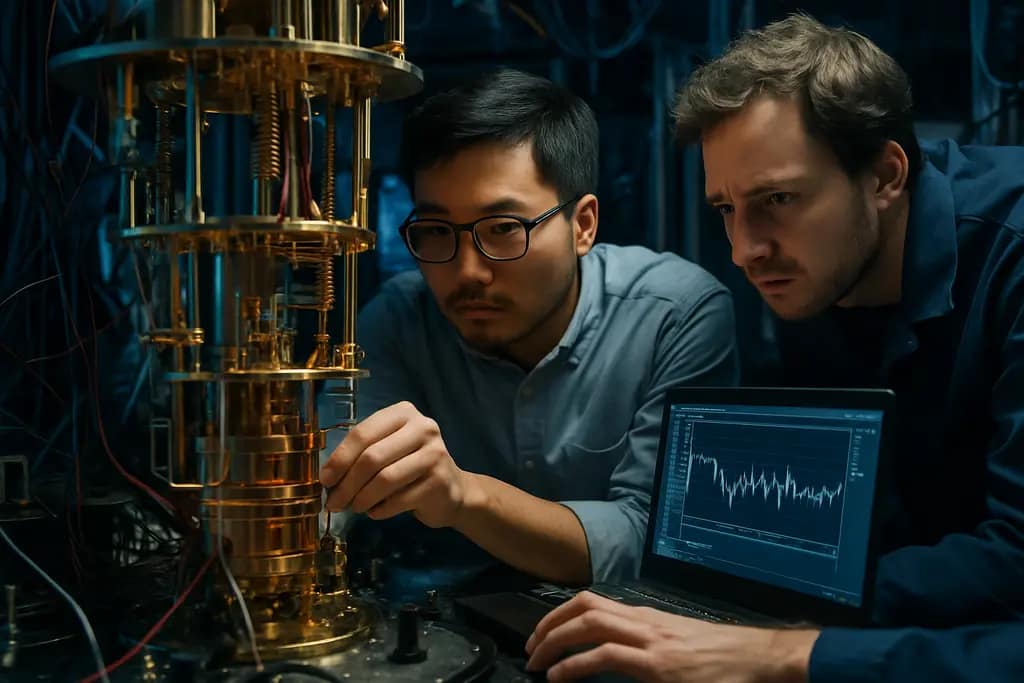
Quantum Sound Jumps moved from indirect inference to direct real-time observation on September 17, 2026, when Stanford physicists reported in Science that they had observed individual quantum jumps of sound, or phonons, in a mechanical resonator according to Stanford Report. The result matters because it extends a measurement record already established for trapped ions and photons into an engineered mechanical system, but it remains an early laboratory finding rather than a deployed technology.
For industrial technology readers, the most useful question is not whether this result will quickly produce new products. The better question is what kind of evidence the experiment provides, where that evidence is still narrow, and what engineering barriers would stand between a physics result and practical quantum sensing, memory, or error-correction hardware.
What Quantum Sound Jumps Showed
Quantum Sound Jumps In The Measurement Record
The Stanford experiment tracked the transition of a mechanical resonator from a one-phonon state to a zero-phonon state during a vibration lasting roughly two milliseconds. The detection scheme paired the resonator with a superconducting qubit and used hundreds of quantum nondemolition measurements during that short interval. Those repeated measurements allowed the team to identify when the phonon number state dropped from 1 to 0 without treating the event only as an averaged statistical signal.
A technical summary of the work reported a mechanical resonator ringdown, or lifetime, of about 2.1 milliseconds, a dispersive frequency shift per phonon of 2χ/2π = 328 kilohertz, and heralding of single-phonon states with about 85% fidelity as summarized by TIISYS. These values help define the scale of the achievement: the measurement window was short, the signal relied on a specific coupled quantum system, and the reported fidelity was significant but not perfect.
For industrial readers, Quantum Sound Jumps are best understood as evidence that discrete phonon loss can be seen in real time in a controlled mechanical resonator. That is different from proving a production-ready sensor, processor, or memory element. The experiment demonstrated observation and control under laboratory conditions, not field operation in factories, vehicles, energy systems, or process plants.
Why Sound Quanta Are Different From Photons
Before this 2026 report, quantum jumps had been observed in trapped ions in 1986 and in photons in 2007. Phonons had remained harder to observe as individual real-time events. Sound quanta are tied to mechanical vibration, and in this case the measured mode involved many atoms moving together. That gives the result special interest for engineered mechanical systems, because it shows that a collective vibration can still display discrete quantum transitions that can be measured event by event.
The finding also helps clarify why phonon-based devices attract attention in quantum engineering. Mechanical modes can couple naturally to vibration and acoustic signals. In principle, that could matter for systems where sound-based interaction is useful, or where photons are difficult to use. The cited work supports the feasibility of observing a key quantum behavior in such a device. It does not yet establish that phononic devices outperform established alternatives in cost, reliability, manufacturability, or uptime.
Implications For Quantum Hardware
Error Signals And Mechanical Devices
One implication concerns quantum error correction. If a mechanical resonator is used to store or transfer quantum information, then a transition in phonon number can represent an error that must be detected. Real-time observation offers a possible way to flag such events. That possibility is scientifically meaningful because error correction depends on identifying errors before they irreversibly degrade useful information.
The practical gap is still large. Error correction in an operating quantum platform requires repeated detection, low added disturbance, integration with control logic, and performance high enough to improve the system rather than add new failure paths. The reported experiment used a superconducting qubit coupled to a resonator and achieved single-phonon heralding at about 85% fidelity. That level may be valuable for research, but any practical architecture would need clear evidence that detection, control, and correction can work together at larger scale.
A related analysis on this site discussed the evidence and limits of quantum sound measurements, with the same caution: a laboratory observation can shape device research without being a finished engineering answer.
Precision Sensing Without Overclaiming
Precision sensing is another plausible area of interest. Mechanical resonators are sensitive to vibration, forces, and mass changes. If discrete phonon loss can be monitored at the single-quantum level, future sensors might use that information to reduce uncertainty or detect weak signals. The Stanford report pointed to possible sensing of minute forces or masses, including proteins, as a direction that could benefit from such control.
That implication should be read as a research direction, not as evidence of a validated sensor product. The supplied reports do not provide industrial field tests, long-duration reliability data, cost models, calibration procedures, or environmental tolerance results. For applications in manufacturing, energy, aerospace, or process control, those factors would determine whether a sensor can leave the lab. Vibration isolation, packaging, thermal stability, maintenance requirements, and data interpretation would all need evidence before adoption decisions could be justified.
Engineering Barriers Before Industrial Use
Scale, Integration, And Manufacturing Fit
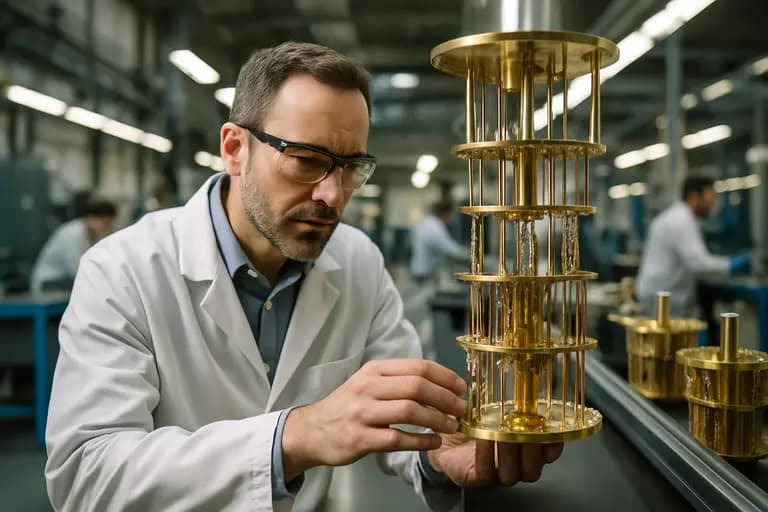
The device platform was described as compatible with chip-fabrication techniques, which suggests that multiple resonators could be integrated on a single chip. That point is relevant because scalable quantum hardware usually needs repeatable fabrication, compact layouts, and device-to-device consistency. Chip fabrication is a promising route for those goals, but it does not by itself solve yield, packaging, coupling, readout, or system-control issues.
In industrial technology, scale means more than making one device smaller. A practical system needs predictable production, test procedures, service methods, spare parts, and interfaces with existing electronics and software. The 2026 observation gives researchers a clearer measurement target for phononic devices. It does not yet answer how many resonators can be operated together, how variation across a chip would be managed, or how performance would hold under non-laboratory operating conditions.
Cost, Safety, And Implementation Questions
The available reports do not provide a cost estimate for commercial implementation, and they do not present a safety assessment for industrial deployment. That absence is normal for early physics work, but it matters for readers evaluating applied technology. A system based on superconducting qubits and mechanical resonators would require specialized fabrication, measurement infrastructure, and control electronics. Whether those requirements can be reduced to an economical package is still an open engineering question based on the cited material.
Safety also needs a narrow reading. The reports describe a quantum measurement experiment, not a factory-ready device. There is no evidence in the cited material of new industrial hazards or of a certified safe product. Any later implementation would need review of electrical systems, thermal management, materials, service access, and operating procedures in the same way other advanced instrumentation is reviewed before deployment.
- Supported by the evidence: individual phonon jumps were observed in real time in a lab mechanical resonator.
- Not yet shown by the evidence: commercial quantum sensors, phononic processors, or fault-tolerant machines based on this result.
- Open engineering issues: integration scale, fidelity improvement, packaging, cost, reliability, and field validation.
Quantum Sound Jumps In Practical Perspective
Quantum Sound Jumps should be treated as a significant measurement advance with practical implications that remain conditional. The result gives quantum engineers a way to observe a specific error-like event in a mechanical resonator. It also strengthens the case for studying phonons as information carriers or sensing elements in hybrid quantum platforms.
The cautious interpretation is also the most useful one. The experiment showed a discrete transition in a controlled mechanical mode and provided measurable parameters for future work. It did not demonstrate a complete quantum computer, a deployed acoustic memory, or an industrial sensor. Those applications would require further evidence across device repeatability, system integration, environmental tolerance, and cost.
For readers following applied science across the same publishing network, LiLiVeSteam offers related technology coverage, while the assessment here stays with the cited physics evidence. The practical significance of the Stanford result is that it narrows one measurement gap in phononic quantum systems. Turning that into dependable industrial technology will require many more tests than a single real-time observation, even one as technically meaningful as this.


