
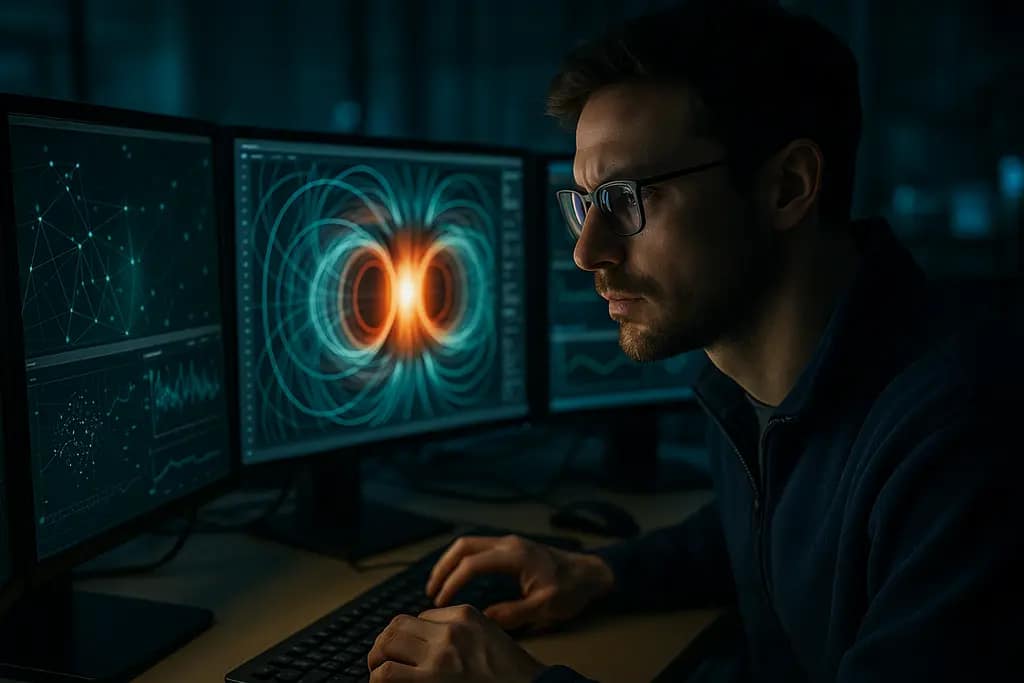
AI Fusion Systems are gaining attention at Princeton Plasma Physics Laboratory because the work connects artificial intelligence, high-performance computing, simulation, and experimental planning. The evidence currently supports a cautious interpretation: PPPL is building research infrastructure intended to make some fusion studies faster and better connected, not demonstrating a finished commercial energy system.
For industrial readers, the PPPL work is useful because it frames AI as an engineering tool with specific jobs. These include reducing simulation bottlenecks, testing ideas virtually before using experimental time, improving data coverage, and supporting plasma monitoring and control. Those are meaningful objectives in a field where experiments are expensive, machines are complex, and physical access to test conditions is limited.
What PPPL’s AI Fusion Systems Work Includes
AI Fusion Systems As Research Infrastructure
In January 2026, PPPL launched the STELLAR-AI platform, which integrates AI with high-performance computing to speed fusion energy research and reduce the months-long timeline associated with some high-fidelity fusion simulations, according to the PPPL announcement. That goal matters because simulation time can limit how quickly researchers compare designs, refine models, and prioritize experiments.
The platform is also tied to PPPL’s participation in the Genesis Mission, a national effort initiated by executive order in November 2025. The mission aims to connect supercomputers, experimental facilities, AI systems, and datasets with the stated goal of doubling the productivity of American research within a decade. That is an ambitious research-management target rather than evidence that fusion power timelines have already shortened.
The Digital Twin Of NSTX-U
As part of STELLAR-AI, PPPL is creating a digital twin of the National Spherical Torus Experiment-Upgrade, known as NSTX-U. The stated purpose is to allow virtual testing of ideas before physical experiments. In practice, that could help researchers decide which operating scenarios are worth scarce experimental time, but the quality of a digital twin depends on the models, data, assumptions, and validation used to build it.
NSTX-U is central to PPPL’s research profile. Princeton describes NSTX-U as the largest spherical tokamak in the United States and says it is designed to be the most powerful spherical tokamak in the world, with relevance as a model for possible fusion pilot plants and commercial reactors, as noted in Princeton’s PPPL overview. That description supports its value as a major research device, but it should not be read as proof that the same design path is ready for commercial deployment.
Why AI Matters For Fusion Research Workflows
Simulation Bottlenecks And Experimental Scarcity
Fusion research depends heavily on modeling because plasma behavior involves interacting physical processes. High-fidelity simulations can take long periods to run, and machine time on major experimental devices is limited. AI Fusion Systems may help by screening candidate scenarios, identifying patterns in data, and narrowing the set of experiments researchers choose to run.
That value proposition is similar to resource optimization in industrial plants. A manufacturer does not gain much by adding sensors if the data cannot help reduce downtime, cut scrap, or improve scheduling. A fusion laboratory does not gain much from AI if the outputs are not trustworthy enough to guide simulation planning or experiment selection. The core issue is not whether AI is present, but whether it improves decisions under real constraints.
Data Gaps, Monitoring, And Control
The research notes describe other PPPL AI efforts, including machine learning methods for suppressing harmful edge instabilities, the Diag2Diag system for filling in missing plasma data, and AI models for disruption prediction. These examples point to a common engineering need: plasma devices require fast interpretation of incomplete, high-volume, and changing data streams.
Still, each of those applications carries validation questions. A model that performs well in one operating regime may need careful testing before it is trusted in another. Missing-data estimates can support monitoring, but they are not the same as direct measurements. Disruption prediction is valuable only if prediction timing, false alarms, missed events, and mitigation responses are evaluated together. These are not reasons to dismiss AI; they are reasons to treat it as a controlled engineering component.
Implementation Limits For AI Fusion Systems
Scale, Cost, And Computing Demand
The available research summary does not provide cost data for STELLAR-AI, the NSTX-U digital twin, or related AI systems. It also does not quantify the computing capacity required to operate the platform. That absence matters for industrial interpretation. A tool that is technically useful inside a national laboratory may require specialized computing, expert support, and curated data pipelines that are not easy to reproduce elsewhere.
AI Fusion Systems also depend on links between experimental hardware, simulation codes, stored datasets, and high-performance computing. Each connection creates practical engineering work: data formatting, quality control, model versioning, access rules, cybersecurity, and responsibility for errors. These needs are familiar in industrial automation, where an analytics system can fail to produce value if plant historians, control systems, maintenance records, and operator workflows are not aligned.
Safety And Reliability Boundaries
Fusion devices involve high-energy plasma behavior and hardware that must be protected from damaging events. The research notes indicate that PPPL has explored AI for disruption prediction and plasma control, but the notes do not establish that AI alone can ensure safe operation. Safety claims require careful evidence about performance across operating states, fallback controls, human supervision, and machine protection systems.
What Industrial Teams Can Learn From PPPL’s Approach
Start With A Bottleneck, Not A Tool
PPPL’s STELLAR-AI effort is framed around a specific research bottleneck: high-fidelity fusion simulations can take months. That framing is valuable outside fusion. Industrial AI projects are strongest when they begin with a defined constraint, such as long engineering cycles, limited test capacity, downtime, quality losses, or energy waste. A broad ambition to “use AI” is less useful than a measured plan to reduce a known delay or uncertainty.
The digital twin example reinforces the same point. Virtual testing has value when it helps allocate physical testing resources more effectively. In a plant setting, that may mean testing operating scenarios before changing a line, estimating maintenance impacts before shutdown, or comparing energy strategies before investing in equipment. The tool must be judged by whether it improves decisions, not by its novelty.
Build Validation Into The Workflow
AI Fusion Systems need validation because plasma behavior is difficult to measure and predict. Industrial users face a parallel issue when models are trained on incomplete operating data or on periods that do not represent future conditions. A predictive model that works during normal production may perform poorly after equipment changes, raw-material shifts, staffing changes, or control-system updates.
- Define the decision the model is allowed to influence.
- Track model performance against measured outcomes, not only historical fit.
- Assign responsibility for review when operating conditions change.
- Keep fallback procedures available when model confidence is low.
These controls are not barriers to adoption. They are practical requirements for using AI in high-consequence technical systems where errors can damage equipment, waste resources, or misdirect research time.
AI Fusion Systems Evidence Needs
What The Current Evidence Supports
The current public evidence supports several measured claims. PPPL has launched STELLAR-AI. The platform connects AI with high-performance computing. It is intended to reduce long simulation timelines. PPPL is developing a digital twin of NSTX-U. PPPL is also participating in a national effort that connects computing, facilities, AI systems, and datasets. These facts point to a serious research infrastructure program.
What the evidence does not yet support is equally important. The public material does not show that AI has solved the engineering barriers to commercial fusion energy. It does not provide a cost model for deploying these systems at scale. It does not prove that digital twin predictions can replace physical experiments. It does not settle how AI-based control methods will perform across all relevant plasma conditions.
For resource-focused engineers, the practical signal is clear but limited. AI Fusion Systems may improve how fusion researchers use compute time, experimental access, and diagnostic data. The next evidence to watch is not marketing language, but validation results: how much simulation time is reduced, how accurately virtual tests match experiments, how AI outputs are checked, and how these tools affect safety and operating decisions. Until those data are public, PPPL’s work is best understood as a significant research-stage integration of AI into fusion science, with promising implications and unresolved engineering questions.


