

Genesis Mission Funding is best read as a research signal rather than a near-term industrial procurement plan. The U.S. Department of Energy announced a $293 million funding opportunity in March 2026 for AI-enabled research workflows tied to national science and technology challenges, including energy-related work. That scale is meaningful for laboratories, universities, and research partners, but it does not establish that resulting methods are ready for factory deployment.
For manufacturers, the practical question is not whether artificial intelligence will appear in more research settings. It already has a role in modeling, simulation, experimental planning, and data analysis. The harder question is how publicly funded AI research moves from scientific workflows into validated industrial methods that can meet cost, uptime, quality, cybersecurity, and safety requirements.
What Genesis Mission Funding Actually Covers
Genesis Mission Funding Is Still Early Stage
The DOE described the March 2026 opportunity as $293 million in support for “The Genesis Mission: Transforming Science and Energy with AI,” inviting interdisciplinary teams to build AI-enabled research workflows across more than 20 national challenges. The funding notice is documented in the DOE’s official announcement. The wording matters: this is about research workflows and national science challenges, not a set of validated manufacturing products.
For industry, Genesis Mission Funding should therefore be interpreted as support for the research infrastructure behind future methods. AI tools may help scientists compare materials, manage large experimental datasets, or coordinate simulations with laboratory measurements. Those uses can be valuable, but they remain dependent on data quality, model verification, reproducibility, access controls, and expert review.
A Funding Opportunity, Not A Deployment Record
A funding allocation can indicate national priorities, yet it cannot prove technical performance. Early-stage research programs often produce useful datasets, tools, methods, and negative results, but many outputs never become reliable production systems. That is normal in applied science. The presence of federal funding improves the chance that teams can test ideas at a meaningful research scale; it does not remove the need for validation under industrial conditions.
Manufacturing leaders should treat this distinction carefully. A model that helps researchers prioritize experiments in a laboratory may face different constraints on a shop floor, where cycle time, maintenance access, human oversight, supplier variation, and equipment downtime affect results. The research stage should be kept visible in any internal assessment.
Why AI Research Workflows Matter To Industry
Where Manufacturing Productivity Could Be Affected
AI-enabled research workflows may influence manufacturing indirectly before they affect production lines directly. If research teams can analyze experimental data more consistently or compare candidate materials more efficiently, downstream industries could see better evidence for process windows, energy use, component performance, or material selection. The potential relevance is strongest where production depends on scientific uncertainty rather than only on equipment availability.
Examples include materials development, energy systems, process optimization, and advanced components. These are areas where manufacturers often need evidence from laboratories before changing tooling, recipes, inspection plans, or qualification protocols. Even then, an AI-assisted research result must pass through engineering review, pilot work, supplier qualification, and quality-system checks before it can affect throughput or cost.
Evidence Needs Before Plant-Level Adoption
Plant teams should ask whether any AI-derived recommendation is explainable enough for engineering use. A production decision needs more than an output score or a ranked list of candidates. Engineers need to know what data were used, how uncertainty was handled, whether the model was tested outside its training conditions, and how results compare with physical measurements.
Cost is another limiting factor. AI research workflows can require computing capacity, data management, expert labor, and secure integration with laboratory systems. In a manufacturing environment, those costs may expand to include industrial networks, validation staff, operator training, data governance, audit trails, and cybersecurity controls. A promising research method can become difficult to justify if the supporting infrastructure is larger than the operational gain.
Funding Allocation Signals And Limits
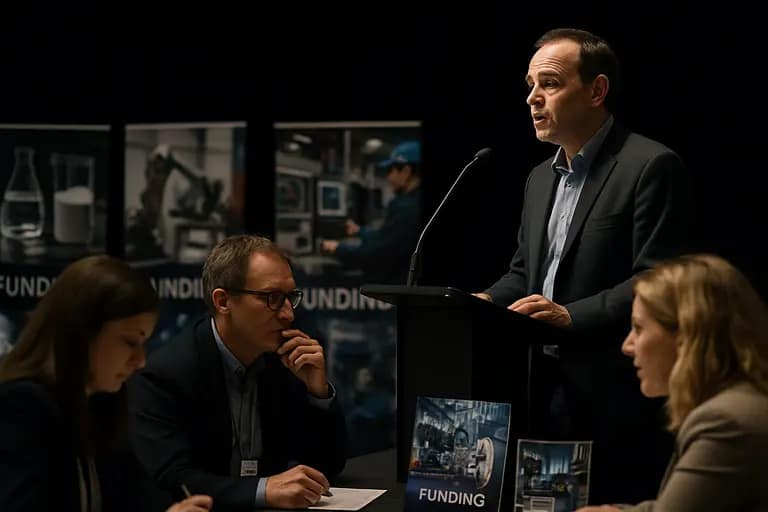
University Participation Provides An Early Readout
University participation gives a useful view of how the initiative is being translated into research tasks. Northwestern University reported that its projects received Phase I support under the Genesis Mission, with work focused on integrating AI into scientific research workflows. That institutional report is available through Northwestern Now. This kind of participation suggests that academic research groups are being asked to connect domain science with AI methods rather than treat AI as a stand-alone tool.
The limitation is equally clear. Phase I research support is not evidence of commercial readiness. It is an initial stage in which teams can define workflows, test assumptions, and generate early results. For manufacturers, the value of such work will depend on whether later evidence shows repeatability, measurable performance, and compatibility with real operating constraints.
Scale Does Not Remove Implementation Barriers
Genesis Mission Funding can help create shared momentum across laboratories and universities, but implementation barriers remain substantial. Scientific datasets are often incomplete, inconsistent, or generated under conditions that differ from industrial production. AI systems can reproduce bias in data, produce plausible but incorrect outputs, or fail when applied outside the conditions in which they were developed.
Safety and governance concerns also deserve early attention. AI-assisted recommendations in energy, materials, or industrial systems may influence experiments, equipment settings, or design choices. Human review, documentation, access control, and change-management procedures are needed before such recommendations can be used in safety-sensitive or quality-sensitive settings.
- Research teams need clear validation plans before claims move beyond laboratory use.
- Manufacturers need evidence from pilot environments before connecting research tools to production decisions.
- IT and operations teams need defined rules for data access, model updates, and cybersecurity review.
- Quality teams need traceable records showing how AI-assisted outputs were produced and checked.
Genesis Mission Funding Questions For Manufacturers
Direct Questions For Technical Teams
Manufacturers tracking Genesis Mission Funding should focus on specific evidence rather than general claims about AI. The most useful questions are practical: What workflow was tested? What data were used? Was performance compared against a baseline? Were results reproduced by another team? What assumptions would fail in a plant setting? These questions help separate scientific progress from deployment readiness.
Procurement teams should also avoid treating federally funded AI research as a signal to buy tools immediately. The stronger approach is to monitor outputs, identify research groups working near relevant materials or processes, and prepare internal data governance so that future pilot projects can be evaluated responsibly.
For manufacturing productivity, the initiative’s near-term value may lie in better research discipline: clearer workflows, more structured data, and closer links between computation and experiment. Those outcomes would still need testing at scale. Genesis Mission Funding is significant because it directs public support toward AI-enabled science, but its industrial impact will depend on evidence produced after the funding stage, not on the size of the announcement alone.


