

A material can be discovered in a single paper and still remain years away from dependable production. The material qualification process is where an interesting result has to become repeatable engineering evidence: not one strong specimen, but predictable behavior across batches, machines, environments, and parts.
That distinction matters more as automated laboratories and high-throughput methods accelerate early materials R&D. Faster discovery can shorten screening, but it does not remove the slower work of validation and process control already visible in efforts to accelerate materials innovation platforms.
Discovery Can Be Fast; Production Confidence Cannot
Discovery asks whether a material can exhibit a useful property. Qualification asks whether engineers can rely on that property within defined limits.
A laboratory team may demonstrate exceptional strength, conductivity, heat resistance, or fatigue behavior in carefully prepared specimens. A production organization must know how performance changes when raw-material lots vary, equipment drifts, geometry changes, temperature shifts, and operators work within an approved process window.
For critical applications, the burden rises further. The FAA’s advanced composite material discipline treats material and process control, structural substantiation, damage tolerance, manufacturing technology, and database standards as connected issues across design, certification, production, and operation.
That is why repeatability outranks peak performance once a material moves toward production.
The Material Qualification Process Is Statistical, Not Demonstrative
A successful demonstration proves that something can happen. Qualification is designed to establish what can be expected repeatedly.
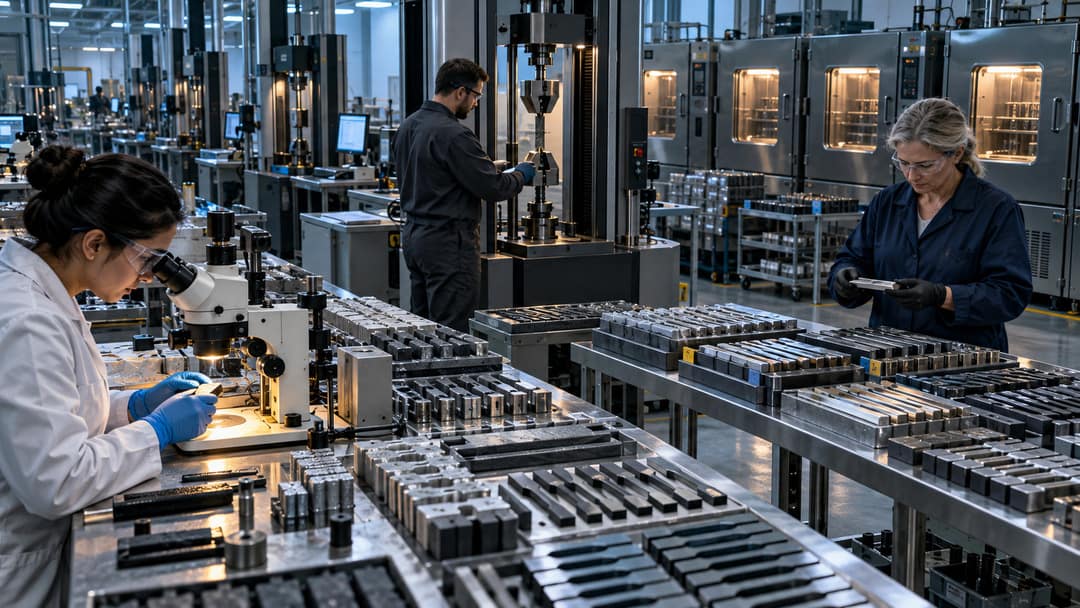
Testing therefore expands beyond a handful of specimens. Engineers may evaluate multiple material batches, processing runs, orientations, temperatures, moisture conditions, loading modes, and production variables. The exact matrix depends on the material, industry, application, and consequence of failure.
The objective is not to make variability disappear. It is to measure it well enough to define acceptable limits and controls.
Every added source of variation creates another question: Is the change statistically meaningful? Does it alter failure behavior? Does it require a tighter specification? Can production detect and control it?
A material that performs extremely well on average can still be difficult to qualify if its results are widely scattered.
Design Allowables Turn Test Results Into Usable Limits
Engineering teams do not normally design critical structures around the best result or even the simple average. They need values that account for the measured distribution of properties and the intended application.
In aerospace composites, the NCAMP qualification framework distinguishes material allowables from the design values ultimately used for a structure. Published allowables can support engineering work, but additional testing or adjustments may still be needed for the actual laminate, operating environment, structural configuration, and certification approach.
That difference is easy to underestimate. Test data is not yet a design value.
A simplified qualification path shows where the time goes:
| Stage | Main question | Typical evidence |
|---|---|---|
| Material characterization | What properties can the material exhibit? | Physical, chemical, thermal, and mechanical tests |
| Repeatability testing | How much do results vary? | Multiple batches, specimens, and process runs |
| Allowable development | What value can designers rely on statistically? | Controlled datasets and statistical treatment |
| Process qualification | Can production reproduce the qualified condition? | Defined process windows and verification testing |
| Application substantiation | Does the material work in the actual design? | Elements, subcomponents, environmental and structural tests |
| Production control | Does performance remain within limits over time? | Acceptance testing, records, inspection, change control |
The sequence explains why a breakthrough property rarely moves directly into a released drawing.
Manufacturing Consistency Has to Survive Real Production
Qualification is partly a materials problem and partly a manufacturing-system problem. If a property depends heavily on cure temperature, heat treatment, powder condition, fiber alignment, deposition parameters, surface preparation, or cooling rate, those variables have to be defined and controlled.
A supplier also has to show that the qualified material represents what customers will actually receive. That means specifications, lot traceability, acceptance criteria, calibrated equipment, inspection, and procedures for handling process changes.
Small changes can matter. A new facility, altered tooling, different raw-material source, revised machine settings, or modified processing step may trigger equivalency work or partial requalification depending on the application.
The practical goal is controlled variation, not perfect sameness. Industrial processes always vary. Qualification defines the boundaries that tell engineers how much variation is acceptable before performance assumptions stop being trustworthy.
Certification Adds a Second Layer of Proof
Material qualification and product certification are related, but they are not interchangeable.
A qualified material may have a well-defined specification and reliable property database, yet the finished component still has to satisfy the requirements of its particular use. Geometry, joints, holes, surface finish, defects, load paths, temperature, fatigue, impact, and manufacturing details can all change structural behavior.
That is why regulated industries can use building-block approaches that progress from coupons toward elements, subcomponents, and larger structural demonstrations where required. Material data supports the design, but it does not automatically certify every component made from that material.
This distinction prevents a common development error: assuming that a supplier datasheet or successful prototype has already answered the questions that certification authorities, customers, or internal engineering standards will ask later.
The Signals That Show a Material Is Moving Toward Production
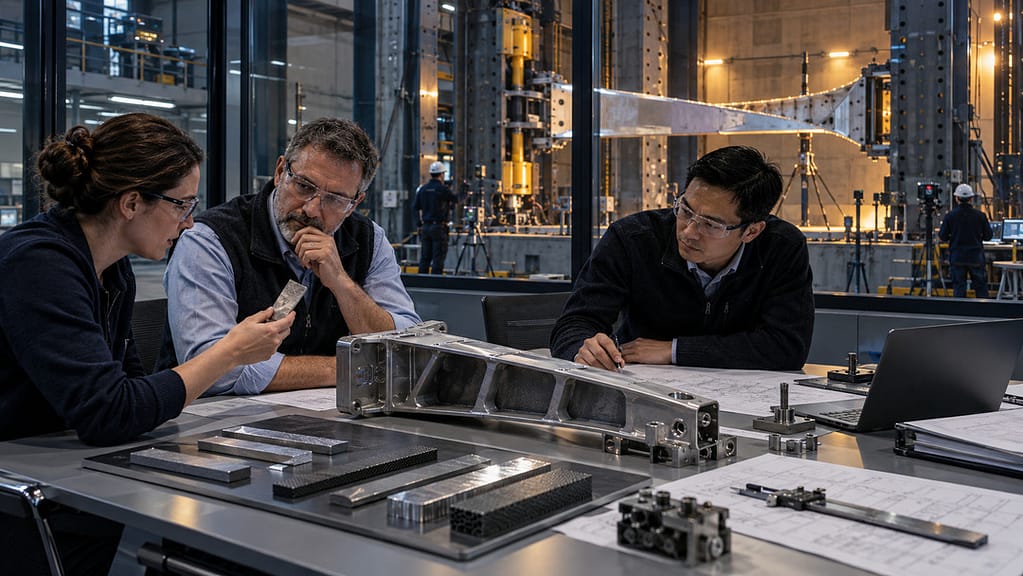
The most useful progress indicators are often less dramatic than discovery headlines. Engineers should look for multi-batch datasets, defined specifications, repeatable processing windows, credible inspection methods, stable supplier controls, and evidence that properties survive realistic environmental conditions.
Equivalency procedures are another strong signal. Once a qualification baseline exists, manufacturers can sometimes demonstrate comparable material or process results without recreating the entire original program. That can reduce duplicated testing, but it still depends on disciplined comparison and documented process control.
The strongest programs also plan for change. Qualification is a maintained state, not a one-time certificate. Suppliers and users need procedures for evaluating changes in materials, machines, tooling, facilities, and process parameters so an approved baseline does not quietly drift.
Material discovery expands what engineers might be able to build. The material qualification process determines what they can responsibly specify, manufacture, and defend with evidence.
As discovery accelerates, that gap will become more visible rather than less. The opportunity is to connect R&D with qualification planning earlier, so test methods, process windows, supplier controls, and application requirements develop alongside the material. A new material reaches production only when its performance can be reproduced, bounded, inspected, and trusted.
Frequently asked questions
What is the material qualification process?
Material qualification establishes controlled specifications and repeatable property data for a material. It typically combines characterization, multi-batch testing, statistical analysis, manufacturing controls, and evidence that defined processing conditions consistently produce acceptable results.
Why does material qualification take longer than discovery?
Discovery may require demonstrating a property under controlled conditions. Qualification must examine variability across specimens, batches, processes, environments, and production conditions before engineers can establish dependable limits for design and manufacturing.
Does qualifying a material certify the finished component?
No. Material qualification establishes evidence about the material and its processing limits. A finished component may still require separate design substantiation, structural testing, environmental evaluation, process verification, and applicable regulatory approval.


