

Mono-material plastics are gaining attention because they address a known weakness in many packaging formats: chemical variety can make products harder to sort and recycle at end of life. The current evidence supports cautious interest, not certainty. Recent research describes promising design routes, while market data show rising investment in mono-material packaging. The open question for manufacturers is whether these materials can meet product protection, processing, cost, and recycling requirements at commercial scale.
For packaging engineers, the issue is not whether a single polymer sounds simpler in theory. The practical question is whether a pack can replace a multilayer structure without losing barrier performance, seal integrity, printability, filling-line reliability, or consumer safety. Recycling value also depends on collection systems, sorting behavior, contamination control, and demand for the recovered polymer. A design that is easier to classify in principle may still fail to produce high-quality recyclate if the surrounding system is not ready.
What Mono-Material Plastics Research Shows
Mono-Material Plastics As A Design Target
A review published on September 21, 2026 in Nature Reviews Materials defined mono-material products as those engineered from a single polymer or comonomer combination to reduce chemical complexity in plastics. The review described molecular, physical, and processing approaches intended to mimic some functions of multimaterial products while improving prospects for end-of-life recycling.
That framing matters for industry because many high-performance plastic products were not made from multiple materials by accident. Different layers or components often provide oxygen barriers, moisture resistance, mechanical strength, heat sealing, stiffness, toughness, appearance, or machine compatibility. A shift toward simpler material composition therefore requires careful compensation elsewhere in the design. The research direction is credible, but it should be treated as an engineering pathway rather than proof that every current multilayer structure can be replaced without trade-offs.
Why Single-Polymer Design Is Not A Single Variable
The scientific argument for reducing material variety is relatively clear: fewer incompatible polymers can reduce one source of recycling difficulty. Yet product design is not controlled by polymer identity alone. Additives, coatings, inks, adhesives, fillers, tie layers, orientation, crystallinity, and processing history can affect both performance and recyclability. A package may be mostly one polymer and still require assessment of minor components, especially when food-contact, shelf-life, or heat-processing demands are strict.
For manufacturers, mono-material plastics may simplify part of the recycling problem, but they do not remove the need for verification. Mechanical properties, barrier performance, seal windows, line speeds, puncture behavior, storage stability, and recovered-material quality all need testing under the specific conditions of use. Evidence from a review article can identify technical options and constraints; it does not substitute for product-specific qualification.
Market Signals For Mono-Material Plastics
Growth Data Needs Manufacturing Context
Commercial interest is visible in the packaging market. Fortune Business Insights reported that the global mono-material packaging market was valued at USD 5.51 billion in 2025, projected it at USD 5.84 billion in 2026, and forecast growth to USD 9.77 billion by 2034, with North America holding a 36.12% share in 2025 in its market forecast. These figures suggest that converters, brands, and suppliers are treating single-polymer packaging formats as a growing commercial category.
This market signal does not mean mono-material plastics have already solved packaging waste. Market growth can reflect regulatory pressure, brand targets, customer demand, procurement trials, and supplier development. It can also include products with different degrees of technical difficulty. A mono-material film for a dry good is not the same challenge as a high-barrier pouch, retort package, or medical-related package where performance requirements may be more demanding.
Cost And Specification Questions
Procurement teams should read market growth alongside qualification risk. A material change can alter raw-material cost, conversion yield, scrap rates, sealing settings, machine uptime, print results, packaging speed, and distribution damage rates. Even if the resin family is simpler, the finished structure may require more careful design to compensate for functions previously delivered by a combination of materials.
The commercial case is therefore best evaluated at the system level. A lower end-of-life burden is valuable, but plants still need to confirm that the package protects the product, runs on existing equipment, and can be supplied consistently. Where line modifications are needed, the cost should be assigned to the packaging transition rather than treated as a separate operational issue.
Recycling Readiness And Plant-Level Constraints
Sorting Compatibility
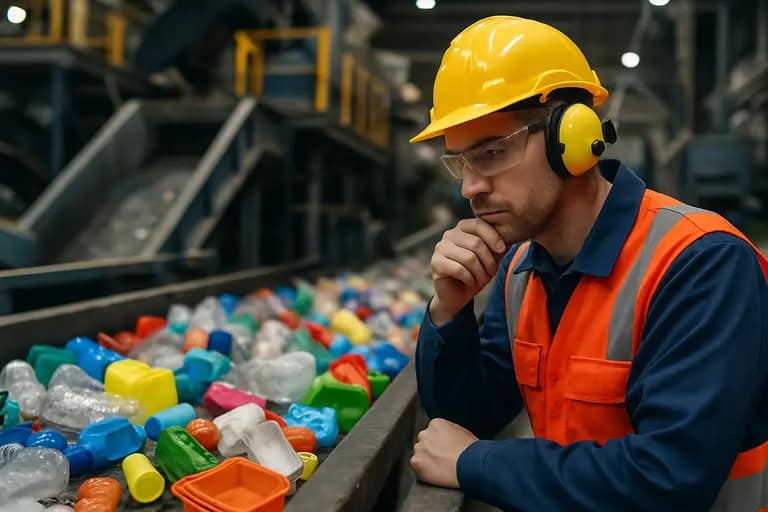
Recycling benefits depend on more than the material label. A pack has to be collected, correctly identified, sorted into a suitable stream, processed without excessive contamination, and converted into recyclate that has a buyer. Single-polymer design can reduce incompatibility, but poor collection or weak sorting infrastructure can still limit recovery. That distinction is central for manufacturers because design decisions are made inside the factory, while recovery outcomes depend on decisions across municipalities, recyclers, brands, and consumers.
Packaging and recycling choices also intersect with energy use in extrusion, lamination, forming, filling, washing, drying, and reprocessing. For those interested in understanding these energy dynamics further, the industrial energy context provides insights into how energy considerations align with packaging redesign efforts. The relevant point for packaging teams is that sustainability claims should consider the full chain, not only the polymer count.
Manufacturing Trials And Verification
Plant trials should be designed to find failure modes, not only to confirm a preferred outcome. A short production run may show that a material can be formed and sealed, but longer runs may reveal tool wear, film blocking, inconsistent seals, curling, print registration issues, slower speed, or higher scrap. Shelf-life and transport testing may also be needed before a design can be considered a practical replacement.
A cautious validation plan can include:
- line-speed trials under normal and stressed operating windows;
- seal-strength, puncture, drop, compression, and storage testing;
- barrier testing tied to the product’s actual shelf-life requirement;
- sortation and recycling compatibility checks with the intended recovery route;
- quality review of recyclate where recovery claims are part of the business case.
These checks help separate material potential from verified plant performance. They also reduce the risk of shifting impact from recycling to product waste, rework, downtime, or distribution damage. A package that is easier to recycle but causes higher product loss may not deliver the intended environmental benefit.
Mono-Material Plastics In Practice
Mono-material plastics should be viewed as a promising but conditional design strategy. The best-supported claim is that reducing chemical variety can make some recycling pathways more plausible. The less certain claim is that any given single-polymer structure will perform as well as a multilayer alternative, cost the same, and be recycled in practice. Those outcomes depend on application, infrastructure, and verification.
For manufacturers, the practical approach is disciplined comparison. Teams should define the incumbent package’s functions, identify which functions are lost or weakened by removing other materials, and test whether the new design restores them without creating new operating problems. Procurement, sustainability, quality, operations, and recycling partners should review the same evidence before claims are made.
The progress is real enough to justify trials and supplier engagement, especially in applications where barrier and mechanical requirements are moderate. It is not mature enough to support broad assumptions that mono-material packaging is automatically recyclable, lower impact, or cheaper. The strongest projects will combine polymer simplification with data from production, shelf-life testing, sorting studies, and recycler feedback. That evidence-first path gives the material category a better chance of improving manufacturing and recovery outcomes without overstating what the current science has shown.


