

Let’s face it. The world of rules and codes can be as exciting as a long seminar on proper widget storage. I’ve spent years trying to understand complex jargon that feels like reading legal contracts.
But there’s a twist. Mastering these rules isn’t just about following them. It’s a clever trick that can lead to operational integrity, safety, and innovation.
This guide aims to help you avoid the hard lessons. We’ll mix the harsh truth of standards with a bit of humor. Think of me as your guide through the paperwork hell. But with better coffee and less complaining.
Why Standards Matter in Production
Industry standards act like a shield for manufacturing, protecting it from harm. They are the heart of compliance engineering.
Standards ensure safety, quality, and consistency. They build trust with customers and regulators. But their real role is deeper. They are lessons learned from past mistakes, turned into rules to avoid future ones.
So, why is following these rules important? It’s like borrowing the wisdom of the industry. You avoid fines and make your operation better, safer, and more efficient.
Working without standards is like baking without a recipe. You might succeed once, but not consistently. Standards give you a reliable guide, turning chaos into science.
This turns compliance engineering into a strategic advantage. It’s the difference between following clear instructions and trying to make something by guesswork. One way is predictable, the other is risky.
When your team sees standards as a guide to excellence, quality and safety become natural. Trust with partners grows strong. It’s the invisible structure that keeps everything stable.
In the end, strong compliance engineering isn’t just for auditors. It’s about creating a system that rarely fails. That’s why standards are essential for smart production.
Overview of Common Industrial Regulations (Automotive, Food, Mining, Textiles)
If industry regulations were a music festival, each sector would have its own stage. Each stage has its own rules. Trying to use mining rules in a food plant is like playing Call of Duty with chess rules. It’s chaotic.
In the food and pharma world, the FDA is in charge. They focus on Good Manufacturing Practices (GMP). It’s a battle against contamination, where keeping records is key. It’s all about being paranoid about unseen threats.
Chemical and process plants have a darker story. OSHA’s Process Safety Management (PSM) is key here. It’s about managing risks of big accidents. The Environmental Protection Agency (EPA) also plays a role, focusing on environmental impacts.
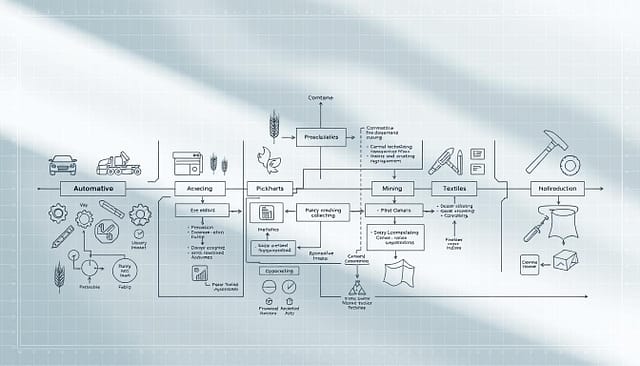
The automotive sector follows IATF 16949. It’s like ISO 9001 on steroids, focusing on quality and mistake-proofing. Traceability is a must, as a single bad part can cause big recalls.
Mining is different, with the earth as the main challenge. The Mine Safety and Health Administration (MSHA) sets rules for safety. These rules are based on lessons learned from mining accidents.
Textiles might seem easier, but it has its own set of rules. It deals with flammability and chemical safety. The goal is to make sure clothes are safe and don’t irritate the skin.
Each set of rules reflects the unique fears and past problems of each sector. Understanding these rules is the first step to following them. For a basic look at industry regulations, check out the basic terms in manufacturing.
Steps to Achieve and Maintain Compliance
If your plant’s compliance strategy is ‘hope nothing blows up,’ we need to have a serious, and slightly sarcastic, conversation. Regulatory adherence isn’t a trophy you dust off once a year. It’s a living, breathing compliance process—a state of being that demands constant vigilance. Think of it as the plant’s immune system; it must always be on patrol.
So, how do you build this perpetual motion machine of conformity? You engineer it, step by step, with a blend of paranoia, data, and institutional muscle memory.
Step One: Conduct a Brutally Honest Risk Assessment. Channel your inner doomsday prepper. What can go wrong? (Everything). What’s the worst plausible scenario? (Often hilariously bad). This isn’t about fear-mongering; it’s about strategic foresight.
This is where formal methodologies earn their keep. Don’t just guess. Use the tools of the trade:
- Process Hazard Analysis (PHA): Your systematic crystal ball. It identifies possible failures in design and operation.
- Layer of Protection Analysis (LOPA): This quantifies the risk. How many independent safety layers stand between a hiccup and a catastrophe?
- Safety Integrity Level (SIL) Assessment: The gold standard for evaluating your safety instrumented systems. Is that emergency shutdown loop reliable enough, or is it just fancy wiring?
This phase is your foundation. Get it wrong, and the whole house is built on sand.
Step Two: Instrument for Constant Monitoring. Data is your alibi. In the court of regulatory law, “I didn’t know” is a guilty plea. You need a nervous system for your plant—sensors, SCADA systems, and dashboards that provide real-time vitals.
Continuous monitoring turns anecdotes into evidence. It tells you a pump is trending toward failure long before it seizes, or that a chemical concentration is drifting out of spec. This isn’t surveillance; it’s preventive diagnostics.
Step Three: Train Your People Until It’s Muscle Memory. The fanciest PHA in the world is useless if the operator on the floor hasn’t internalized the response. A well-trained operator is your first, best, and most adaptable safety system.
Training shouldn’t be a once-a-year snooze-fest. It needs to be continuous, scenario-based, and drilled into reflex. When the alarm sounds, you want action, not confusion.
Step Four: Validate Your Automation. Here’s a terrifying thought: just because a PLC says it’s doing something doesn’t mean it’s doing it right, or safely. Automation validation is the process of proving that your automated systems actually achieve their intended function, even under stress.
This circles back to SIL assessments. Validating a safety system confirms its reliability matches its assigned SIL level. It’s the difference between a guardrail and a painted line on a cliff road.
Step Five: Vet Your Supply Chain Rigorously. Your compliance is only as strong as your weakest vendor’s paperwork. A substandard gasket, an uncertified motor, a raw material with impurities—all can introduce catastrophic risk.
Supplier compliance means auditing their practices, demanding their certifications, and building relationships with partners who share your obsession with standards. Sometimes, the smartest step is bringing in a design consultant—a tactical outsider who speaks regulator-ese and can see the forest for the very detailed, hazardous trees.
| Core Step | Primary Action | Key Tool/Methodology | Desired Outcome |
|---|---|---|---|
| Risk Assessment | Identify and quantify possible failures | PHA, LOPA, FTA, HAZOP | A prioritized risk register and mitigation plan |
| Continuous Monitoring | Real-time data collection and analysis | SCADA, IoT Sensors, Predictive Analytics | Early fault detection and operational transparency |
| Employee Training | Develop competency and instinctual response | Scenario Drills, Micro-learning, Competency Assessments | A human layer of protection that is alert and capable |
| Automation Validation | Verify automated system performance and safety | SIL Assessment, Functional Safety Audit, Simulation | Verified reliability of safety-critical control systems |
| Supplier Compliance | Ensure external partners meet required standards | Vendor Audits, Certificate Management, Quality Agreements | A resilient and trustworthy supply chain |
Ultimately, achieving and maintaining compliance is a cyclical, not linear, process. You assess, you monitor, you train, you validate, you vet. Then you do it all over again, because processes degrade, people change, and regulations evolve.
The goal is to make excellence routine. When the compliance process becomes ingrained in your plant’s DNA, you’re not just avoiding fines—you’re building a legacy of reliability and safety. Now, isn’t that better than just hoping?
Audits and Documentation
Think of an audit as a big review, not a scary test. It’s like a grand jury where your documents are the main witnesses. The auditor is not your enemy but a critical reviewer of your work.
Your job is to show a clear, well-documented story. This story should be so good that the auditor will be impressed. This is where compliance engineering turns into a detailed story.
Every document is like a piece of evidence. It’s not just a record; it’s a witness for your processes. A Piping and Instrumentation Diagram (P&ID) should be updated often, like a pop star’s Instagram.
Why? Because it’s like the map of your plant’s system. An old P&ID is like using a 1998 map of Manhattan. You’ll miss the new subway lines.

The Safety Data Sheet (SDS) is not just a form. It’s like a biography of every chemical in your facility. Your operating procedures are like the smartest operators’ knowledge, written down.
A maintenance log should be clear and detailed, like a detective’s case file. It should show when the belt was last tightened and the pump’s vibration reading. This is not just busywork. It’s the script and stage directions all in one.
The goal is to have control that is so smooth, it’s boring. You want your documents to tell a story that is so predictable, the auditor will struggle to stay awake. Their pen should be hovering over the checklist, finding nothing but perfect conformity.
To make your compliance story work, treat documentation as a living part of your operation. Don’t see it as just a quarterly task.
To see who’s in your compliance story, here’s a list of key documents and their roles:
| Document Type | Primary Purpose | Critical Update Trigger | Audit Value |
|---|---|---|---|
| P&IDs (Piping & Instrumentation Diagrams) | Visual map of all process flow and control loops. | After any physical plant modification or annually. | Proves understanding of system interconnectivity and hazard points. |
| SDS (Safety Data Sheets) | Hazard communication for all chemicals on site. | Immediately upon receipt of a new supplier version. | Demonstrates active chemical risk management and worker right-to-know. |
| Operating Procedures | Step-by-step instructions for safe and efficient task execution. | After an incident, change in process, or yearly review. | Shows standardized work and formalized training basis. |
| Maintenance Manuals & Logs | Record of equipment service, repairs, and performance history. | After every maintenance action and during predictive monitoring. | Provides a forensic trail proving preventative care and asset integrity. |
Mastering this table is key to compliance engineering. When the auditor asks for a specific SDS, you’re ready. You present it with the training record for Joe from shipping. You show the P&ID for the valve on the floor. The maintenance log for that pump is already ready.
This creates a seamless paper trail. It turns a possible interrogation into a guided tour of your competence.
The final act is simple. You give the auditor a binder that tells a complete, boring story. The story has no surprises and no villains. The climax is the auditor signing off and leaving early.
This is the quiet victory of world-class documentation. It’s the sound of nothing going wrong, documented perfectly.
Case Study: Overcoming a Regulatory Challenge
Let’s dive into a real story where engineering dreams met industry regulations head-on. Our hero is ChemiCorp, a mid-sized chemical maker. Their tale shows how innovation can sometimes outpace safety rules.
It all started with a win. ChemiCorp introduced a new automation system, boosting their efficiency. But, this upgrade had a hidden problem. It created a new pressure issue that old safety systems couldn’t handle.
ChemiCorp found themselves in a tough spot. Their own success had brought a new, untested risk. The team was smart but worked in separate groups. They needed to work together to tackle this new risk.
Then, a design consultant stepped in. They didn’t just offer a quick fix. They did a detailed risk analysis to understand the problem. The results showed the current safety measures were not enough.
The consultant suggested a new Safety Instrumented Function (SIF) with a Safety Integrity Level (SIL) 2 rating. This meant they had to replace old sensors, logic solvers, and valves. They also updated the relief system design and the safety documents.
This change didn’t just fix the problem. It turned a compliance risk into a safety improvement. The table below shows how things changed.
| Aspect | Pre-Consultant State | Post-Consultant Resolution |
|---|---|---|
| Hazard Assessment | Incomplete, siloed understanding | Quantified via formal LOPA study |
| Primary Safeguards | Generic controls, not hazard-specific | SIL-2 rated Safety Instrumented System |
| Documentation Status | Outdated, not reflecting new risk | Comprehensive P&IDs, safety requirements specs |
| Team Coordination | Siloed engineering disciplines | Integrated project approach with clear ownership |
| Regulatory Standing | At risk of non-compliance | Proactive alignment with industry regulations |
The cost of this change was high. But, the risk of not acting was even higher. This story is not unique to ChemiCorp. A study on global operational and regulatory challenges shows this issue is common in modern industries.
So, what did ChemiCorp learn? Sometimes, you need to admit your success has outpaced your safety measures. The real mistake is waiting too long to seek help. True engineering is about knowing when to innovate and when to ensure safety.
FAQs
Compliance isn’t just about following rules. It’s a conversation between teams. Here are answers to common questions, based on real experience.
Q: Isn’t this all just a massive, expensive distraction from actually making product?
Think of compliance like building a house. You need permits, inspections, and a solid foundation. It’s not just a cost; it’s a safety measure. Viewing it as a hindrance is like saying guardrails slow you down.
Q: How do we keep up with constant changes to standards?
Stay updated like it’s your industry’s newsletter. Network for insights, not just leads. Remember, your standards library must always be current. Outdated info can lead to big problems.
Q: What’s the single most common audit failure?
It’s not the big issues, but the small ones. Like outdated documentation. Your records must match reality. A small mistake can signal a bigger problem.
Q: Can we automate the entire compliance process?
You can automate some parts, like monitoring and reports. But, judgment and culture are human tasks. Automation helps, but can’t replace human oversight.
Key Takeaways
For the engineer scrolling fast, here are the cliff notes. Think of this as your cheat sheet for making rules work for you.
First, compliance engineering is not a back-office chore. It’s your frontline defense. It’s integrated into every bolt you tighten and every line of code you write. This is your job.
Second, industry standards are not shackles. They are the collective wisdom of every failure that came before you. Use them. They prevent you from reinventing the wheel, only to find it’s square.
Third, the compliance process never ends. It’s a loop of plan-do-check-act spinning at industrial RPM. You audit, you adjust, you repeat. Stasis is an illusion.
Fourth, your documentation is both a historical record and a legal shield. Write every log entry, every inspection report, as if your career depends on it. One day, it might.
Lastly, view regulatory challenges as design constraints. An architect doesn’t fight gravity; they use it to build something stable. A smart compliance process turns constraints into smarter, more robust solutions.
Mastering this world is part detective work, part translation, and part philosophy. Get it right, and you don’t just keep the plant running. You become the reason it never skips a beat.


