

Let’s be honest. You didn’t click on this for another glossy brochure filled with stock photos of people in hard hats smiling at conveyor belts. You’re here for the war stories.
This is a forensic look at where tailored technical design actually moves the needle. We’re cracking open the casebook from the trenches to show you what sector-specific engineering really looks like when the rubber meets the road.
I’ll be your slightly sarcastic guide through the gritty details of automotive, food processing, mining, and textiles. We’re blending first-hand field observations with the cold, hard analytics of what makes a project succeed.
Forget generic, off-the-shelf obsolescence. This is about the strategic survival tactics that separate the winners from the also-rans. Ready to see how it’s done?
The Need for Custom Solutions
Custom solutions in plant engineering are not just nice to have; they’re essential. They’re like a tailored suit for your plant. Standard solutions might work for a day, but they won’t impress anyone.
Every plant manager knows this. They feel the need for something special. It’s not just about being different; it’s about being better.
Standard solutions seem appealing because they’re cheap and quick. They come with instructions. But, what if your plant doesn’t fit the mold? What if your materials are unpredictable, or your goals are too high?
This is when things get serious. It’s the point where generic solutions become laughable. At this stage, every problem needs a unique solution.
I’ve seen it in plant engineering case studies. A standard conveyor system failed with a special material. A generic reactor couldn’t handle a new catalyst.
Starting with a custom approach is tough. It takes more money and brainpower. But, it’s the best way to stay strong and profitable in the long run.
Looking at plant engineering case studies, a clear pattern appears. Plants that went custom didn’t just fix one issue. They gained a lasting advantage. They prepared for future changes and breakthroughs.
This section is your reason to believe. Before we explore specific examples, we need to understand why custom solutions are smart. They’re not a last resort; they’re a strategic choice. The case studies prove it loudly.
Automotive: Engineering Innovation and Results
In today’s auto world, a Kafka cluster is as key as a robotic welder. Functional safety standards are like crash tests. Vehicles are now data centers on wheels. Factories are real-time analytics hubs. This is a revolution in engineering, needing tailored industry solutions.
BMW’s smart manufacturing uses Apache Kafka, not spreadsheets. It’s the heart of their shop floor. IoT sensors send out data on torque and temperature. Kafka handles this information, letting systems communicate smoothly. This prevents machine failures, saving millions.
Tesla faces a different challenge. They have millions of cars, each a data collector. Their goal is to make the fleet smarter with every mile. Their solution must just work for a global fleet, with seamless updates.
Functional safety is another critical area. It involves ISO 26262 and motor controller development. A bug here can be disastrous. Tools like MATLAB are essential for managing complex ECUs. This is where engineering meets life-or-death responsibility.
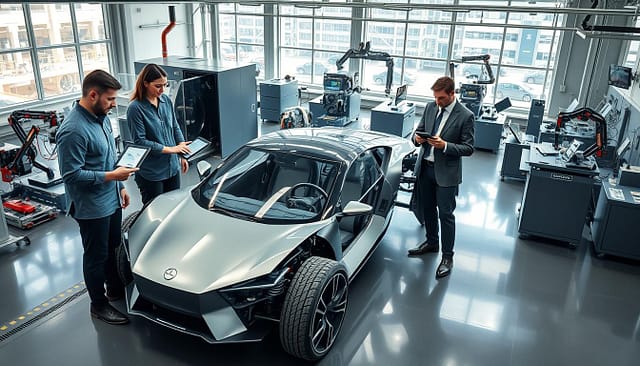
These stories show a key truth. There’s no one-size-fits-all solution. The best strategy is a mix of specialized approaches. The table below shows how different challenges need different engineering mindsets.
| Company / Domain | Core Challenge | Tailored Solution | Measurable Result |
|---|---|---|---|
| BMW (Smart Manufacturing) | Real-time data overload from thousands of factory IoT devices. | Apache Kafka as a central, decoupled data backbone. | Predictive maintenance saving millions in downtime. |
| Tesla (Connected Fleet) | Managing and updating software for millions of vehicles globally. | A monolithic, scalable data platform built for over-the-air dominance. | Continuous fleet learning and rapid feature deployment at scale. |
| Safety & Compliance (ISO 26262) | Eliminating systemic risk in safety-critical systems (e.g., braking, steering). | Model-Based Development (MATLAB/AUTOSAR) and rigorous process certification. | Certified functional safety, avoiding catastrophic failures and liability. |
Porsche and Audi show the pattern. Success comes from matching the right tool to the task. The real innovation is in choosing the right tailored industry solution for each problem.
Success in Food Manufacturing
Food manufacturing is like alchemy, turning simple ingredients into something special under FDA watch. It’s not your grandma’s kitchen anymore. It’s a place where big brands and health meet, with sector-specific engineering at the heart of it all.
Take salad dressing, for example. Oil and vinegar might separate on their own, like a quick divorce. But with special emulsifiers, they stay together perfectly. This is thanks to the same tech used in cosmetics and medicine, making your dressing creamy.
Plant-based meats are another challenge. They need to feel like real meat, which is hard. But with the right enzymes, they can. This tech comes from the health and beauty world, making plant-based foods feel real.
Keeping food fresh for longer is a big goal. We don’t want weird preservatives. So, we use smart packaging and natural helpers to keep food fresh. This way, we’re not just making food; we’re designing culinary experiences that are good for the planet.
The table below shows how old problems get new solutions in food. Each challenge gets a special, sector-specific fix.
| Traditional Food Challenge | Standard Industry Response | Engineered Custom Solution | Key Benefit |
|---|---|---|---|
| Texture loss in frozen foods | Add stabilizers & gums | Ice-crystal control via specialized freezing cycles & cryoprotectants | Preserves mouthfeel, reduces ingredient list |
| Alternative protein blandness | Mask with heavy seasoning | Enzymatic modification & fermentation to develop umami compounds | Creates authentic flavor without additives |
| Short fresh produce shelf life | Rush logistics, accept waste | Edible, plant-based coatings & modified atmosphere packaging | Reduces spoilage by 40-60% |
| Emulsion separation in sauces | Use synthetic emulsifiers | Ultrasonic homogenization & natural phospholipid systems | Clean label, superior stability |
This isn’t just cooking. It’s creating food that’s both delicious and healthy. Every detail, from mixing to filtering, affects how food tastes and feels. Making food efficiently is key, as small improvements can save a lot of money.
The real magic of food engineering is that it’s invisible. Enjoying a creamy yogurt or a plant-based burger is a win for applied biotechnology and mechanical ingenuity. It’s all about science and precision, not magic.
Mining Sector: Unique Engineering Wins
In the mining sector, equipment failure is a huge financial loss. A 400-ton haul truck stopping means no revenue. This harsh reality makes mining a key test for plant engineering case studies. It’s where theory meets a reality that tries to crush your plans.
Engineering in mining is like designing for a war zone. It faces dust, heavy loads, and extreme temperatures. The goal is to create systems that can survive. Let’s explore how custom solutions are changing the game, both literally and financially.
Lubrication in mining is like sunscreen in a volcano. Standard lubricants fail due to extreme pressure, contamination, and heat. Advanced oil additives and custom formulas are critical. A compelling plant engineering case study shows a lubricant that withstands ball mill gears and repels dust.
This lubricant extended component life by over 300%. Downtime for lubrication failures dropped. The ROI was huge, saving thousands of hours of downtime.
Predictive maintenance in mining is different from office work. It involves installing sensors to “listen” to machines. These systems predict failures weeks ahead.
This shift from reactive to proactive maintenance is a game-changer. It turns unplanned downtime into scheduled repairs. The savings are in the millions of dollars.
Material handling in mining is a massive physics problem. Custom engineering focuses on energy efficiency and throughput. Solutions include tailored conveyor belts and optimized crushers.
The aim is to move more material with less energy and wear. Successful plant engineering case studies show a 15-20% energy reduction and increased throughput.
What ties these mining wins together? They see the extreme environment as a design parameter. The high-performance additives and innovations tested in mining set a benchmark for all industries.
In essence, mining doesn’t just use engineering; it forges it in fire. The lessons and solutions from mining become the gold standard for reliability. That’s a win worth digging for.
Textiles & Specialty Industries
Have you ever seen a fabric that’s both waterproof and breathable? That’s the magic of tailored industry solutions. This field is all about combining science and technology. On one hand, we have the amazing world of material science. It creates everything from fire-resistant fibers to adhesives that stick steel to silicone.
On the other hand, we have the digital world. Here, these products find their market. It’s not just about making something better. You also need to find a smart way to sell it.
Let’s talk about the chemistry behind it all. Modern textiles and composites often rely on special additives. These additives can make paint scratch-resistant or give fabrics stain-guard powers.
Imagine an adhesive that keeps your car’s interior together in hot summers and cold winters. That’s what specialty resins and sealants do. They’re like molecular matchmakers, bonding different materials together. This is not generic stuff. It’s highly specific chemistry for a tough job.
But what’s the point of a miracle fabric if nobody can find it? That’s where the digital world comes in. After creating the perfect water-resistant coating for outdoor gear, you need a digital store that’s just as smooth. For B2B suppliers, platforms like Adobe Commerce create omnichannel experiences.
Designers can spec materials, check inventory, and place orders easily. The product is born in the lab, but its life is managed online.
The real magic happens when these two worlds work together. The table below shows how they solve common challenges.
| Specialty Industry Challenge | Custom Engineering Solution (Physical) | Tailored Digital Solution |
|---|---|---|
| Creating durable, weather-resistant performance fabrics | Advanced coating additives that repel water while maintaining breathability. | An integrated B2C e-commerce site with rich media showing product performance in real-world conditions. |
| Bonding dissimilar materials in automotive or electronics | Special-formulation adhesive resins designed for specific thermal expansion rates and substrates. | A secure B2B portal with technical datasheets, batch tracking, and automated reordering for manufacturing clients. |
| Improving the application and durability of industrial coatings | Additives that enhance flow, leveling, and UV resistance for longer product life. | A content management system (like Adobe Experience Manager) that delivers targeted technical guides and tutorials to applicators. |
So, the next time you wear a high-tech rain jacket or notice your sneakers are lasting longer, think about the two parts. There’s the physical innovation—the clever chemistry that solved a problem. And then there’s the digital innovation—the online framework that got that solution to you.
In textiles and specialty industries, success means mastering both sides. That’s the full story of a modern, tailored industry solution.
Comparative Analysis: Benefits by Industry
If custom engineering were a movie, each industry would have its own genre. Automotive is a thriller, food a drama, mining a survival epic. Each has its own unique problem and solution.
Let’s look at the data. We’ve moved from stories to facts. Studies in automotive, food, mining, and textiles show a key point: sector-specific engineering is not one-size-fits-all. The basic steps are the same: find a problem, design a solution. But each industry’s success is tied to its own needs and goals.

| Industry | Primary Pressure | Core Engineering Win | Key Metric Impacted |
|---|---|---|---|
| Automotive | Regulatory compliance, functional safety, data velocity | Risk mitigation & system agility | Time-to-insight, safety certification |
| Food & Pharma Ingredients | Brand integrity, supply chain transparency, contamination risk | Product differentiation & traceability | Market share, recall avoidance |
| Mining & Additives | Brutal operating environments, asset degradation, downtime cost | Asset preservation & operational uptime | Mean Time Between Failure (MTBF) |
| Textiles & Digital Fabrication | Fast fashion cycles, material innovation, customization demand | Speed-to-market & design flexibility | Prototype iteration speed |
In automotive, the stakes are high. The goal is a safer car that talks data fluently. Custom Kafka platforms help avoid legal trouble and keep customers happy.
Food manufacturing faces a different challenge. The fear is contamination. A custom tracking system is a shield for brands. It builds trust and saves money.
Mining is a harsh environment. The focus is on keeping expensive assets running. A custom sensor array is a smart investment in uptime.
Textiles are all about speed. Custom tools speed up design and production. Being first and unique is key to success.
The key takeaway is clear. The sector-specific engineering benefit reflects an industry’s core concerns. Automotive focuses on risk and data. Food is about purity and origin. Mining is about endurance and cost. Textiles aim for speed and newness.
Custom engineering doesn’t just tweak solutions. It shapes success itself. It addresses unique problems in each industry’s language. The tools might be code, sensors, or alloys. The real product is peace of mind, in the currency each industry values most.
Lessons Learned for Plant Engineers
If plant engineering were a movie, the plant engineering case studies would be the director’s commentary. They are full of hard truths and unexpected twists. The credits have rolled on those custom projects. Now, let’s talk about what stayed with us after the screen went dark.
This isn’t just management fluff. It’s the real wisdom from the factory floor. Consider this your cheat sheet, forged in the fires of real-world deadlines and budget constraints.
Lesson one is a classic, from automotive precision: decoupling is your friend. Think of BMW’s strategy as a philosophical one. By isolating systems, you create buffers against failure. One module’s hiccup doesn’t become the entire line’s cardiac arrest.
Lesson two, from Tesla, is brutally simple: “just works” beats “technically brilliant but fragile” every single time. Elegant complexity is a trap. The goal isn’t to impress other engineers with clever code. The goal is uptime. A system that hums along reliably for 10,000 hours is a masterpiece.
Lesson three is the accountant’s grim reminder: never underestimate the tax of regulation. Whether it’s ISO 26262 for functional safety in auto or food-grade sanitary standards, compliance isn’t a feature you bolt on later. It’s the foundation you pour on day one.
Lastly, the most universal lesson: the last 10% of a custom project is where 90% of the value is captured or incinerated. This is the grind—integration, training, and long-term support. You can have the world’s best machine, but if your team fears it or can’t maintain it, you’ve built a very expensive paperweight.
| Core Lesson | Industry Example | Key Takeaway | Impact Metric |
|---|---|---|---|
| Strategic Decoupling | Automotive (BMW) | Isolate systems to contain failures and simplify upgrades. | Reduced system-wide downtime by up to 70% in cited engineering case studies. |
| Reliability Over Complexity | EV Manufacturing (Tesla) | Prioritize robust, simple operation over technically ornate solutions. | Higher overall equipment effectiveness (OEE) and lower mean time to repair (MTTR). |
| Compliance by Design | Automotive & Food Processing | Integrate regulatory standards (e.g., ISO 26262) into the initial design phase. | Avoids cost overruns of 25-40% associated with retrofitting compliance. |
| The 10% Integration Rule | All Sectors (Mining, Textiles) | Final integration, training, and support define ultimate project success. | Direct correlation to user adoption rates and long-term return on investment. |
So, what’s the through-line for a plant engineer? It’s a shift from being a builder of things to a designer of outcomes. The real product isn’t the machine on the floor. It’s the predictable, efficient, and adaptable operation it enables.
They remind us that the most elegant engineering often looks boringly reliable. And in the world of plant operations, boring is beautiful. For a deeper dive into the data behind these principles, a review of plant engineering case studies is highly recommended.
Conclusion
Custom engineering is not just for the elite anymore. It’s now a must-have for all. Trying to win by just being cheaper is a losing game.
Looking at cars, food plants, mines, and textile mills shows us something. Those successes weren’t luck. They were the result of careful planning and problem-solving.
The key skill for the future is creating tailored industry solutions. It needs technical know-how and the ability to think across different fields. You have to see the big picture.
Another important skill is telling stories. You need to explain why investing in a tailored industry solution is worth it. The benefits might not always be clear in numbers. Sometimes, it’s about saving time, improving quality, or finding new markets.
So, here’s the last thought. In a world that’s always changing fast, the safest choice is to be different. The smart move is to go custom. Now, it’s time to create something new and exciting.


