
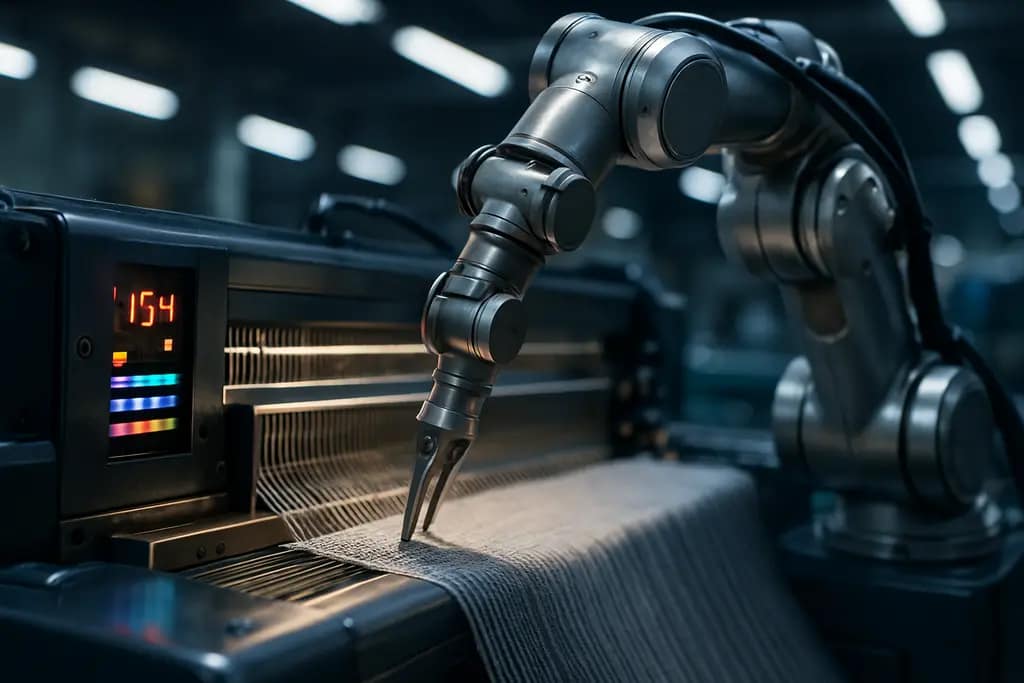
Robotic apparel manufacturing is moving from laboratory-style demonstration toward early commercial deployment, and CreateMe’s MeRA platform is one of the clearer cases to assess. The available evidence supports a cautious reading: CreateMe has announced a production platform, garment launches, and supply-chain partnerships, but the public record still relies heavily on company statements and trade coverage rather than independent production audits or peer-reviewed environmental data.
That distinction matters for sustainable apparel manufacturing. Automation, bonding, compact factories, and shorter replenishment cycles could reduce some forms of waste if they perform at scale. Yet sustainability claims in apparel are difficult to verify without measured data on energy use, defect rates, garment life, wash durability, adhesive recovery, recycling yields, and cost per unit under routine factory conditions.
Robotic Apparel Manufacturing Claims From CreateMe
What MeRA And Pixel Are Said To Do
On September 11, 2025, CreateMe announced its MeRA™ robotic apparel manufacturing platform and Pixel™ microadhesive bonding technology, presenting the system as an alternative to traditional sewing for selected garment categories. The same announcement said MeRA can reach production speeds up to 20 times faster than manual sewing, with twice the precision, and approximately 250 garments per hour in a compact footprint, according to the CreateMe launch announcement.
The Pixel bonding element is central to the technical claim. CreateMe describes seams under 1 millimeter wide and says the bonding approach allows materials to be disassembled cleanly, which the company links to recyclability. The company also cites performance attributes such as moisture-wicking and thermal regulation. Those statements are meaningful, but they should be read as platform claims until supported by broader third-party testing across fabrics, wash cycles, wear conditions, and end-of-life processing.
Robotic Apparel Manufacturing In Commercial Context
The platform is not being described only as a prototype. Textile World reported that each MeRA production line is designed to produce more than 1 million units per year, a level that would put the technology in the range of high-volume apparel categories if achieved consistently in factory service, as described in Textile World’s coverage. That production target is one reason the system has attracted attention beyond small-batch customization.
CreateMe’s February 2026 partnership with UNTUCKit and Supima® added another commercial signal. The partners announced plans for the first commercially available digitally bonded T-shirt styles, targeting up to 50,000 bonded T-shirts per year starting in Q3 2026. As of August 20, 2026, that timing placed the target inside the present quarter, but the research notes do not provide independently verified shipment volumes or field performance results.
Sustainability Logic And Evidence Limits
Where Adhesive Bonding Could Matter
The sustainability argument for bonded garment assembly rests on several mechanisms. If automated cutting, pattern optimization, and lower defect rates reduce fabric waste, the process could address a material loss problem. CreateMe’s impact materials state that the apparel industry generates roughly 90 million tons of fabric waste annually, and the company says its process seeks to optimize patterning, reduce defect waste, and support circularity through thermoreversible adhesives.
The adhesive portion deserves close technical scrutiny because it affects manufacturing speed, seam performance, recyclability, and potential end-of-life separation. For those exploring related subjects in materials and processing within the same network, Kilburn Chemicals offers a valuable reference point. In CreateMe’s case, the key question is not whether adhesive bonding is interesting; it is whether the bond can meet garment durability needs while still allowing practical, clean disassembly at scale.
What The Data Does Not Yet Prove
The broader environmental context is severe. The research notes cite apparel and footwear as contributing about 8% of global greenhouse gas emissions and using about 79 trillion liters of water per year. Those figures explain why manufacturers are testing automation, local production, and lower-waste processes. They do not, by themselves, prove that any single platform reduces emissions or water use after all inputs are counted.
A defensible sustainability assessment would need measured comparisons against conventional sewn garments. That comparison would need to include fabric utilization, adhesive inputs, energy demand, machine uptime, rejects, transport distances, washing durability, garment lifetime, repairability, and actual recycling outcomes. Without that data, robotic apparel manufacturing should be treated as a promising production pathway under evaluation, not as a demonstrated environmental fix for the sector.
Scale, Cost, And Implementation Barriers
Capacity Claims Need Plant-Level Verification
CreateMe’s reported performance figures are significant, but factory capacity is not defined by machine rate alone. A line that can produce around 250 garments per hour still depends on upstream fabric supply, pattern preparation, handling, inspection, packaging, maintenance, and labor skills. If any of those steps cannot match the automated cell, the practical output may fall below the headline rate.
The research notes state that MeRA cells are designed as modular microfactories of roughly 1,200 square feet per line, placed near end-consumer locations, with small minimum batches around 100 units and replenishment measured in days rather than months. Those features would be relevant for demand volatility and inventory control. They also introduce implementation questions: local labor training, spare parts availability, adhesive supply, quality standards, and integration with brand ordering systems.
Cost And Safety Evidence Remains Limited
CreateMe’s model is described as aiming to be cost-competitive with offshore sewing. That is a high bar because offshore apparel production benefits from mature supply chains, labor specialization, and established vendor networks. Automation can reduce dependence on manual sewing time, but it can add capital costs, maintenance needs, software support, utilities, bonding materials, and process qualification costs.
Safety and product acceptance also need evidence. The public research notes do not provide independent safety evaluations for adhesive chemistry, long-term skin-contact considerations, or full end-of-life handling. They also do not provide comparative wash-test datasets across multiple fabric constructions. In commercial apparel, small differences in hand feel, seam flexibility, drape, and durability can affect adoption even if the production system works mechanically.
- Evidence supported: CreateMe announced MeRA, Pixel bonding, commercial-grade garments, a UNTUCKit and Supima® partnership, and a Seed to System initiative with Avalo and Laguna Fabrics.
- Evidence still needed: independent operating data, verified environmental accounting, long-duration garment testing, recycling yield results, and cost comparisons under routine production conditions.
- Implementation risks: capital intensity, adhesive qualification, fabric compatibility, operator training, maintenance support, and supply-chain coordination.
CreateMe Robotic Apparel Manufacturing Assessment
CreateMe’s June 23, 2026 Seed to System initiative with Avalo and Laguna Fabrics broadened the company’s framing from garment assembly to a linked system involving climate-smart cotton, domestic textile making, and robotic assembly. That strategy is technically coherent because sustainability in apparel cannot be judged only at the sewing or bonding step. Fiber supply, fabric formation, cutting, assembly, logistics, use, and end-of-life handling all affect the result.
The cautious assessment is that CreateMe has moved beyond a concept presentation and into an early commercial phase with defined product targets and reported platform specifications. That is meaningful progress for robotic apparel manufacturing. The evidence does not yet show whether the system can deliver lower total environmental impact, durable consumer products, and cost parity across broad apparel categories. Those questions require measured factory operation and independent lifecycle data rather than launch claims alone.
For manufacturers, the practical implication is to assess the platform category through trials, not slogans. A pilot should define garment type, fabric range, quality thresholds, output targets, defect accounting, energy measurement, adhesive use, labor requirements, maintenance time, and end-of-life testing before wider adoption. CreateMe’s platform is a relevant case because it combines automation, bonding, and localized production. Its sustainability value will depend on verified performance after those elements are tested under commercial constraints.


