
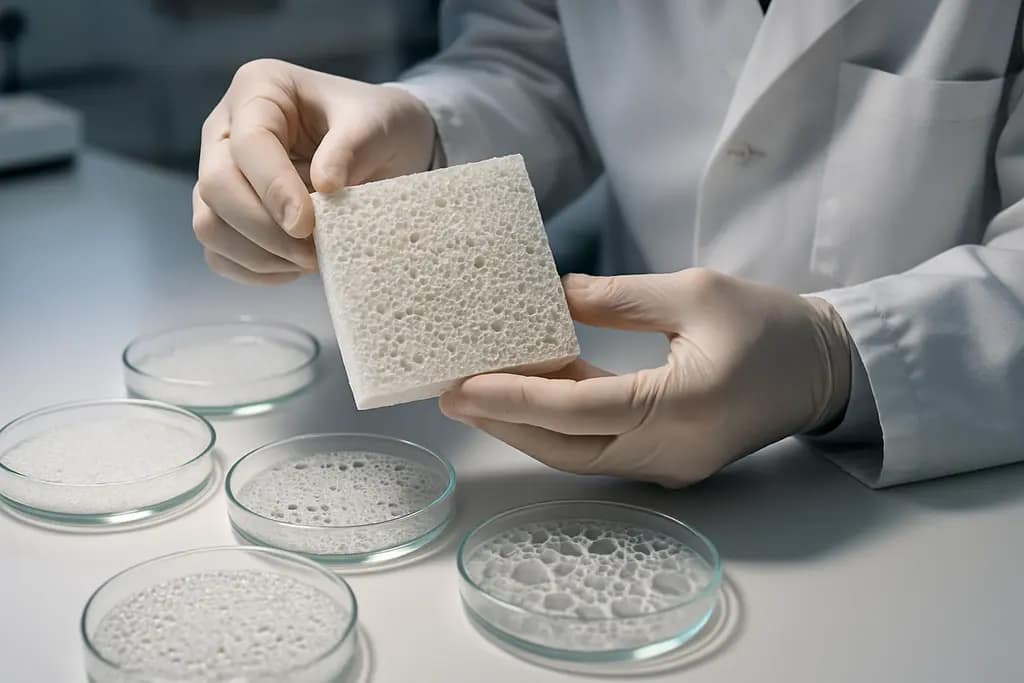
Foam AI Patterns are drawing attention because two very different systems, flowing foams and trained neural networks, appear to share some mathematical behavior. The evidence remains early and mostly research-stage, but it offers a useful way to think about optimization, microstructure, and prediction in material science without assuming that foam physics and artificial intelligence are the same problem.
For manufacturers and materials teams, the interest is practical as well as theoretical. Foams are used because pore size, wall thickness, density, and cell connectivity can affect energy absorption, insulation, mechanical response, and weight. AI models are being tested as tools for recognizing microstructure and estimating properties from images or scan data. The scientific question is whether shared mathematical structure can help researchers design better models, not whether AI has already solved foam engineering.
Foam AI Patterns And Optimization Evidence
What The Penn Work Reported
On January 23, 2026, the University of Pennsylvania reported research showing that the internal rearrangement of bubbles in flowing foams can mathematically resemble how deep learning systems move through broad, relatively flat regions during training. In both cases, the visible or external form can look stable while internal variables keep shifting. The report described this as a similarity in optimization dynamics, not as proof that foams compute or that neural networks behave like physical bubbles in every respect. The work was summarized by Penn Today.
The cautious interpretation is that foam physics may offer a physical analogy for some aspects of AI training. Deep learning systems often adjust large numbers of parameters while trying to reduce error. A foam under flow can rearrange bubbles internally while retaining its outward shape. The shared pattern is not the material itself, but the movement through many possible configurations under constraints.
Where Foam AI Patterns Appear In Data
Foam AI Patterns also appear in a more applied setting: image-based recognition of porous materials. A study published on January 24, 2025, introduced FD-Conv, a model for multi-source foam ceramic microstructure image recognition. The model combined convolutional neural networks with a frequency-domain block and global feature extraction inspired by Transformer-style methods. The paper reported recognition accuracy at least 7.6% higher than prior state-of-the-art techniques for the tested image recognition task, according to the Scientific Reports study.
That result is specific. It concerns recognition of foam ceramic microstructure images under the study conditions. It does not establish a universal model for all foams, all imaging systems, or all manufacturing environments. Still, the result is relevant because foam microstructures often contain features at different scales. A model that combines local image patterns with frequency-domain information may be better suited to those data than a simpler image classifier, at least in the tested setting.
Microstructure Recognition As A Practical Test
Why Images Alone Can Be Incomplete
Foam materials are not defined only by what appears in a single two-dimensional image. The research notes include a June 2025 review stating that 2D images are not sufficient for certain quantitative microstructural features. That limitation matters for industrial analysis because pore networks are three-dimensional. A cross-section can show cell size and local morphology, but it may miss connectivity, hidden defects, tortuosity, or gradients through the thickness.
This is one reason AI models in foam research are being tested with different inputs, including microscopy, CT-derived representations, pore density, strain, solvent type, and other material descriptors. The value of a model depends on whether the data capture the physical features that control the property being predicted. If the input data omit a critical feature, even a strong model architecture can produce misleading confidence.
Model Speed Does Not Replace Validation
The research notes describe several examples where machine learning models predicted compressive response, stress, energy absorption, or porous morphology in polymer, carbon, ceramic aerogel, and aluminum foam systems. Some studies reported that learned models were faster than finite-element approaches or useful as surrogate models. That speed can matter during screening, especially when many candidate microstructures must be compared.
Yet computation speed is not the same as field reliability. A model trained on a narrow set of pore densities, solvents, microsphere fractions, or scan geometries may perform poorly when production conditions change. Manufacturing teams would need checks for measurement consistency, batch variation, calibration drift, and out-of-distribution samples before treating predictions as production evidence.
The difference between a research model and an industrial decision tool is often the strength of validation. Lab data can show that a method is promising within defined boundaries. Plant use requires repeated performance across materials, operators, instruments, and process variation. Readers comparing related science resources across the same network may also find related technical coverage useful for separating early findings from applied claims.
Limits Before Industrial Use

Scale, Cost, And Data Barriers
Foam AI Patterns may help researchers reason about optimization, but several barriers remain before such work affects routine production. High-quality 3D scans, labeled microstructure images, compression data, and controlled processing records can be costly to generate. Small datasets can lead to models that appear accurate in testing but fail under broader conditions. Imaging methods also differ in resolution, contrast, noise, and sample preparation, which can weaken transfer from one lab to another.
Scale is another issue. A sample core, a lab coupon, or a small aerogel specimen does not necessarily represent a full production panel, molded part, or large billet. Foam processes may produce spatial gradients in density and pore morphology. If the training data come from small and relatively uniform samples, the resulting model may not describe full-scale parts well enough for engineering release.
Safety And Implementation Questions
Safety and quality decisions should not depend only on an AI prediction unless the model has been validated for that use. Foams can be used in energy absorption, insulation, filtration, lightweight structures, and other settings where failure modes matter. A prediction of compressive behavior or energy absorption must be tied back to physical testing, accepted standards, and the actual service environment.
Implementation also requires integration with existing measurement and quality systems. Teams would need defined sampling plans, traceable imaging procedures, model version control, acceptance criteria, and a process for investigating disagreement between AI predictions and test results. Those steps add cost and time, but they are necessary if model outputs influence material release or process changes.
- Research stage: mostly laboratory, modeling, and image-recognition studies rather than settled production practice.
- Evidence strength: useful within stated datasets, with limited certainty outside those bounds.
- Industrial barrier: data quality, validation scope, imaging cost, and integration with quality systems.
- Practical implication: AI can support analysis, but physical testing remains necessary for safety-related claims.
What Foam And AI Means For Materials Work
The most useful reading of this research is neither dismissive nor promotional. Foam physics and AI training appear to share some mathematical patterns in how systems move through many possible internal states. That observation may help researchers build better intuitions about optimization and stability. It may also encourage new model designs for analyzing porous microstructures.
For material science teams, the near-term value is more modest. AI can help classify images, compare patterns, or estimate properties when the training data are relevant and the uncertainty is understood. Foam AI Patterns should be treated as a research signal that connects physical systems and computational models, not as a guarantee of better foam products.
The implication for manufacturing efficiency is clear enough: use these findings to ask better questions. Which microstructural features are being measured? Does the model see the features that control the property of interest? Has it been tested on data from the same process, scale, and measurement system? Until those answers are documented, Foam AI Patterns remain an informative research bridge rather than a production-ready method.


