
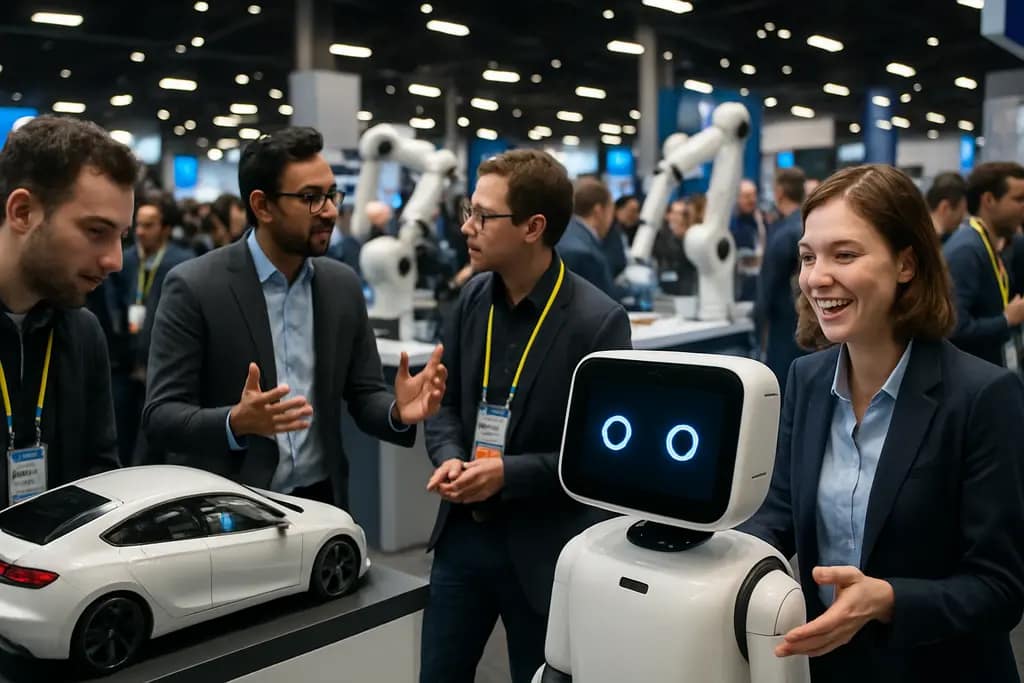
AI Autonomous Technologies were one of the clearest technical themes at CES 2026, which took place in Las Vegas, Nevada, on January 6–9, 2026. The event drew more than 148,000 attendees and more than 4,100 exhibitors, including about 1,200 startups, according to the official CES 2026 report. For industrial engineers, the more useful question was not whether AI appeared often on the show floor. It was how far those demonstrations had moved from presentation concepts toward deployable systems with defined safety cases, validation processes, cost structures, and maintenance needs.
The evidence suggested a broad shift. AI was not confined to software dashboards or cloud analytics. It appeared in vehicle autonomy, assisted driving, robotics, simulation tools, data workflows, and compute hardware. Yet the level of maturity varied sharply. Some exhibits described production programs or near-term vehicle platforms; others remained prototypes, early-stage company demonstrations, or announced plans. That distinction matters because autonomous engineering depends on repeatable behavior in uncertain physical conditions, not only model performance in controlled demonstrations.
What AI Autonomous Technologies Meant At CES 2026
AI Autonomous Technologies As An Engineering Category
For engineering teams, AI Autonomous Technologies at CES 2026 covered systems that perceive surroundings, make decisions, and act through vehicles, robots, or assisted-control platforms. That definition is broad, which is part of the issue. A Level 2++ driver-assistance feature, a Level 4 robotaxi display, a humanoid robot prototype, and a data-management tool for autonomous vehicle training all sit under the same broad commercial label, but they carry different safety, regulatory, and integration burdens.
EE Times reported that 1,460 exhibitors listed AI technology among their offerings, making AI the top listed CES 2026 category; the same report counted 710 Vehicles & Mobility exhibitors and noted that the category had fallen by more than 200 exhibitors from the prior year in its CES 2026 analysis. Those figures support two observations. AI’s presence was broad, but mobility participation was not simply expanding without friction. Autonomous technology remained a major draw, yet companies appeared to be operating in a more selective market.
Autonomy Was One Part Of A Broader AI Push
The business signal around AI Autonomous Technologies was also shaped by who attended. More than 55% of CES 2026 attendees were senior-level executives, based on the event’s official figures. That does not prove procurement decisions followed, but it suggests that autonomy and AI were being evaluated by decision-makers who influence capital spending, product strategy, and platform roadmaps.
For manufacturers and industrial suppliers, the relevance extends beyond passenger cars. Autonomous vehicle engineering draws on perception, embedded compute, safety monitoring, simulation, sensor fusion, software updates, and field data management. These same concerns appear in warehouse robots, yard logistics, mobile inspection systems, automated material movement, and other industrial autonomy programs. Coverage from technology-focused sites within the network, such as SGTT, can provide comparisons of AI advancements across different sectors, offering insights without assuming uniform progress across industries.
Engineering Signals Behind The Vehicle Displays
Vehicle Programs Shifted Toward AI Lifecycle Work
One of the strongest engineering signals at CES 2026 was the move from software-defined vehicle language toward AI-defined vehicle language. The research record for the event identified NVIDIA’s Alpamayo 1 as a Vision-Language-Action model, paired with a simulation framework called AlpaSim and datasets described as containing more than 1,700 hours of driving data. Mercedes-Benz was identified as the lead customer for deploying the Alpamayo 1 and Drive AV software stack on a new CLA platform in 2026, with an address-to-address Level 2++ feature.
Those details point to a practical requirement: autonomy is not a single release. It requires training data, simulation, validation, monitoring, software updates, and fleet feedback across a product lifecycle. For plant and vehicle engineers, the difficult work sits in system assurance. A model that performs well in a staged demonstration still needs defined operating conditions, fallback behavior, audit trails, cybersecurity controls, and update governance before it can be treated as dependable in commercial service.
Compute And Sensor Choices Became More Visible
CES 2026 also showed how much autonomy now depends on compute architecture. Lenovo presented a Level 4 Autonomous Driving Domain Controller called AD1, built on dual NVIDIA DRIVE AGX Thor systems. The research notes described this controller as being deployed by WeRide in its GXR robotaxi, with that vehicle characterized as a mass-produced Level 4 autonomous vehicle on the platform.
That kind of announcement is significant, but it should be read carefully. Level 4 autonomy is defined by operation within a specific operational design domain, not by unrestricted capability everywhere. The engineering question is therefore where the system operates, under what weather and road conditions, with what remote support model, and under which regulatory permissions. The hardware platform is only one part of that chain.
Sensor and data companies at CES 2026 also pointed to practical constraints. Startups highlighted ADAS, robotics autonomy, generative autonomy approaches without HD maps or LiDAR, data lifecycle tools, 4D radar for adverse weather, and special-purpose autonomous mobility. These areas address real engineering pain points: map maintenance, corner cases, perception in poor conditions, labeling costs, and validation repeatability. None of those categories alone guarantees safe autonomy, but each reflects an attempt to reduce known sources of uncertainty.
Commercial Claims Need Careful Reading
Display Does Not Equal Deployment
Robotaxis and autonomous systems had high visibility at CES 2026. Tensor Auto displayed a SAE Level 4 robotaxi intended for private ownership, Geely revealed a mass-production-ready Level 3 autonomous driving system, and BMW showed the iX3 with Qualcomm’s Snapdragon Ride Pilot for assisted driving. These examples show the range of autonomy claims presented at the event, from assisted driving to more automated systems.
The wording matters. A displayed vehicle, a production-ready system, and a deployed commercial fleet are different stages. Engineering teams should separate prototype demonstration, design validation, limited release, production start, customer delivery, and scaled operation. Each stage adds evidence, but none removes the need for operational monitoring after release.
Physical AI Remained Uneven In Maturity
Robotics and physical AI were also prominent at CES 2026. The research record described AI as embedded in mobility, robotics, and humanoid concepts rather than limited to software products. It also noted that fully capable humanoid assistants remained futuristic, with many systems shown as prototypes or production plans rather than proven industrial labor substitutes. Hyundai’s version of the Atlas humanoid robot was described as having mass production planned for 2028, targeting 30,000 units annually for industrial use.
For factories, that means interest should be paired with due diligence. Humanoid and mobile robotic systems may eventually address tasks in spaces designed for people, but industrial adoption depends on uptime, maintainability, safety certification, battery management, tooling, end-effector reliability, training burden, and integration with plant workflows. A prototype can be informative without being ready for routine production work.
Implementation Barriers For Industrial Teams

Validation Is The Central Constraint
The hardest part of autonomy remains proving acceptable behavior across enough conditions to support responsible deployment. AI models can fail in ways that are difficult to predict from conventional rule-based testing alone. That is why simulation frameworks, driving datasets, scenario generation, and data lifecycle tools received attention at CES 2026.
Industrial adopters should treat validation as a system process rather than a vendor claim. Useful evaluation questions include:
- What operating domain is explicitly supported, and what conditions are excluded?
- How are edge cases captured, labeled, tested, and reviewed after deployment?
- What fallback state occurs when sensors, compute hardware, maps, or connectivity degrade?
- Who approves software updates, and how are changes verified before release?
- What evidence is available from field operation rather than staged demonstrations?
These questions apply to vehicle autonomy and to factory robotics. The setting changes, but the engineering discipline is similar: define the boundary, test inside it, monitor drift, and avoid expanding use faster than evidence supports.
Cost, Safety, And Integration Shape Adoption
AI Autonomous Technologies can require expensive compute, sensors, thermal management, data pipelines, networking, cybersecurity controls, and maintenance skills. Those costs do not always appear in a product demonstration. A plant considering autonomous mobile systems or AI-assisted inspection needs to budget for integration labor, commissioning time, operator training, spares, and support contracts.
Automotive companies face parallel issues. AI-enabled vehicle platforms require coordination across software, electronics, mechanical systems, safety engineering, compliance teams, and service organizations. A related review of GM AI tools in automotive development discusses similar integration limits in manufacturing, software, testing, and ADAS work. The common lesson is that AI capability has to fit the engineering organization, not only the product roadmap.
Safety is another adoption gate. Assisted-driving systems still depend on clear human-machine interaction and driver expectations. Higher automation levels require stronger evidence of autonomous fallback behavior within defined operating conditions. In industrial settings, mobile robots and humanoid systems must coexist with workers, forklifts, pallets, cables, stairs, and changing layouts. The test environment must reflect those physical realities.
CES 2026 AI Autonomous Technologies Assessment
CES 2026 showed that AI Autonomous Technologies had moved deeper into engineering platforms, especially in mobility, robotics, simulation, and embedded compute. The evidence supports a measured interpretation: AI was no longer presented only as a software feature, but as part of autonomous systems that sense, decide, and act in the physical world.
That does not mean autonomous deployment became straightforward after the January 2026 event. The show presented a mix of commercial programs, platform partnerships, prototypes, startup tools, and future production plans. Engineers evaluating these systems should focus less on the presence of AI and more on the evidence behind each claim: operating domain, validation data, safety behavior, update controls, cost, support model, and demonstrated field performance.
The most practical implication from CES 2026 is that autonomy is becoming a lifecycle engineering problem. Model performance, compute hardware, vehicle architecture, data governance, simulation, monitoring, and maintenance all have to work together. For industrial teams, the cautious path is to pilot narrowly, measure against defined operating conditions, and scale only when the evidence from field use supports the next step.


