

When your Wi-Fi goes down or your favorite monstera turns yellow, panic sets in. You don’t think about the cause. You just want a quick fix.
We’ve all tried to fix symptoms without finding the real issue. It’s like treating a symptom without fixing the problem. This is true whether it’s a router issue or a dead basil plant.
Today, we often just treat the symptoms, not the root cause. The first step in troubleshooting is to understand the problem clearly.
Root Cause Analysis
Imagine your favorite detective show, but instead of a murder weapon, the clue is a server log timestamped 2:17 AM. Root Cause Analysis is where we swap the magnifying glass for a query console and the suspect lineup for a dashboard of system metrics. This isn’t just about fixing things; it’s the intellectual core of effective technical support.
The most elegant tool in this detective kit is deceptively simple: the 5 Whys. Developed in the Toyota production system, it works like mental Jenga. You keep asking “why” until the foundational block of the problem is exposed. Let’s apply it to a classic office mystery.
Problem: The quarterly sales report failed to generate.
- Why? The database connection timed out.
- Why? The server’s memory was exhausted.
- Why? A new data aggregation script was running.
- Why? The script lacked proper memory management loops.
- Why? The developer used a quick-fix template without review.
See what happened? We journeyed from an IT alert to a process failure. The 5 Whys transforms reactive technical support into proactive problem prevention. It’s the difference between rebooting a server weekly and fixing the code that breaks it.
Now, contrast this human, conversational method with its silicon counterpart. Modern technical support ecosystems employ machine learning models that perform RCA at scale. These algorithms don’t get bored scanning millions of log entries. They correlate events with inhuman patience, spotting patterns no human could see.
An AI might notice that database crashes always follow a specific user’s query pattern. Or that network latency spikes predictably 30 minutes after the Tokyo office lunch hour begins. This isn’t magic; it’s pattern recognition at computational scale.
| Analysis Technique | Human Strengths | Machine Strengths | Ideal Use Case |
|---|---|---|---|
| 5 Whys Interview | Context understanding, political nuance, creative questioning | N/A | Process failures, team communication issues, ambiguous symptoms |
| Machine Learning Correlation | Setting parameters, interpreting unusual results | Processing vast datasets, finding subtle patterns, 24/7 monitoring | Infrastructure monitoring, security anomaly detection, performance trends |
| Fishbone Diagram | Visual thinking, collaborative brainstorming, categorizing causes | Auto-populating from historical data, suggesting categories | Complex multi-departmental issues, manufacturing defects, service failures |
| Statistical Analysis | Asking the right questions, business context | Calculating probabilities, regression analysis, significance testing | Quality control, A/B testing failures, resource allocation problems |
The table reveals a beautiful symbiosis. Humans ask brilliantly naive questions. Machines find needles in digital haystacks. The best RCA happens when Sherlock Holmes gets a supercomputer sidekick.
This partnership represents a fundamental shift in how we approach technical support. We’re moving from symptom-chasing to system-understanding. From putting out fires to finding who’s leaving matches around. The goal isn’t just a fix that lasts until tomorrow’s coffee. It’s a solution that rewrites the rules so the problem can’t happen again.
Think of it as preventive medicine for your technology stack. You wouldn’t just treat a fever without finding the infection. Why would you restart a server without understanding why it crashed?
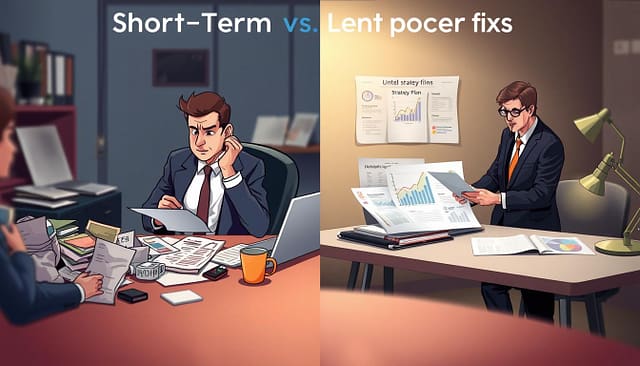
Short- vs. Long-Term Fixes
Choosing between a quick fix and a lasting repair is more than just time. It’s about how you approach the problem. One method might just silence the alarm. The other aims to prevent it from sounding in the first place.
Every seasoned troubleshooter has faced this dilemma. Do you use duct tape or call the engineering team?
The Art of the Quick Win
Let’s talk about the short-term fix. It’s about using the Pareto Principle to solve 80% of the problem with 20% of the effort.
Think of it like using a book to keep a fire door open. It solves the immediate problem. A software hotfix or a machine adjustment that gets things running again? Those are quick wins.
This phase is called “Solution Generation.” It’s all about speed and solving symptoms.
While a smart hack can keep things running, treating it as a permanent fix can lead to process failures.
Engineering the Permanent Solution
Now we move to the long-term fix. This is where you stop using temporary solutions and find a lasting one.
This phase is called “Solution Development.” Ideas are refined, and the goal is to prevent problems from happening again.
For example, a software hotfix becomes a planned update. A machine adjustment leads to a full calibration and new maintenance plans.
This work is less glamorous. It involves redesigning processes, updating documents, and having tough conversations. It breaks down big problems into smaller, manageable parts—a key problem-solving technique for lasting improvement.
The long-term fix asks, “What in our system allowed this to happen?” It builds resilience, not just quick fixes.
The Cost-Benefit Analysis You Can’t Ignore
So, how do you decide? Let’s look at the facts.
- Short-Term Pros: Quick relief, little downtime, low initial cost.
- Short-Term Cons: Technical debt, hidden costs, risk of problems coming back.
- Long-Term Pros: Systemic improvement, prevents future issues, often cheaper in the long run.
- Long-Term Cons: Higher upfront cost, longer time to implement, needs stakeholder support.
The best approach? Use short-term fixes as a bridge, not a permanent solution. Plan for the long-term fix before the quick fix fails.
Use technology to track which temporary fixes are lasting. That list will guide you in preventing process failures.
True problem-solving maturity is knowing when to use each approach. It’s finding the right balance between quick fixes and lasting solutions. Both are needed, but only one builds something that lasts.
Consultant-Led Problem Solving
In business, consultants are like directors, turning chaos into order. They help teams solve problems together, not just one person. This way, everyone’s ideas are heard and solutions are found faster.
A good facilitator is like a guide for your brain. They use process architecture to help teams work together better. This turns the team’s differences into strengths.
Methods like Lightning Decision Jam (LDJ) and Design Sprint 2.0 help teams work fast. They start with ideas, then pick the best ones quickly. This way, teams can focus on making things happen, not just talking about it.
This approach is key for solving big problems. It gets everyone involved from the start. When teams work together, they can really make a difference.
The Facilitator’s Toolkit: From Six Hats to World Cafe
Facilitators use tools like Edward de Bono’s “Six Thinking Hats.” This method helps teams see things from different angles. It stops them from just thinking the same way.
The “World Cafe” method is like a speed-dating for ideas. Teams share ideas in small groups, building on each other. It helps find patterns that might be missed in regular meetings.
Today, humans and technology work together well. AI does the basic work, so humans can focus on the important stuff. The consultant leads the team, with AI supporting them.
From Discussion to Decision: The Accountability Engine
The biggest problem in solving problems is not having enough ideas. It’s making decisions. Consultant-led methods make sure teams make clear plans and set deadlines.
This approach is great for growing technical support teams. It helps figure out how to handle new problems quickly. The consultant makes sure the right people are involved and knows what to do next.
For those wanting to learn these skills, there are guides like structured problem-solving guides. The goal is to learn these skills so teams can solve problems on their own.
Consultant-led problem solving shows that groups can be smarter than one person. It’s about working together well. When solving big problems, having a leader is key.
Documentation Practices
Writing things down is like eating your veggies. It’s good for you, but not always exciting. Yet, it’s key to keeping knowledge alive in your team.
Poor documentation is a big problem. It wastes your team’s time and sanity. It makes solving problems today feel like doing it again tomorrow.

From Graveyard to Living System
For years, knowledge bases were where ideas went to die. But now, they’re a place where teams can grow together. A good knowledge base is like a living brain for your team.
When you add context to your solutions, it gets even better. AI can help by analyzing past problems and finding solutions fast. This turns firefighting into proactive work.
The Sage’s True Lesson: Clarity and Legacy
Documentation isn’t just for keeping records. It helps your team think clearly. Writing down what happened forces you to understand it better.
This turns secret knowledge into something everyone can use. It helps new team members learn without starting from scratch. They just need to know where to look.
| Documentation Type | Primary Purpose | When It Shines | Common Pitfall |
|---|---|---|---|
| Post-Mortem / Incident Report | Learning from failure. Documents the timeline, root cause, and corrective actions for a major incident. | Preventing repeat incidents. Building institutional memory around system weaknesses. | Becoming a blame-storming session instead of a learning opportunity. |
| Runbook / Standard Operating Procedure (SOP) | Enabling repeatable action. Provides step-by-step instructions for common tasks or recovery procedures. | Handling emergencies. Training new team members. Ensuring consistency. | Becoming outdated and dangerous if not updated. |
| Integrated Knowledge Base Article | Enabling self-service. Offers solutions and guides for common issues, often linked to ticket systems. | Scaling support. Deflecting repetitive tickets. Empowering end-users. | Being disconnected from daily tools. |
| Architectural Decision Record (ADR) | Capturing context for decisions. Explains the “why” behind a major technical choice at a point in time. | Onboarding engineers. Preventing old debates from resurfacing years later. | Being too technical and losing the narrative. |
Before moving on from a problem, think if you’ve really won. Documentation is key to keeping your team’s knowledge safe. It turns a group of smart people into a truly intelligent team.
Case Examples
Let’s dive into two digital mysteries that show the messy art of problem-solving. Theory gives us a map, but reality often throws us into the jungle without a compass. These stories aren’t just about fixes; they’re about the full, frustrating, and enlightening arc of intelligent troubleshooting.
The Phantom Slowdown: A Web App Mystery
A SaaS application used by thousands starts crawling every Tuesday afternoon. Users rage-tweet. The support team’s go-to move? The classic “turn it off and on again” reboot of the main services. It worked. For about a week.
This is where consultant-led troubleshooting enters, stage left. Instead of accepting the quick fix as a victory, we treated the symptom like a clue. We deployed a classic 7-step process, starting with defining the problem precisely: “Intermittent latency spikes on Tuesdays between 2-4 PM, correlating with user load.”
Log analysis became our detective’s notebook. We saw memory consumption graphs that looked like a cardiogram for a panic attack. Using the “5 Whys” technique, we drilled down:
- Why did the app slow? Memory was exhausted.
- Why was memory exhausted? A specific background job was leaking.
- Why was it leaking? A third-party analytics plugin had a flawed caching mechanism.
- Why did it only fail on Tuesdays? Tuesday was the day for bulk data syncs from client systems, triggering the plugin’s bug.
The long-term fix wasn’t just patching the plugin. We replaced it entirely and implemented automated memory monitoring with alert thresholds. The documentation? We created a new runbook titled “Tuesday Troubleshooting” that future engineers could follow. The lesson? A quick restart is a band-aid. Real troubleshooting finds the wound.
The Email Blast Fiasco: When Automation Goes Rogue
Our second case is a masterclass in human-system failure. A marketing team’s “Welcome” email blast went out to 50,000 existing customers, including some who had been with the company for a decade. Cue the confusion and the angry replies.
The immediate, face-palm fix was an apology email. Necessary, but about as effective as putting a “Wet Floor” sign up after everyone has already slipped. The real troubleshooting began by asking not “what broke?” but “how was this even possible?”
We facilitated a root cause analysis session that felt more like a therapy circle for the marketing and tech teams. Mapping the workflow revealed the horror: an approval process that relied on a single checkbox in their CRM, with no segregation of duties or final review. Ownership was so diffuse, everyone thought someone else had clicked “verify.”
The solution was a redesigned process, built using a Design Sprint methodology. We mapped every touchpoint, identified failure nodes, and implemented guardrails: a two-person approval rule, mandatory audience segment reviews, and a final “confirmation screen” that blatantly listed the recipient count and criteria.
This case underscored that troubleshooting isn’t just for servers and code. Flawed processes are just as breakable. The documentation output was a visual workflow diagram posted on the team’s wall—a constant reminder of the cost of ambiguity.
| Aspect | The Phantom Slowdown | The Email Blast Fiasco |
|---|---|---|
| Primary Symptom | Intermittent application latency | Incorrect customer communication |
| Short-Term Fix | Service restart | Apology email |
| Root Cause | Memory leak in third-party plugin | Flawed approval workflow & unclear ownership |
| Long-Term Solution | Plugin replacement & automated monitoring | Redesigned process with guardrails & checks |
| Key Lesson | Monitor for patterns, not just outages | Clarity in process prevents human error |
So, what do these tales teach us? Effective troubleshooting is a narrative. It starts with a symptom, delves into a detective story using structured methods like the 5 Whys, and ends with a resolution that changes the system itself. It blends the immediate need to stop the bleeding with the strategic vision to prevent future wounds. Whether you’re chasing a phantom in your server logs or a typo in a workflow, the principles remain the same: be curious, be structured, and never stop at the first answer.
Conclusion
So, what’s the final diagnosis after our tour through the troubleshooting ward? We started in panic, but we leave with a blueprint. True problem-solving isn’t a frantic search for bandaids; it’s the architectural planning of resilient systems.
The method is clear. You dissect with Root Cause Analysis, then build back better. You apply the tactical tourniquet of a Short-Term Fix, but your real mission is the permanent cure. This is where consultant-led thinking shines, turning chaos into a structured playbook. Every solved case, documented in tools like Confluence or Notion, becomes a vaccine against future outbreaks.
In today’s complex digital ecosystem, this disciplined approach is your only real edge. Superior technical support has evolved. It’s no longer a help desk reciting scripts. It’s a strategic function that designs out flaws before they crash the party. It uses every tool, from old-school checklists to new AI co-pilots, not to find quick answers, but to build lasting wisdom.
The goal is simple but profound: stop reacting to process failures. Start engineering them into oblivion. Build the fireproof building instead of just stocking more extinguishers. That’s the enlightened path from reactive janitor to proactive architect. Your move.


