
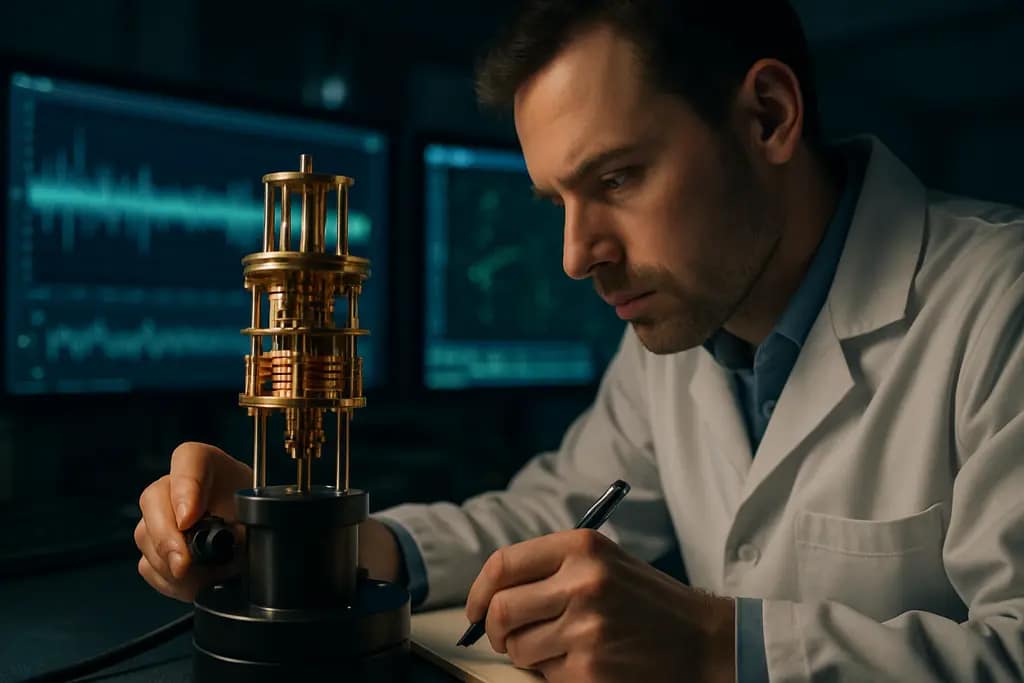
Quantum sensors moved from a broad research promise to a more specific nuclear-monitoring result on September 10, 2026, when NIST reported improved X-ray energy measurements for uranium, plutonium, and neptunium. The finding matters because safeguards work depends on distinguishing emissions from different nuclear materials, but the evidence should be read as a measurement advance rather than a complete field-deployed safety system.
The most concrete result came from superconducting transition-edge sensors, or TESs, used to measure X-ray emissions from actinides. NIST reported that the work reduced uncertainty in those X-ray energy readings by one-third to one-eighth compared with previous methods, improving the ability to separate those emissions from gamma rays in nuclear safeguards contexts, according to the agency’s September 2026 report.
What Quantum Sensors Changed In Measurement
Quantum Sensors And Actinide X-Ray Readings
The NIST result is best understood as a precision measurement advance. Uranium, plutonium, and neptunium can emit X-rays whose energies help analysts infer material composition. If the measured energy values carry lower uncertainty, analysts have a better technical basis for separating relevant X-ray lines from nearby gamma-ray signals. That distinction is useful in nuclear safeguards because the task is not merely to detect radiation, but to interpret what type of material produced it.
The research was published in Physical Review Letters on September 10, 2026, based on the research notes provided. That publication route indicates a formal scientific result, but it does not by itself establish that every nuclear facility can adopt the method at scale. The reported improvement is in measurement uncertainty, not a reported full-system performance figure for routine inspection campaigns, emergency response, or unattended long-duration monitoring.
Why Lower Uncertainty Matters For Safeguards
In safeguards and safety work, small differences in spectral interpretation can affect how quickly analysts classify materials or decide whether additional measurements are needed. A lower-uncertainty reference for X-ray energy can support faster and more precise material assessment in weapons-facility and reactor-related settings. The cautious reading is that better reference measurements improve the analytical foundation; they do not remove the need for calibration, chain-of-custody controls, facility procedures, and independent verification.
NIST has also deployed arrays of these TES detectors at multiple national laboratories and research facilities, including SLAC at Stanford, Argonne’s Advanced Photon Source, Brookhaven’s National Synchrotron, Los Alamos National Laboratory, and CERN, according to the research notes. That breadth suggests the technology has moved beyond a single isolated experiment. It still remains distinct from a compact commercial instrument installed across routine safeguards sites.
Where The Evidence Is Strongest
Laboratory Networks Versus Operational Sites
The strongest evidence in the 2026 record is for measurement science under expert institutional control. National laboratories and major research facilities can support specialized detector operation, controlled data collection, and expert interpretation. That is a meaningful step, especially for standards work, but it is not the same as widespread operational use in industrial plants, border environments, or remote monitoring stations.
This distinction affects investment decisions. A facility considering new radiation-monitoring capability would need to examine operating requirements, maintenance access, data handling, staff training, calibration practices, and compatibility with existing safety systems. The available evidence supports further evaluation of these tools; it does not support treating them as a drop-in replacement for established radiation detection and nuclear material accountancy methods.
Relationship To Space-Based Detection
The 2026 record also includes established national-security monitoring programs that are not the same as laboratory TES measurement work. On July 23, 2026, the U.S. National Nuclear Security Administration delivered its fifth next-generation Global Burst Detector payload for a GPS satellite, supporting above-ground nuclear detonation monitoring as part of a long-running detection framework, according to the Department of Energy’s NNSA announcement.
That payload is relevant because it shows that nuclear monitoring is not one technology category. Space-based burst detection, laboratory reference measurement, and facility-level safeguards each serve different operational needs. Treating all of them as one system would blur the technical questions. A detector designed for global detonation monitoring is assessed differently from an instrument intended to refine actinide X-ray reference values.
Implementation Barriers Remain Material
Scale, Cost, And Facility Integration
The main implementation barriers are not only scientific. Scaling a promising detector into routine nuclear-safety use requires reliable packaging, repeatable calibration, validated data workflows, cybersecurity planning for connected instruments, and trained staff. Cost also matters, especially if a technology needs specialized infrastructure or expert operators. The research notes do not provide procurement prices, lifetime maintenance costs, or mean-time-between-failure figures, so any economic comparison would be premature.
For manufacturers and nuclear-technology suppliers, the practical test is whether a sensor improves a defined decision point. Better measurement accuracy has value only if it supports a documented task: material verification, alarm adjudication, inspection planning, safety assessment, or standards development. A recent related analysis on nuclear monitoring evidence makes a similar distinction between promising measurement results and deployment limits.
- What decision would the sensor improve, and who acts on that result?
- Has the measurement method been validated under the expected operating conditions?
- Can the facility maintain calibration, data quality, and traceability over time?
- Does the instrument fit existing radiation-safety, cybersecurity, and inspection procedures?
Room-Temperature Claims Need Separate Review
The research notes also point to activity outside national laboratories, including room-temperature NV-diamond sensor announcements and fieldable nuclear magnetic resonance sensing platforms. These developments may reduce deployment friction in some environments, especially where avoiding cryogenic cooling is valuable. Still, announcements and early platforms need separate validation for nuclear-monitoring use cases. Magnetic-field sensitivity, chemical identification, or temperature response does not automatically translate into qualified nuclear safeguards performance.
A broader August 16, 2026 review in Sensors and Actuators A: Physical, as summarized in the research notes, found that technology readiness varies by sensor class. Optical lattice clocks and SQUIDs were described as higher readiness, while NV-diamond magnetometers and Rydberg RF sensors remained largely in laboratory or early experimental stages. That range is a useful warning against treating the field as uniformly mature.
Nuclear Safety Implications For Buyers

Standards Work May Be The Nearer Payoff
For many organizations, the nearer payoff may be improved reference data and standards work rather than immediate replacement of existing monitors. If actinide X-ray energy values are known with lower uncertainty, instrument developers and safeguards analysts may have a stronger basis for calibration and spectral interpretation. That can improve the quality of future systems, even before the underlying detector technology becomes practical for broad deployment.
This is where careful procurement language matters. A request for proposals should not simply ask for advanced sensing. It should specify the measurement target, operating setting, validation requirements, reporting format, maintenance expectations, and acceptance tests. Vendors and laboratories can then show whether a given sensor has evidence for that job rather than relying on general claims about quantum measurement.
Policy Interest Does Not Equal Technical Readiness
The UNIDIR expert discussion on April 22, 2026, as summarized in the research notes, indicates that governments and policy analysts are paying attention to quantum sensing, computing, and communication in the nuclear domain. Magnetometers and gravimeters were named as relevant technologies. Policy interest is reasonable, but it should not be confused with deployed technical capability. Verification regimes require repeatable evidence, agreed procedures, and confidence across parties, not only promising physics.
For readers interested in additional insights on scientific advancements in the nuclear domain, visiting Li Live Steam could provide valuable related information. In nuclear monitoring, though, the evidence standard must remain strict: each claimed improvement needs a defined measurement task, a known operating environment, and a clear comparison with existing methods.
Quantum Sensors In Nuclear Safety Decisions
Quantum sensors have shown a credible measurement gain for actinide X-ray analysis, especially through the September 10, 2026 NIST work on TES detector measurements. The result is scientifically significant because it reduces uncertainty in data that can support nuclear-material interpretation. It is not, based on the available evidence, proof that a new class of safety instruments is ready for broad operational deployment.
The practical implication is measured adoption. Laboratories, standards bodies, and safeguards organizations can use the improved data to refine reference values and test instrument concepts. Facility operators should ask narrower questions: whether the sensor has been validated for their radiation environment, whether it integrates with existing safety systems, and whether its cost and maintenance demands are justified by a specific monitoring decision.
The strongest 2026 evidence supports a careful middle position. The science has advanced, the nuclear-monitoring relevance is real, and the path to routine use still depends on validation, integration, and operational discipline.


