

AI Thermoelectric Materials are drawing attention because they connect two difficult tasks: finding compounds with useful transport behavior and designing devices that can convert heat gradients into usable electrical output. As of September 28, 2026, the evidence supports faster screening, better prediction, and more informed generator design. It does not yet support broad claims that these methods have solved cost, scale, durability, or manufacturing barriers.
The practical interest is clear. Heat losses remain a persistent concern in industrial systems, electronics, vehicles, and power equipment, but thermoelectric materials have historically faced trade-offs among electrical conductivity, thermal conductivity, and the Seebeck coefficient. Recent AI work tries to search those trade-offs faster than conventional trial-and-error or slow simulation workflows. The question for manufacturers is not whether AI can rank candidates. It is whether those rankings can move through validation, device assembly, and production controls without losing performance.
What AI Thermoelectric Materials Actually Change
AI Thermoelectric Materials As A Screening Tool
AI models can compare large sets of candidate materials and estimate properties tied to thermoelectric performance. The most useful models are not just black-box ranking systems; they can help researchers test whether a descriptor, defect pattern, composition, or geometry is likely to matter before scarce lab time is spent on synthesis and measurement.
The stronger implication is workflow efficiency. If a model can reduce the number of weak candidates sent to the lab, research teams can reserve equipment time for better-defined experiments. That is a meaningful gain, but it is still a research-stage gain unless the predicted material can be synthesized reproducibly, measured under relevant temperature gradients, and built into a device with stable contacts and repeatable geometry.
This pattern is not unique to thermoelectrics. A similar caution appears in AI design for solid-state electrolytes, where computational search can widen the candidate pool while physical validation still decides whether a material is useful. The same discipline applies here: model quality matters, but materials engineering remains experimental.
Why The Current Evidence Is Promising But Narrow
The recent findings show that AI can support both material discovery and generator design. They do not show that high-volume production is solved. Performance metrics reported in papers often come from controlled datasets, simulations, or specific device configurations. Those settings are valuable because they isolate technical variables, but they may not capture contact degradation, thermal cycling, module packaging, supply constraints, or maintenance conditions.
For plant-level energy efficiency, the gap between a candidate material and a deployed heat-recovery product can be wide. A generator must be placed where the temperature difference is useful, where heat flow does not interfere with the main process, and where electrical output justifies installation and upkeep. AI can improve selection and design decisions, but the installation case still depends on the site.
Evidence From Device-Level AI Models
What The May 2026 TEGNet Result Shows
One of the more concrete 2026 results came from work on TEGNet, a framework for thermoelectric generator design. The study reported more than 99% accuracy in predicting generator performance and about 0.01% of the compute time required by conventional solvers. It also reported conversion efficiencies above 9% for segmented-leg devices and about 8.7% for n-p paired generators in near-room-temperature systems, according to Nature Reviews Electrical Engineering.
Those figures matter because device design is not only a materials problem. Segmenting legs, pairing n-type and p-type elements, and selecting geometry all affect output. Faster prediction can help researchers test more design cases before committing to fabrication. For manufacturers, that could shorten the path from candidate material to prototype module, provided that the underlying inputs match real operating conditions.
The careful reading is that this result strengthens the case for simulation-assisted thermoelectric design. It does not mean a factory can treat thermoelectric recovery as an off-the-shelf efficiency measure. The reported performance sits within the scope of the tested designs and assumptions. Industrial waste-heat streams may include vibration, fouling, intermittent duty cycles, difficult mounting surfaces, or maintenance access limits. Those factors can shift the engineering case even if the modeled device is strong.
Defect Engineering Is Still A Trade-Off Problem
Why Defects Cannot Be Optimized In Isolation
Thermoelectric performance often depends on controlled disorder, composition, grain boundaries, and related defects. AI is being used to search those variables, but defect engineering is inherently a balancing exercise. Improving one transport property can hurt another, and models need enough valid data to avoid recommending changes that look attractive numerically but fail in fabrication or testing.
A review published on September 4, 2025 described the use of deep neural networks, graph-based models, and transformer architectures for defect engineering in advanced thermoelectric materials. The review focused on composition, disorder, grain boundaries, and related defect features while stressing trade-offs in transport behavior, as shown in the Oak Ridge National Laboratory record.
That framing is useful for assessing AI Thermoelectric Materials because it treats AI as a decision aid, not as a substitute for materials science. A model may identify a promising defect pattern, but engineers still need to test phase stability, processing repeatability, joining methods, and long-duration performance. Defects that improve a measured property in a coupon may also create reliability concerns when the material is cycled under load.
Scale, Cost, And Manufacturing Limits
Manufacturing Questions Still Dominate
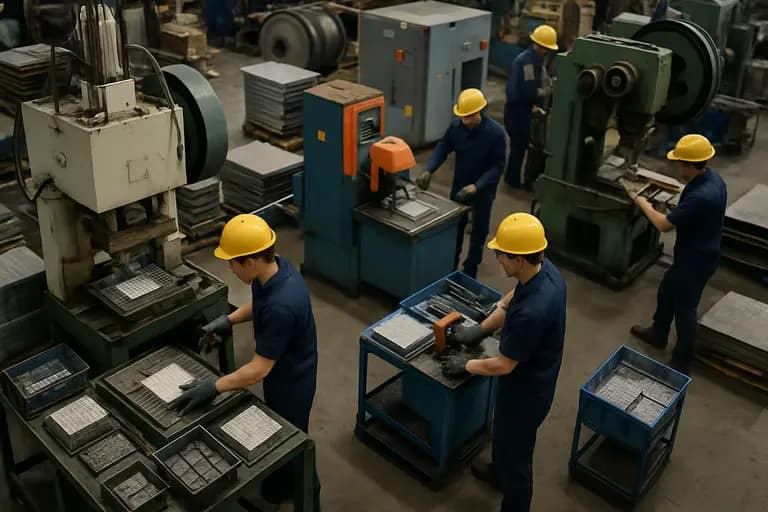
Thermoelectric devices require more than a strong material. They need repeatable synthesis, shaped legs or films, electrical interconnects, thermal interfaces, insulation, packaging, and quality inspection. If AI points to a candidate that depends on difficult processing or sensitive composition control, the cost curve can erase the expected energy benefit.
Several practical questions should be answered before AI-derived candidates are treated as deployable energy-efficiency assets:
- Can the material be made consistently at the size and purity required for modules?
- Does the device keep performance after thermal cycling and mechanical stress?
- Are contact resistance, bonding, and packaging losses included in efficiency estimates?
- Does the heat source provide a stable enough temperature difference to justify installation?
- Are raw materials, processing controls, and end-of-life handling acceptable for the intended market?
These questions are not objections to AI-driven thermoelectric work. They are the boundary conditions that decide whether a lab result has industrial value. A model that reduces compute time or improves screening can still be useful even if commercialization remains uncertain. It can narrow experiments, guide materials selection, and help device teams avoid low-value design iterations.
For those interested in a broader science discussion, SGTT can offer interesting insights here that align with a manufacturing-focused analysis. The key standard here remains evidence quality: reported performance should be tied to the test setting, not generalized beyond what the study demonstrated.
AI Thermoelectric Materials For Energy Efficiency
The energy-efficiency case for AI Thermoelectric Materials is credible but still conditional. The strongest evidence points to better prediction, faster screening, and more capable generator design workflows. The weaker part of the case is deployment: cost, reliability, material availability, module packaging, and site-specific heat integration still need proof at scale.
A cautious interpretation is that AI will most likely help thermoelectrics first by improving research productivity and prototype design. It may help identify candidates that would be missed by narrower experimental searches, and it may reduce the time needed to compare generator architectures. Those are important gains, but they should be described as enabling evidence rather than a finished efficiency solution.
For manufacturers, the near-term value is likely in targeted evaluation. Facilities with stable waste-heat streams, accessible mounting points, and clear electrical-use cases may have a stronger reason to monitor validated thermoelectric modules. Facilities with variable heat, severe contamination, or difficult maintenance conditions should be more cautious. In both cases, AI can improve the search process, but measured field performance will decide whether the efficiency gain is real enough to justify adoption.


