
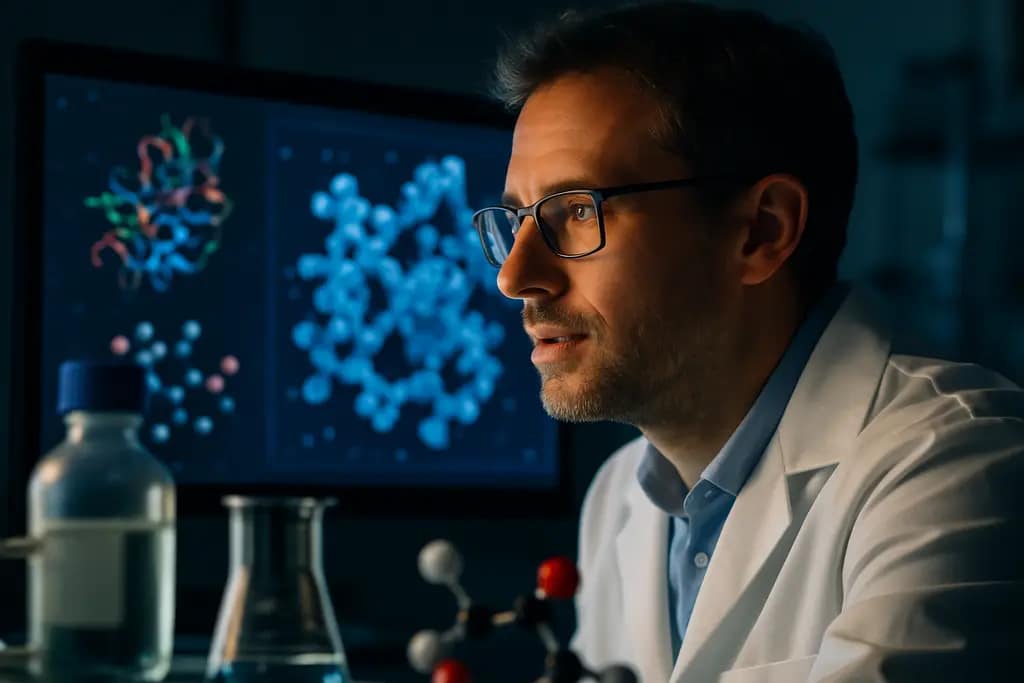
AI Reaction Pathways are becoming a more serious research tool for solid-state material discovery because recent models are beginning to address a harder question than property prediction alone: not just which compound may be useful, but how it might form under synthesis conditions. The 2026 findings reviewed here remain largely computational, early-stage, or lab-validated in specific systems. They do, however, indicate a shift toward modeling intermediates, diffusion, impurities, and reaction selectivity with more direct relevance to experimental synthesis planning.
For manufacturers and applied R&D teams, the significance is practical but not settled. Faster pathway screening could reduce wasted experiments, narrow candidate recipes, and expose kinetic barriers earlier. The evidence does not show that AI can reliably design scalable production routes on its own. Scale-up, interface behavior, defect chemistry, data quality, and experimental confirmation remain the main constraints.
Why AI Reaction Pathways Matter Now
From Candidate Materials To Candidate Routes
Many materials AI workflows have focused on predicting properties, stability, or structure. Those tasks can help identify candidates, but solid-state synthesis depends on whether atoms can move, which intermediate phases appear, and whether competing products form under practical processing conditions. That is why pathway modeling is receiving closer attention in 2026.
On August 3, 2026, researchers at Lawrence Berkeley National Laboratory reported a model that combined thermodynamics with machine-learning-predicted atom diffusion to simulate full solid-state reaction pathways in minutes. In tests on barium-titanium oxides, the approach reportedly reproduced patterns consistent with decades of experimental synthesis data, including intermediate phases and impurities. That does not establish general performance across all chemistries, but it shows why route-level prediction is being treated as a separate problem from material screening.
The practical value of AI Reaction Pathways is that they can connect computational selection with synthesis planning. If a model can identify likely dead ends, impurity routes, or temperature-dependent formation sequences, experimental teams can test a smaller set of more defensible conditions. The industrial implication is not automatic discovery; it is better triage before time, furnace capacity, precursor inventory, and characterization resources are committed.
What The 2026 Findings Show
Diffusion, Intermediates, And Impurity Prediction
The Berkeley work is notable because it included atom movement, not only thermodynamic preference. Solid-state reactions are often limited by diffusion and local chemistry, so the lowest-energy product is not always the phase that appears first or dominates under a given schedule. A related 2026 study on ion correlations in the Ba-Ti-O system incorporated machine-learning-derived transport properties into a cellular reaction model to account for diffusion-limited effects. The reported goal was to predict which phases form over time and temperature for different ratios.
Those findings support a cautious interpretation: kinetics and thermodynamics need to be modeled together when synthesis planning is the target. A model that ranks compounds by stability can still miss a reaction path if it omits transport, local phase competition, or processing history. AI Reaction Pathways can address part of that gap, but only when the training data, physical constraints, and validation systems match the chemistry being studied.
AI Reaction Pathways And Kinetic Selectivity
A June 15, 2026 study in Materials Horizons assessed machine-learning models for predicting whether hypothetical solid-state compounds are synthesizable. The reported finding was cautionary: many models overpredicted synthesizability, and model scores correlated weakly with thermodynamic heuristics unless reaction selectivity was included. For applied teams, that means a high model score should not be treated as evidence that a material can be made under usable conditions.
Reaction pathway generation is also advancing outside the narrow category of solid-state synthesis. In a Nature Communications paper published on July 17, 2026, the MolGEN framework used deterministic flow matching to generate transition states and reaction products. In a decomposition network for γ-ketohydroperoxide, it identified a lower-barrier pathway using 12 quantum-chemistry evaluations rather than 1,156, according to the Nature Communications study. That result was not a direct demonstration of scalable ceramic or battery-material production, but it indicates how pathway-generation methods may reduce expensive computations in chemistry problems where transition-state searches are a major cost.
Synthesis Recipes And Closed Feedback
Several 2026 studies also moved toward recipe generation. On August 10, 2026, a large-language-model framework used data from 4,407 open-access solid-state synthesis papers to build a recipe dataset. With retrieval-augmented generation, it proposed recipes for unreported oxy-selenide solid-state electrolytes, which were then synthesized through iterative model-experiment feedback. A June 20, 2026 system called Synthesis-GPT used a multi-agent language-model workflow over curated literature to extract stoichiometrically accurate synthesis routes and performance descriptors, supporting route recommendation and recipe guidance for high-conductivity solid electrolytes.
Those reports align with broader work on AI design for solid-state electrolytes, where computational screening must still meet interface, conductivity, stability, and manufacturability tests. A June 2026 preprint described a framework for integrating machine-learning interatomic potentials, language models, and closed-loop simulation-experiment feedback for solid electrolytes, while emphasizing unresolved issues such as interfacial stability, defect chemistry, and scale-up in solid electrolyte discovery. Because that work is a preprint, its claims should be read as a proposed research framework rather than settled evidence.
Evidence Limits And Implementation Barriers
Preprints, Bench Validation, And Overprediction
The strongest reading of the evidence is that pathway-aware AI is improving research workflows in defined cases. The weaker reading, which should be avoided, is that these systems can now predict any solid-state synthesis route with production-level reliability. The research base includes peer-reviewed studies, preprints, model demonstrations, and lab feedback loops. These are not the same evidence category, and they should not be weighed equally.
Validation remains the central issue. A model can reproduce known Ba-Ti-O behavior, extract recipes from thousands of papers, or reduce quantum-chemistry evaluations in one benchmark without proving transferability to every oxide, sulfide, selenide, or mixed-anion system. Readers who follow evidence standards across this publishing network may recognize the same cautious separation between research findings and practical claims at Wills Glaucoma; the materials research discussed here is not medical guidance and should be assessed within its own technical context.
Scale, Interfaces, And Process Control
Several barriers are especially relevant to manufacturing. The June 2026 solid-electrolyte framework identified interfacial stability, defect chemistry, and scale-up as open challenges. Those topics are not minor details. Interfaces can change electrochemical performance, defects can alter transport, and scale-up can change heating, mixing, diffusion length, and phase evolution. The research notes do not provide plant-level cost models, qualified safety procedures, or production yield data, so industrial adoption cannot be inferred from computational speed alone.
Human-in-the-loop and robotic platforms may help close this gap, but they are still evidence-generating systems. A PRX Intelligence paper published on September 10, 2026 demonstrated SARA-H, which combined robotic synthesis, automated phase identification, and AI agents. Applied to the Bi-Ti-O oxide system, it mapped processing windows that stabilize metastable phases and confirmed that bismuth doping slows the anatase-to-rutile transformation in TiO₂. That result is meaningful for kinetic phase behavior, but it remains a system-specific demonstration rather than a universal synthesis planner.
Industrial Implications For Materials Teams
What Manufacturers Can Test Without Overstating
For industrial R&D groups, the near-term use case is disciplined screening rather than autonomous process design. AI Reaction Pathways can help rank candidate routes, flag possible impurity formation, compare intermediate phases, and suggest experiments that test competing kinetic hypotheses. The value is higher when teams document negative results, feed characterization data back into models, and compare predictions against reproducible synthesis outcomes.
- Use pathway models to reduce the first experimental matrix, not to remove validation.
- Separate thermodynamic stability predictions from kinetic formation predictions.
- Track impurity phases and intermediates as model outputs, not only final target phases.
- Require bench confirmation before treating a generated recipe as a viable route.
- Assess scale-up, interface behavior, and defect chemistry as separate gates.
The cost implication is also narrower than some claims suggest. The Nature Communications result showed a large reduction in quantum-chemistry evaluations for a specific decomposition network, which may lower computational cost in similar pathway searches. It does not quantify savings in furnace time, precursor cost, quality control, safety qualification, or production scrap for solid-state manufacturing. Those measures would need separate studies.
AI Reaction Pathways For Solid-State Material Discovery
A Careful Reading Of The Evidence
The new approach to reaction pathways is best understood as an emerging layer in the materials discovery stack. Property prediction can nominate candidates. Thermodynamics can screen stability. Pathway models can suggest how formation may proceed. Closed-loop experiments can test the predictions and return data to the model. Each layer reduces uncertainty in a different way, but none removes the need for synthesis, characterization, and process qualification.
AI Reaction Pathways should therefore be treated as a promising research method with defined evidence, not as a proven production solution. As of October 7, 2026, the strongest support comes from specific 2026 demonstrations: diffusion-aware pathway simulation in Ba-Ti-O systems, recipe generation from large literature datasets, flow-matching methods that reduce transition-state search costs in a chemistry benchmark, and human-in-the-loop platforms that map kinetic processing windows. The unresolved work is just as significant: broader validation across chemistries, clearer data standards, bias control, reproducible negative data, scale-up studies, and practical cost accounting.
For manufacturers, the prudent path is to use these tools to ask better experimental questions. The models can help identify which pathways deserve attention, which assumptions need testing, and which synthesis routes appear less credible. That is a useful acceleration of scientific work, provided the evidence is kept in view.


