
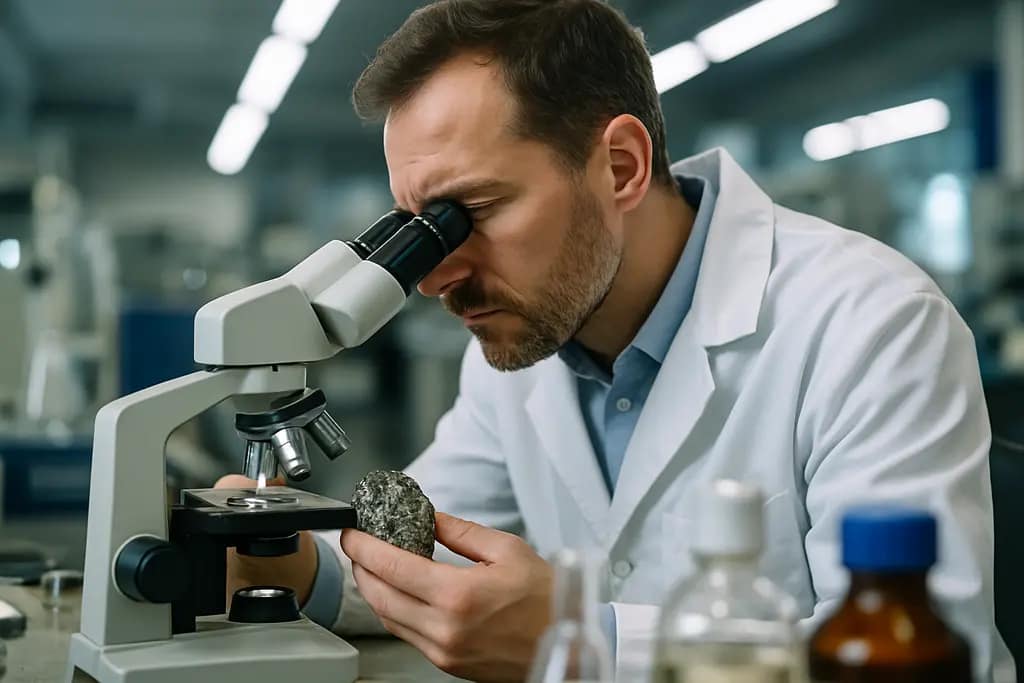
The Genesis Mission awards put federal support behind AI-assisted research in critical minerals, rare-earth recovery, and device-oriented materials design. The practical question for manufacturers is not whether AI is now a proven answer to supply constraints. It is narrower and more useful: which parts of the mineral and materials development process are being tested, what evidence exists so far, and what barriers remain before plant-scale deployment is realistic?
On March 17, 2026, the U.S. Department of Energy issued a Request for Applications for the Genesis Mission, with about $293 million in funding for national science and technology challenges across advanced manufacturing, biotechnology, critical materials, nuclear energy, and quantum information science, according to the DOE funding announcement. By October 6, 2026, the initiative had moved into a Phase I award structure, meaning the work discussed here should be treated as early-stage research rather than field-proven industrial practice.
What Genesis Mission Awards Funded
Genesis Mission awards and the Phase I evidence base
The Genesis Mission awards covered a broad set of AI-for-science projects, including critical minerals and related energy technologies. The research notes identify 278 Phase I projects involving more than 300 institutions, with individual awards ranging from about $500,000 to $5 million. Phase II opportunities were larger, with submission deadlines extending through December 17, 2026. That timing matters: as of October 6, 2026, many projects were still at the proposal-to-early-execution stage, so their expected impact could not yet be judged from operating data.
For manufacturing leaders, Phase I funding is best read as a signal of research direction. It does not show that a recovery route, sensing method, separation process, or device design workflow has reached commercial readiness. It does show where federal labs and universities are testing AI against problems that have direct industrial relevance: locating deposits, separating rare-earth elements, improving selective binding, and modeling mineral recovery processes.
Why the critical minerals focus matters now
The research notes identify “Securing America’s Critical Minerals Supply” as a Genesis Mission challenge announced on September 3, 2026. Its stated scope included AI across the critical minerals supply chain, with rare-earth elements included among the targets. The challenge connected geophysical data, process optimization, and economic modeling, which suggests an interest in linking discovery, extraction, separation, and decision support rather than treating them as disconnected research tasks.
This is relevant to manufacturers because rare-earth elements are tied to components used in energy, electronics, and advanced equipment supply chains. Still, the connection from research award to factory resilience is indirect. Deposit detection does not automatically create permitted mines. A promising separation chemistry does not automatically meet throughput, waste, safety, and cost requirements. Device design concepts still need validation under operating conditions and supply constraints.
Rare-Earth Recovery Research Paths
AI-guided sensing and deposit detection
One named Phase I project, “Multimodal AI Finders for Rare Earth Element Deposits: Texas, the Colorado Mineral Belt, and the Southwest United States,” was led by Texas A&M University. The project used hyperspectral imagery, ground-truth geochemistry, and geo-dynamics for rare-earth deposit detection. The project appears in the official Phase I project list.
The technical value of this kind of work is its attempt to combine different data types. Hyperspectral imagery can identify surface spectral signatures, geochemistry can help verify material composition, and geo-dynamics can add geologic context. AI may help search patterns across these datasets. The limitation is equally clear: detection is not recovery. A mapped target still requires geological validation, resource assessment, environmental review, economic analysis, and eventual engineering design before it could affect industrial supply.
Separation methods and selective binding
Rare-earth separation is difficult because these elements can have similar chemical behavior. The research notes identify an MIT Phase I project titled “AI-Driven Discovery of Electrochemical Separation Methods for Rare Earth Elements,” awarded on July 22, 2026 under RFA DE-FOA-0003612. They also identify University of Washington work on BIND, or Biophysics-Informed Learning of Coordination for Metalloprotein Design, aimed at designing selective metal-binding proteins for rare-earth recovery, environmental monitoring, and radionuclide management.
Brookhaven National Laboratory research described in the notes points to another direction: AI-engineered biomolecules and cells that bind specific rare earth elements such as terbium under ambient conditions. The notes state that this approach is being studied as an alternative to traditional chemistry that may require more than 500 chemical steps, toxic reagents, and high temperatures, with a goal of reducing extraction to fewer than five steps at equal or greater purity.
Those targets are scientifically interesting, but they should be interpreted cautiously. A target for fewer steps is not the same as a demonstrated commercial flowsheet. Selectivity, regeneration of binding materials, impurity tolerance, process control, biostability, waste handling, and throughput all matter. For plant engineers, the key issue is whether a promising separation mechanism can be converted into a controlled, maintainable process that meets quality, safety, and cost requirements.
Device Design And Digital Models
From molecular design to process decisions
The phrase “device design” in this context covers more than a finished product. Some projects focus on designing proteins or electrochemical methods that could become part of a recovery or sensing system. Others use digital twins and AI models to connect physical behavior with operating choices. The Genesis Mission awards therefore sit between laboratory science and applied engineering, with many projects still working on the scientific basis for later process or device development.
PNNL’s Phase I work on AI-driven physics-based digital twins for in situ uranium mining optimization is not a rare-earth project, but the notes describe an analogous workflow for mineral recovery: using site-specific subsurface data to optimize wellfield pumping strategies and lixiviant sweep efficiency. Berkeley Lab-led work described in the notes included digital twins of three mining sites to simulate reactive transport, including fluid flow, solute transport, and chemical reactions for mineral recovery optimization.
These examples show how AI can be used as a modeling aid rather than a stand-alone decision maker. A digital twin is only as useful as the data, assumptions, and validation behind it. Subsurface systems can be heterogeneous, measurement can be sparse, and reaction models may not capture every field condition. Manufacturers assessing similar tools should ask whether the model has been tested against independent data, whether uncertainty is quantified, and how operators would respond when model outputs conflict with plant observations.
Limits for industrial adoption
The Genesis Mission awards raise a familiar manufacturing question: what would it take to move from research funding to dependable production? For rare-earth recovery, barriers include feedstock variability, permitting, material handling, reagent or biomolecule supply, equipment durability, impurity control, safety analysis, and waste management. For device-oriented design, the barriers include repeatable fabrication, qualification testing, material availability, lifecycle performance, and compatibility with existing production systems.
Cost is another open point. The research notes provide award sizes, but not total installed costs for commercial deployment. A lower-step separation pathway could still face capital and operating constraints if the binding material is expensive, regeneration is difficult, or process monitoring is demanding. In the same way, an AI-generated design can be technically promising but unattractive if it depends on scarce inputs or cannot be manufactured at the required tolerance.
- Has the method been demonstrated only in modeling, in the laboratory, or with field data?
- What impurities or feedstock variations were included in testing?
- Does the project report purity, yield, energy use, reagent use, and waste outputs?
- Can the approach be inspected, maintained, and controlled by plant personnel?
- What data rights, cybersecurity, and model governance issues would appear in deployment?
Implications For Manufacturing Productivity
Where manufacturers can learn without overcommitting
For manufacturers, the practical value of the Genesis Mission awards is not immediate substitution of existing supply chains. A more defensible use is early technical scanning. Companies that depend on rare-earth inputs can monitor which approaches move from Phase I concepts into validated separation, sensing, or recovery demonstrations. Procurement teams can track whether alternative recovery methods are likely to affect supply risk, but engineering teams should wait for reproducible data before assuming process availability.
There is also a workforce implication. AI-assisted mineral recovery and device design require collaboration among geoscientists, chemists, materials scientists, controls engineers, data scientists, and production engineers. If research results later move toward pilot plants, manufacturers will need staff who can interpret both process data and model uncertainty. A related discussion of Genesis Mission funding addresses how AI research priorities should be viewed as early evidence rather than completed deployment.
Readers interested in further updates can find more related content at Li Live Steam. Though the connection to this article is mainly editorial, the mentioned platform provides more information within the publishing network.
Genesis Mission Awards For Rare-Earth Innovation
The strongest interpretation of the Genesis Mission awards is cautious but constructive. The awards show that DOE-backed research is testing AI in rare-earth deposit detection, electrochemical separation, selective metal-binding proteins, biomolecular recovery concepts, and digital models for mineral processes. These are credible research directions for critical minerals and device-related materials work.
They are not yet proof of commercial solutions. Phase I projects need validation, scale-up evidence, economic analysis, safety review, and integration studies before manufacturers can treat them as dependable supply or production options. The near-term value is in evidence generation: which methods work under realistic conditions, which fail under impurity or scale pressure, and which can be translated into equipment, controls, and operating procedures. That evidence will determine whether today’s AI-assisted concepts become useful tools for rare-earth recovery and device design after the research phase matures.


