
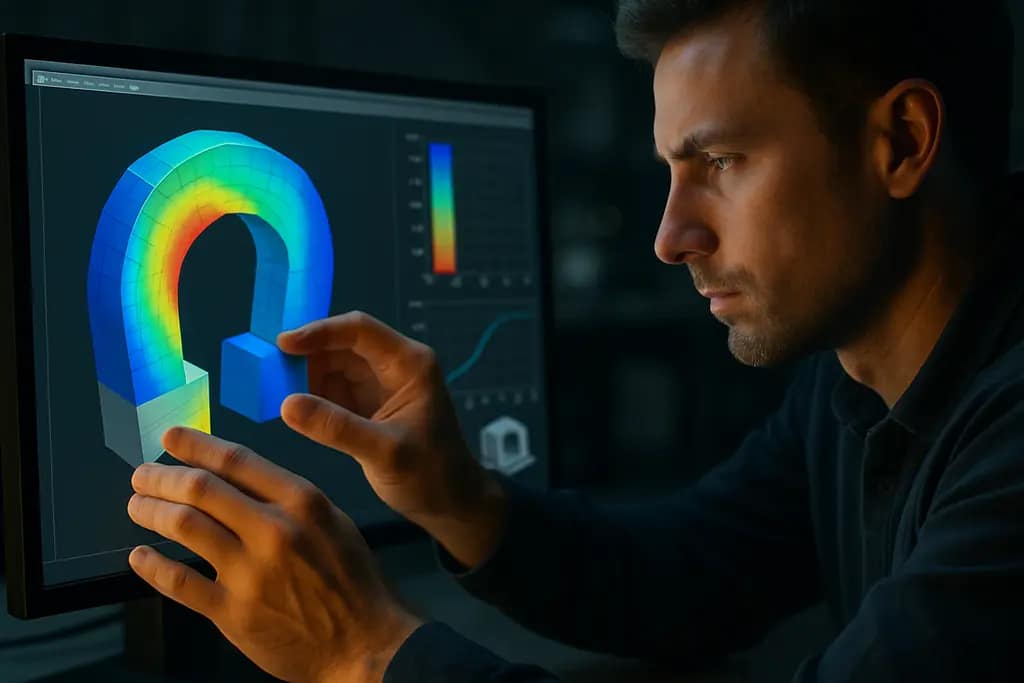
AI Magnet Design is drawing attention because permanent magnets sit inside many industrial systems, including motors that must operate reliably under heat, vibration, and long duty cycles. The research record from 2024 through 2026 suggests that machine learning can narrow the search for rare-earth-free compositions, but it does not yet show a simple replacement path for all rare-earth magnets used in demanding equipment.
The practical issue is not whether algorithms can identify interesting chemistries. They can. The harder question is whether predicted materials can be synthesized consistently, processed into useful magnet forms, retain properties at operating temperature, and meet cost and supply requirements at industrial scale. That distinction matters for manufacturers assessing future motor, generator, robotics, and automation supply chains.
Why AI Magnet Design Is Being Tested Now
Rare-earth-free permanent magnets remain a priority because rare earth supply, processing, and cost exposure can affect industrial users. Research groups are using machine learning, density functional theory, adaptive genetic algorithms, and high-throughput simulations to search wider chemical spaces than conventional trial-and-error screening would allow.
AI Magnet Design Starts With Trade-Offs
AI Magnet Design is useful mainly because magnet performance depends on several linked properties. A candidate material may show attractive saturation magnetization but insufficient anisotropy. Another may look stable in computation but prove difficult to make as a phase-pure material. For industrial use, coercivity, maximum energy product, thermal behavior, mechanical stability, corrosion behavior, and processing route all matter. A model that optimizes one property cannot settle those questions alone.
This is why the strongest research workflows combine prediction with physics-based checks and, where possible, experimental validation. The reported Fe–Co–X searches, including systems where X includes B, C, P, Si, or S, show how algorithms can guide researchers toward narrower candidate sets. In one reported framework, Fe₃CoB₂ was identified as a promising rare-earth-free magnet candidate with saturation polarization around 1.4 Tesla and room-temperature magnetocrystalline anisotropy near 1.0–1.2 MJ/m³. Those numbers are meaningful research signals, but they are not the same as a qualified industrial magnet product.
What Recent Magnet Studies Actually Show
The clearest evidence for machine learning in this field is its ability to reduce search time and rank candidates before expensive synthesis work. A January 2024 study described screening hundreds of rare-earth-free candidate materials with machine learning models before first-principles calculations narrowed the set. Other work reported closed-loop use of machine learning, adaptive genetic algorithms, density functional theory, and experiments to identify Fe₃CoB₂. These are notable because they connect computation with laboratory validation, not just database prediction.
Multi-Property Models Are Relevant But Not Direct Proof
A separate study published on September 1, 2026, in npj Computational Materials used machine learning to predict multiple properties of rare-earth permanent magnet materials, including Curie temperature, residual magnetization, saturation magnetization, coercivity, and maximum energy product. The study reported that 14 of 18 model-and-optimizer combinations achieved R² values above 0.90 for Curie temperature prediction npj Computational Materials study. This supports the idea that models can handle several magnetic-property targets at once.
For rare-earth-free work, however, that evidence should be read cautiously. The September 2026 paper focused on rare-earth permanent magnet materials, not rare-earth-free replacements. Its relevance is methodological: it shows how multiproperty optimization may help researchers reduce rare-earth content or compare trade-offs more efficiently. It does not prove that rare-earth-free materials can match incumbent magnets across all industrial requirements.
Experimental Magnets Are Closer To Application Than Predictions
Laboratory and institutional work has also moved beyond purely computational screening. In May 2025, Ames National Laboratory reported rare-earth-free bonded magnets intended for industrial motors that maintained functional magnetism at elevated temperatures and were designed for many high-temperature industrial uses Ames Laboratory report. This is closer to an application context than a composition screen, because industrial motors impose heat-related constraints that many magnetic materials do not survive well.
Even there, caution is warranted. A bonded magnet format, a laboratory result, or a targeted motor application does not automatically cover the performance envelope of sintered rare-earth magnets in compact high-torque machinery. Industrial qualification typically depends on repeatability, aging behavior, thermal cycling, mechanical loading, manufacturability, and supplier capability. The public research record supports progress, not universal substitution.
Industrial Barriers Beyond The Prediction Model
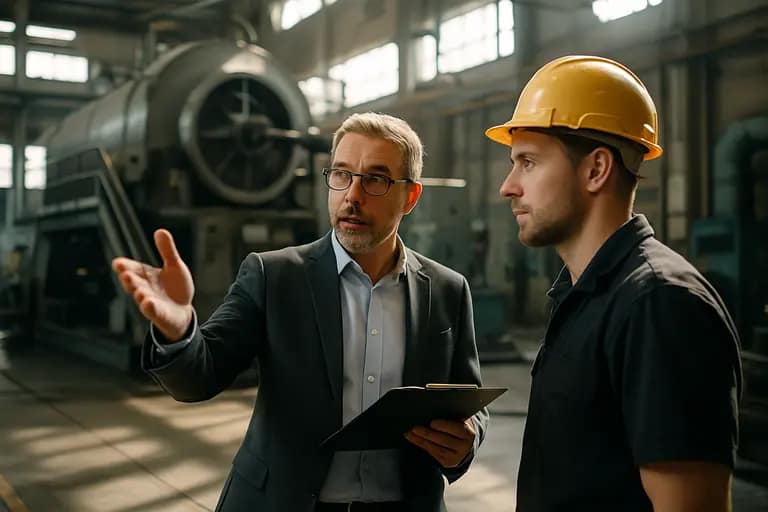
The main implementation barriers are downstream from the algorithm. AI Magnet Design can help rank candidates, but plants do not install predictions. They install parts that have passed materials processing, magnet fabrication, quality assurance, and system-level validation.
Scale And Processing Remain Open Questions
A predicted compound must be made in a controlled and repeatable way. Phase purity, grain structure, binder selection for bonded magnets, alignment, densification route, and heat treatment can change magnetic properties. If a promising material requires narrow processing windows or expensive inputs, its industrial value may be limited even if the computed properties look strong.
Cost assessment is also more complicated than removing rare earths from the formula. Manufacturers must consider raw-material availability, powder production, forming process, magnetization requirements, scrap rate, inspection methods, and integration into existing motor designs. A lower-risk material on paper may require redesigned rotors, changed thermal management, or new supplier controls.
- Model results should be treated as screening evidence, not procurement evidence.
- Experimental validation should include temperature-relevant testing for the intended use.
- Motor-level trials are needed before plant engineers assume direct interchangeability.
- Supply and processing routes should be evaluated alongside magnetic properties.
Safety and environmental questions also need case-specific review. Rare-earth-free does not automatically mean low impact. Boron, carbon, iron, cobalt, nitrogen, and other elements each bring their own mining, processing, worker-safety, and end-of-life considerations. Cobalt-containing systems, for example, may reduce rare-earth exposure while still raising supply-chain and sourcing questions.
AI Magnet Design For Rare-Earth-Free Magnets
AI Magnet Design is best understood as a research accelerator for rare-earth-free permanent magnets, not a finished answer to magnet supply risk. It can sort large chemical spaces, connect predicted structures with magnetic-property targets, and help researchers choose more promising experiments. The strongest evidence comes when computation is followed by synthesis and measured magnetic performance.
For industrial readers, the implication is practical: track the materials that move from prediction to reproducible fabrication, then from samples to component testing. Research claims should be compared against operating temperature, coercivity requirements, energy product, corrosion exposure, mechanical durability, and the cost of changing motor architecture. Readers comparing adjacent industrial technology coverage across this network may also follow the updates provided on Lili Live Steam.
The 2024–2026 research record shows genuine movement in rare-earth-free magnet discovery, especially around Fe–Co–based systems and bonded magnet concepts for industrial motors. The evidence does not yet justify treating these materials as drop-in replacements across all permanent magnet applications. The most defensible view is narrower: AI-guided methods are improving the candidate pipeline, while scale-up, processing, and qualification remain the tests that will determine industrial use.


