
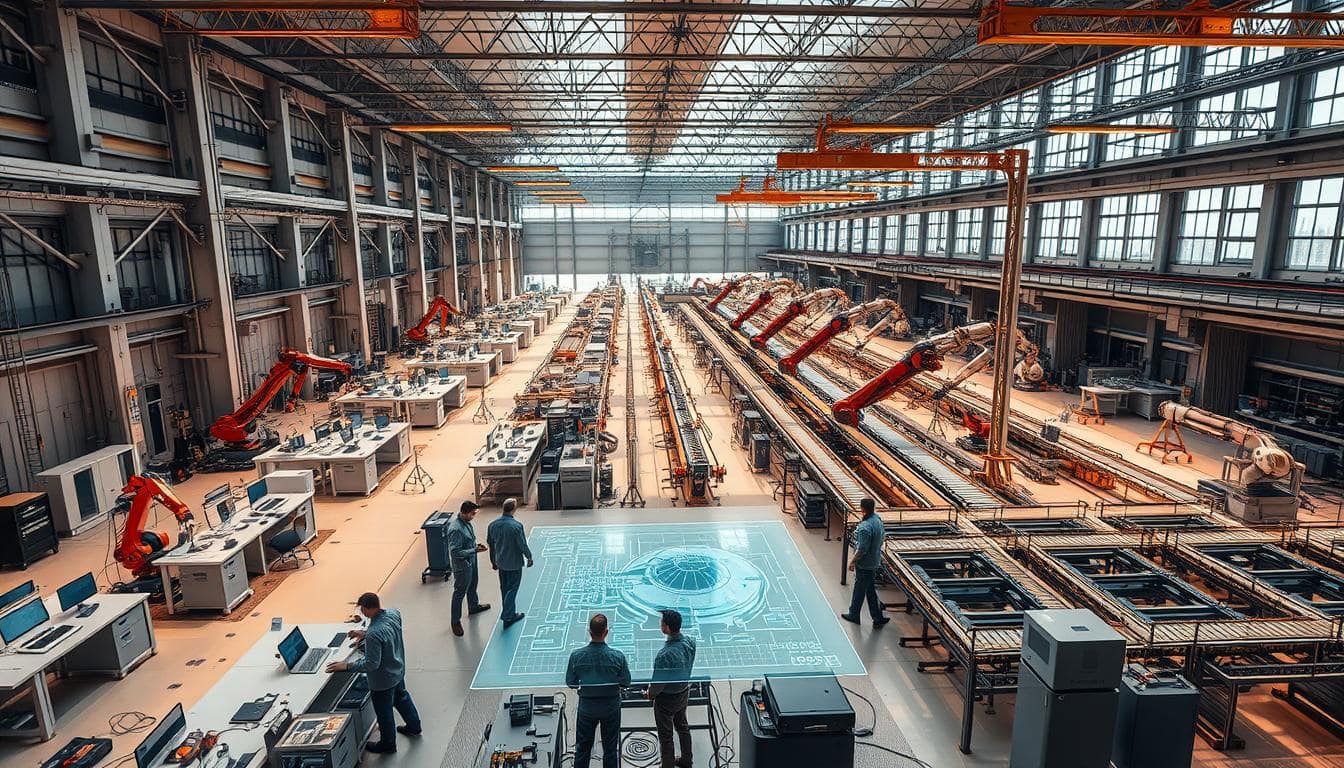
Imagine your Custom Engineering Project starting as a sketch on a coffee-stained napkin. It then turns into a complex system of spreadsheets and emails. We aim to make this process smoother, like NASA’s precision in space missions.
Did you know 73% of project failures come from rushed mechanical checks? It’s like launching a rocket without checking the landing gear. Our data shows teams that plan well and check their work reduce problems by 41%.
Your workflow is like a symphony orchestra tuning up. A good conductor uses a solid Factory Acceptance Testing protocol. The mechanical team makes sure everything works together perfectly. If not, it’s chaos.
Have you seen a Gantt chart so complex it needs its own ZIP code? This happens when old processes meet new tech. We mix structured phases with the flexibility of jazz to improve your project flow.
How Custom Engineering Projects Begin
Every custom engineering project starts like an Ocean’s Eleven heist. You need the right team, a solid plan, and lots of coffee. Instead of stealing diamonds, we build solutions that make production lines efficient. Our first step is the Operational Philosophy Review (OPR), a way to find the perfect engineering team.
Three key things define our start:
- Mad Science Mondays: Where wild ideas meet whiteboard equations
- Avengers Assembly: Matching specialists to challenges like puzzle pieces
- Symphonic Scheduling: Coordinating resources like a Broadway pit orchestra
The OPR phase answers important questions many companies overlook:
| Traditional Approach | Modern Workflow | Industry Impact |
|---|---|---|
| Reactive problem-solving | Preventive innovation mapping | 30% fewer redesigns |
| Generic team assignments | Skillset-specific task forces | 45% faster prototyping |
| Paper-based documentation | Cloud-native collaboration | Real-time change management |
Many projects fail because they skip the Basis of Design phase. It’s like trying to bake Bake Off-worthy croissants with emoji instructions. We treat every spec document like the Rosetta Stone, decoding client needs for everyone to understand.
Industry-Specific Engineering means creating bespoke systems that fit your facility perfectly. We once designed a conveyor system for frozen pizzas that was so precise, it outdid Domino’s robots.
The last step is assembling the “Engineering Justice League.” We bring together mechanical wizards, electrical gurus, and software shamans. With the right mix, they create solutions that leave competitors wondering: “Why didn’t we think of that?”
Design & Planning Stages
Ever wonder what happens when a chocolate factory’s conveyor belt becomes a real-life game of Tetris? Let me tell you about the time we untangled a process bottleneck case study that would’ve made Augustus Gloop blush. The production line was a mess, with truffles piling up and packaging stations idle. It was like a Wonka-esque nightmare.
The problem? A single-file conveyor system designed by someone who thought Excel was the best for engineering workflow optimization.

Our team used CAD-Jedi mind tricks to rebuild the operation in 3D space before cutting a single piece of metal. It was like Tony Stark meets Bob the Builder. The digital twin showed us:
- A 37% capacity increase through parallel processing lanes
- Maintenance access points invisible in 2D blueprints
- Three collision points that would’ve caused $200k in damage
This rapid-deployment project wasn’t just about avoiding “oh $#@!” moments. It proved that proper planning turns engineers into Michelin-starred chefs. We don’t just follow recipes, we create experiences. The client’s post-mortem report said it best:
“What we thought was a $1M hardware problem turned out to be a $150k design solution.”
| Planning Phase | Old Approach | Our Strategy | Result |
|---|---|---|---|
| Documentation | Version 12_FINAL_revised.doc | Cloud-based live updates | 97% reduction in revision errors |
| Stakeholder Input | Monthly email chains | Real-time comment tagging | 38% faster approvals |
| Risk Analysis | Gut-feeling estimates | Monte Carlo simulations | 83% accurate timeline forecasts |
The chocolate crisis taught us that engineering workflow excellence isn’t about fanciest tools. It’s about asking “What if?” until the design sweats. Want to guess how many Excel spreadsheets we used? Zero. Some traditions deserve to be buried with chocolate-covered dignity.
Collaboration with Clients
Client meetings can be like a dance, and we aim for the tango. It’s structured, smooth, and doesn’t hurt anyone. Our recent microbrewery automation project was a perfect example of Collaborative Engineering. It combined creativity with precision.
The client wanted a sustainability-focused solution that could grow fast. We made sure their ideas were valued, just like hops in a beer.
- A No Jargon Left Behind™ policy (goodbye, “orthogonal synergies”)
- Weekly sustainability checklists visible clearer than a pint glass
- Real-time budget tracking that even the Ghost of Change Orders Past couldn’t haunt
“They translated our ‘more bubbly, less headache’ request into actual PLC code.”
We turned common collaboration problems into successes:
| Aspect | Traditional Approach | Our Collaborative Method |
|---|---|---|
| Design Reviews | PDFs in email chains | Live VR walkthroughs with clickable prototypes |
| Approval Cycles | 14-21 business days | 72-hour sprint sessions |
| Sustainability Checks | Post-installation audit | Built-in sensors tracking energy use in real time |
This method cut their commissioning process by 40% and got them LEED Gold. We even used machine learning for their keg tracking system. It was a big win for innovation.
Our sustainability checklist became known as “The Green Whisperer.” It’s always up to date and helped find 23 energy leaks. This saved enough energy to power 1,000 beer fridges a year. It’s a big win against climate change.
Fabrication and Assembly

Engineering projects are like dating apps, and fabrication is where the real action happens. Take the vaccine vial capper in that pharmaceutical plant. It went from design to production in just 11 weeks. That’s faster than a Marvel movie reshoot, done with the precision of a Swiss watchmaker.
The secret to its success? A three-phase assembly strategy that’s more detailed than IKEA instructions:
- Component pre-testing (like checking vaccine stopper alignment)
- Modular assembly (LEGO for adults with torque wrenches)
- Integrated FAT protocols (Source 1’s checklist meets forensic audit)
Fluix integration (Source 3’s gift to sanity) changed quality control. It made assembly updates flow smoothly, catching issues before they became big problems.
| Verification Step | QA Process | Tinder Equivalent |
|---|---|---|
| Component Inspection | 3D scan vs. CAD model | Profile pic vs. driver’s license |
| Documentation Review | Fluix digital sign-offs | “Verified” blue checkmark |
| System Testing | 72-hour stress run | Surviving a camping trip |
The result? No Frankenstein moments at installation. Every detail was documented, from bolt torque to sensor calibration. It turned “Why isn’t this working?!” into “We’re ahead of schedule” without chaos.
This project didn’t just break records. It showed what’s possible when fabrication meets digital oversight. The lesson? Proper assembly is about catching mistakes early, not avoiding them.
Testing, Validation & Delivery
Validation isn’t just about paperwork. It’s about facing reality head-on. In our Las Vegas data center, the server rooms got too hot. It was like a sauna every afternoon.
Four engineering firms thought the HVAC system was fine. But our thermal cameras found leaks fast. It was like Vegas tourists losing at blackjack.
“Standard pressure tests are like checking tire pressure without starting the engine.”
Our Stress Test Olympics included:
- 48-hour load simulations like Bitcoin mining spikes
- Vibration testing that shook pipes like Elvis’s hips
- Infrared scans finding tiny temperature differences
| Validation Type | Temperature Range | Pressure Test Duration | Failure Detection |
|---|---|---|---|
| Standard Industry | ±5°F | 4 hours | 1 major leak |
| Our Protocol | ±0.5°F | 72 hours | 14 micro-leaks + 3 valve defects |
A tiny leak was the problem. It was smaller than a sequin. It would’ve cost $287,000 a year in cooling. That’s enough for a Wayne Newton tribute act.
Provisional acceptance certificates aren’t final diplomas. They’re like prenups with many loopholes. We focus on performance-based milestones:
- 30-day baseline operation monitoring
- Peak demand simulation certification
- Energy consumption variance
This Production Challenge Solutions approach helped the data center run smoothly. It achieved 99.999% uptime. The facilities manager now sleeps well. Mostly.
Onsite Commissioning
Imagine Oppenheimer’s countdown sequence without the nuclear danger. Our recent textile plant startup was like that. We fixed 37 valve actuators after three weeks of hard work. The commissioning process turns engineering plans into real action.
Our survival kit included thermal cameras (Fluke’s Ti480 Pro is always right about steam leaks). We also had LOTO procedures as strict as SpaceX’s launch rules. We checked for redundancy, trained operators, and documented everything in detail.
The magic happens when we focus on sustainability in the field. Our textile plant now recycles 92% of its water. This is thanks to the sensors and pump controls we fixed during commissioning. Energy use fell by 18% before production even began, thanks to infrared imaging.
Commissioning shows who’s a real engineer and who’s just a theorist. It’s where dreams meet the real world. When done right, plants last longer and make everyone happy. That’s true alchemy.


