
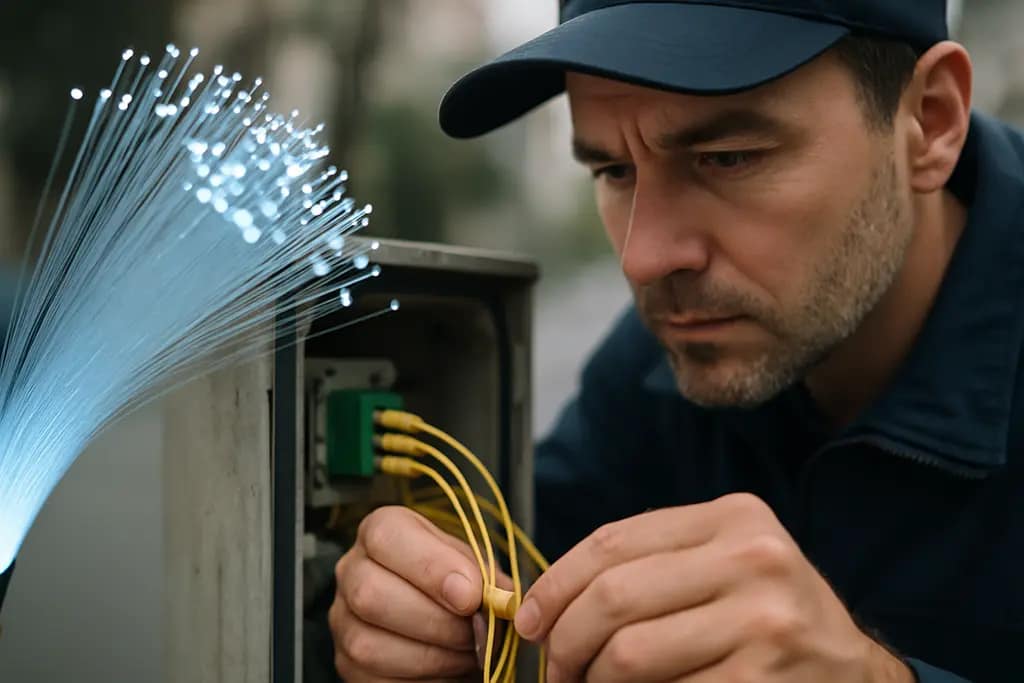
Quantum entanglement in urban fiber networks moved from controlled laboratory links toward field-tested metropolitan infrastructure in several reported demonstrations during 2026. The evidence does not show a finished commercial utility network, but it does show that entangled photons can be distributed through deployed fiber under real environmental conditions when stabilization, synchronization, and careful network engineering are applied.
The practical significance is narrower, and more useful, than broad claims about quantum communications. These tests indicate that existing city fiber can support some quantum networking functions over tens of kilometers. They also show why implementation remains demanding: photon loss, polarization drift, synchronization, node reliability, and compatibility with conventional telecom operations still shape what can be built.
What Entanglement Shows In Urban Fiber Networks
Why Urban Fiber Networks Matter For Testing
City fiber is not a quiet laboratory channel. It may run underground, on aerial routes, near conventional data traffic, and through equipment shelters that see daily thermal and mechanical variation. That makes deployed metro fiber a useful proving ground for quantum networking claims because the link must perform while exposed to conditions that research benches usually control more tightly.
For urban fiber networks, the main scientific finding is not that entanglement exists. That has long been established in physics. The newer evidence concerns whether entangled photons can remain usable after passing through already deployed metropolitan fiber, and whether their quantum correlations can be maintained long enough and often enough to support networking experiments across multiple nodes.
What The NIST Demonstration Reported
On August 5, 2026, NIST and collaborators reported sending entangled photons through 62 kilometers, or about 38.5 miles, of commercial aerial fiber between Gaithersburg and College Park in Maryland. The team reported 92.8% uptime for entangled-photon distribution and used real-time polarization stabilization while the fiber was exposed to temperature shifts and wind, according to the NIST report.
That result is notable because aerial fiber can be less physically stable than buried fiber. Wind movement and temperature variation can alter polarization, which matters because many entanglement-distribution methods rely on preserving the polarization state of photons. The reported uptime suggests that active stabilization can reduce, though not remove, one of the practical problems in field deployment.
Evidence From Deployed Fiber Tests
Metro Demonstrations Already Took Place In 2026
The research record supplied for this topic includes several reported 2026 demonstrations in live or deployed fiber. On February 18, 2026, Qunnect and Cisco completed a metro-scale entanglement swapping demonstration over deployed commercial fiber in New York City. The reported route covered 17.6 kilometers between Brooklyn and Manhattan, with more than 99% polarization fidelity, local swapping rates above 1.7 million entangled pairs per hour, and 5,400 pairs per hour over the metro fiber.
On February 19, 2026, Deutsche Telekom’s T-Labs and Qunnect reported quantum teleportation over 30 kilometers of commercial fiber in Berlin, with about 90% average teleportation fidelity. The work was described as taking place in a live network environment with co-propagating classical data traffic. On February 24, 2026, ABQ-Net was launched in Albuquerque as an open-access entanglement-based quantum network, beginning with two active nodes connected by commercial metro fiber.
Timing Stability Remains A Measured Constraint
A July 30, 2026 academic preprint, titled Interconnection of Quantum Networks at Urban scale: Analysis of Temporal Stability of Entangled Photon Sources, reported tests of entangled photon sources across metropolitan-scale fiber. During an 8-hour acquisition, the maximum synchronization drift was about 120 picoseconds, and the correlation peak width was consistent with detector jitter, according to the preprint record.
Because this source is a preprint, it should be treated cautiously until peer review and independent replication provide stronger confirmation. Even so, the reported measurement is useful for engineering analysis. Synchronization drift at picosecond scale can affect how distributed nodes identify correlated photon detections, especially when multiple links, detectors, and entangled-photon sources must operate together rather than as a single point-to-point experiment.
| Reported Work | Fiber Setting | Measured Point | Engineering Implication |
|---|---|---|---|
| NIST Maryland, August 5, 2026 | 62 km commercial aerial fiber | 92.8% uptime distributing entangled photons | Active polarization stabilization appears necessary for exposed routes |
| New York City, February 18, 2026 | 17.6 km deployed commercial fiber | Entanglement swapping with high reported polarization fidelity | Metro node interconnection is technically plausible under tested conditions |
| Berlin, February 19, 2026 | 30 km commercial fiber | About 90% average teleportation fidelity | Quantum and classical traffic coexistence needs continued validation |
| July 30, 2026 preprint | Metropolitan-scale fiber | About 120 ps maximum synchronization drift over 8 hours | Timing control remains a design requirement for multi-node systems |
What The Findings Could Mean For City Infrastructure
Reuse Of Existing Fiber Is Promising But Not Cost-Free
The repeated use of commercial or telco-grade fiber is one of the most important operational signals from the 2026 demonstrations. If quantum links can run through portions of installed metro fiber, cities and network operators may not need wholly separate rights-of-way for every early deployment. That could reduce some civil-construction barriers, although the research supplied here does not provide a verified cost model.
This is where interpretation needs restraint. Using existing fiber does not mean deployment is simple. Entangled-photon distribution may require dedicated wavelengths, low-loss paths, compatible optical equipment, stabilization systems, calibrated detectors, and node facilities. Conventional telecom teams would also need operating procedures for maintenance windows, fiber repairs, and service interruptions that affect quantum links differently from ordinary data channels.
Potential Applications Are Still Mostly Pre-Commercial
The supplied research points to possible uses in secure quantum communication, quantum teleportation services, distributed quantum sensing, and eventually connections between quantum processors. The ABQ-Net and UTC/EPB examples also show interest in open-access or software-reconfigurable testbeds, which can give researchers and startups shared infrastructure for experimentation.
Those applications should be described as research-stage or early field-test opportunities, not proven services at city scale. The NIST and preprint evidence supports feasibility for specific links and time windows. It does not prove long-duration reliability across many neighborhoods, mixed vendors, diverse fiber plants, and production service obligations.
Urban infrastructure planning also connects to power and data systems. For readers comparing communications research with grid infrastructure issues, insights can be found through energy infrastructure coverage, offering a related policy and systems context. The linkage matters because some national research efforts described in the supplied notes aim to connect quantum sensing, networking, and computing with critical systems such as energy grids and urban computing.
Implementation Barriers Still Need Measurement

Scale And Reliability Are Separate Questions
The strongest 2026 evidence concerns tens of kilometers of fiber and small numbers of nodes. That is meaningful, but a citywide network would involve many more endpoints, fibers, connectors, splices, switches, equipment rooms, detectors, and maintenance events. Every added element can introduce loss, drift, or operational failure modes.
Uptime is also not the same as service availability for a commercial product. The NIST-reported 92.8% uptime is a useful field-test result for entangled-photon distribution over a challenging aerial route. A production communications service would likely be judged by different reliability expectations, recovery procedures, monitoring, and service-level definitions. The cited work does not settle those requirements.
Classical Traffic Coexistence Needs Careful Controls
Several supplied examples describe quantum experiments conducted alongside conventional data traffic or in telecom-grade fiber. This is important because cities already carry classical communications over the same broad infrastructure. Still, coexistence is a technical condition to be engineered, not an automatic property of all deployed fiber.
Classical optical signals can create background noise that interferes with single-photon detection. Filtering, wavelength planning, power management, and network operations need to be assessed link by link. The supplied research indicates feasibility under tested conditions, but not a universal rule that every metro fiber route is suitable without modification.
- Scale: reported links span tens of kilometers, while wider city deployment would require more nodes and longer operating periods.
- Cost: no verified cost model is provided in the cited evidence, so capital and operating costs remain uncertain.
- Safety: the research supplied does not provide a specific safety assessment for deployment crews or public infrastructure.
- Operations: stabilization, synchronization, detector calibration, and maintenance practices remain central requirements.
Urban Fiber Networks As Tested Infrastructure
The evidence from 2026 supports a cautious but meaningful shift: urban fiber networks are no longer only theoretical carriers for entanglement experiments. They have been used in reported field demonstrations involving aerial fiber, underground metro fiber, live network environments, and open-access testbeds. That is a significant experimental base for the next phase of engineering work.
The implication for manufacturers, network operators, and public-sector technology planners is that quantum networking should be evaluated as an infrastructure integration problem. The science is tied to physical fiber condition, telecom operating practice, optical stabilization, detector performance, synchronization, and node design. Procurement decisions should therefore focus less on broad claims and more on measurable link budgets, uptime records, coexistence tests, and maintenance requirements.
For urban fiber networks, the central question is now less about whether entangled photons can ever survive deployed city fiber. The stronger question is whether these links can be scaled, operated, repaired, and monitored with enough consistency to support defined applications. The current evidence is encouraging for research and testbed expansion, but it remains early for claims about broad commercial service.


