
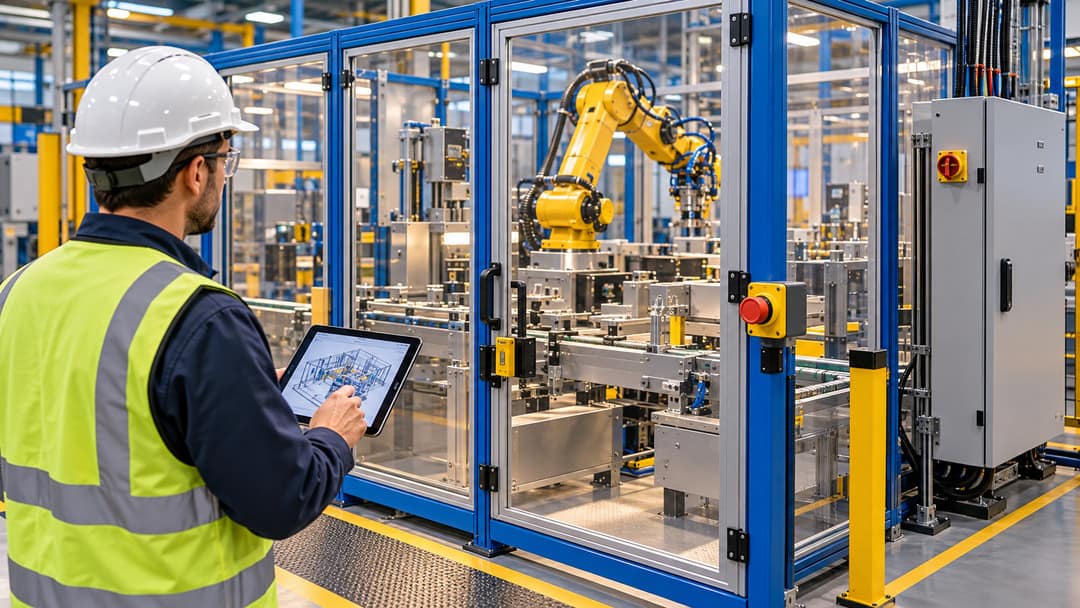
An emergency stop button cannot replace a machine guard, a safety interlock, or a proper hazardous-energy isolation system. These protective measures perform different jobs, and treating them as interchangeable can leave workers exposed to moving machinery.
The distinction matters when manufacturers install automation equipment, upgrade production lines, or modify older machines.
A machine may have a clearly visible red emergency stop button and still lack adequate protection against rotating shafts, crushing points, moving tools, or unexpected startup.
For engineers and operations managers, the important question is not simply whether the equipment can stop. It is whether people are protected before they encounter a hazard, whether hazardous motion stops in time, and whether stored energy can be controlled during maintenance.
What an Emergency Stop Actually Does
An emergency stop, often called an E-stop, allows someone to initiate a protective stopping function when an actual or impending emergency is recognized.
Its purpose is to help prevent or reduce harm after someone identifies a dangerous situation.
That creates an important limitation: someone generally must recognize the danger and activate the device.
Consider an automated packaging machine with moving rollers.
If an operator notices an unexpected obstruction, an emergency stop may provide a way to initiate a stop. However, if a hand becomes trapped between rollers before the operator can react, the emergency stop cannot prevent the initial contact.
Its effectiveness also depends on the machinery’s stopping behavior.
Some machines can stop rapidly. Others contain moving components with substantial inertia, meaning they may continue moving while decelerating.
An emergency stop therefore does not necessarily mean every hazardous movement stops instantaneously.
The International Organization for Standardization addresses emergency-stop design in ISO 13850:2015, Safety of machinery — Emergency stop function.
The standard describes requirements for emergency-stop functions and recognizes circumstances in which emergency stopping would not reduce risk. It also distinguishes emergency stopping from other protective functions, such as guarding and braking.
As of October 12, 2026, ISO lists the 2015 edition as published and identifies a future revision under development. The existence of the standard does not automatically make it a legal requirement in every country or application.
The engineering implication is straightforward.
An E-stop is an additional protective measure. It should not be used to justify leaving workers exposed to hazards that could reasonably be prevented through suitable machine design and safeguarding.
Why Machine Guards Provide a Different Kind of Protection
A machine guard is intended to prevent contact with hazardous machinery components.
Unlike an emergency stop, a suitable physical guard does not depend on someone noticing danger and reaching a button in time.
For example, a fixed barrier surrounding a rotating drive mechanism can prevent accidental access during normal production.
The US Occupational Safety and Health Administration (OSHA) establishes general machine-guarding requirements under 29 CFR 1910.212.
The regulation addresses hazards including points of operation, rotating components, ingoing nip points, flying chips, and sparks. It requires appropriate guarding where these hazards expose employees to injury.
The regulation applies within its defined US jurisdiction. Other countries may use different legislation and technical requirements.
A fixed guard is often practical when employees do not need regular access to the hazardous area.
However, many manufacturing operations require workers to open access doors for loading, cleaning, inspection, or product changeovers.
These applications may need interlocked guards.
An interlocked guard is connected to a protective control function. Depending on the machine and its approved design, opening the guard can initiate a stop or prevent hazardous operation until appropriate conditions are restored.
This is different from an emergency stop because the protective response is associated with access to the hazardous area rather than relying on someone to recognize an emergency.
The arrangement still requires engineering analysis.
If hazardous movement continues after a door is opened, the machine may need guard locking or another suitable protective measure so workers cannot reach the danger zone before the hazard has ended.
The stopping time, access distance, possible movements, and reliability of the safety-related control system all matter.
A door sensor alone does not establish that a machine is safely guarded.
The Most Important Safeguarding Question: Can Someone Reach the Hazard?
A common design mistake is concentrating on whether a safety device changes an electrical signal without assessing whether it actually prevents injury.
Consider a hypothetical automated assembly cell.
The cell has a hinged access door fitted with an interlock switch.
Opening the door sends a stop request to the machine controller.
At first glance, the arrangement may appear adequate.
But suppose a moving mechanism continues traveling after the stop request. If the operator can reach that mechanism before it stops, the arrangement may not provide adequate protection.
The problem is not necessarily the interlock switch itself. It is the relationship between hazardous motion, stopping performance, and how quickly someone can reach the danger.
The UK’s Health and Safety Executive (HSE) explains this principle in its introduction to machinery safety.
HSE recommends preventing access to dangerous parts through suitable safeguards, using fixed guards where practical and appropriate interlocking arrangements when access is necessary.
Its guidance also recognizes the importance of preventing access while hazardous movement continues.
The page was last updated on November 19, 2024, and describes Great Britain’s machinery-safety framework. It is useful engineering guidance but should not be presented as a universal legal standard.
This has consequences for the design of automated equipment.
Engineers need to evaluate the complete protective arrangement, including the physical barrier, access points, safety-related control functions, stopping behavior, and possible failures.
A protective system must also account for foreseeable operating activities.
Routine cleaning, tool changes, jam removal, and maintenance may expose workers to different hazards from those encountered during normal production.
A safeguard that performs adequately during automatic operation may not address every hazardous condition during servicing.
Why an Emergency Stop Is Not Lockout/Tagout
Stopping a machine is not the same as isolating its hazardous energy.
This distinction is especially important during maintenance.
An emergency stop might stop normal machine movement while electrical, pneumatic, hydraulic, or mechanical energy remains available elsewhere in the equipment.
Stored energy may also remain after electrical power has been disconnected.
Examples include compressed air in pneumatic circuits, hydraulic pressure, suspended loads, and energy stored in springs.
If maintenance personnel enter a hazardous area without appropriate energy controls, unexpected movement or release of stored energy can cause serious injury.
OSHA’s 29 CFR 1910.147 hazardous-energy control standard addresses servicing and maintenance activities where unexpected energization, startup, or release of stored energy could injure employees.
The standard distinguishes energy-isolating devices from ordinary control-circuit devices such as push buttons and selector switches.
It also establishes requirements for energy-control procedures, training, and inspections within its scope.
The practical difference is substantial.
An emergency stop initiates a protective control function.
Lockout/tagout involves controlling hazardous energy through applicable isolation methods and procedures.
Neither the physical appearance of an emergency stop nor the fact that a motor has stopped demonstrates that the equipment is properly isolated.
Qualified personnel must identify the relevant energy sources, apply the required controls, and verify the resulting condition under the applicable procedures.
Manufacturers should not treat resetting an E-stop, opening an interlocked guard, or switching a machine into maintenance mode as an automatic substitute for required hazardous-energy isolation.
Three Different Protections, Three Different Questions
The differences become clearer when the protections are evaluated according to their intended functions.
A machine guard addresses the question: Can a person contact the hazardous part during the activity being assessed?
A safety interlock addresses a different question: Does the protective control system respond appropriately when access conditions change?
An emergency stop addresses whether an operator can initiate an appropriate protective response when an emergency is recognized.
Hazardous-energy isolation adds another requirement: Can the equipment be made and maintained safe from unexpected energy release during the work being performed?
These functions can operate together, but they should not be confused.
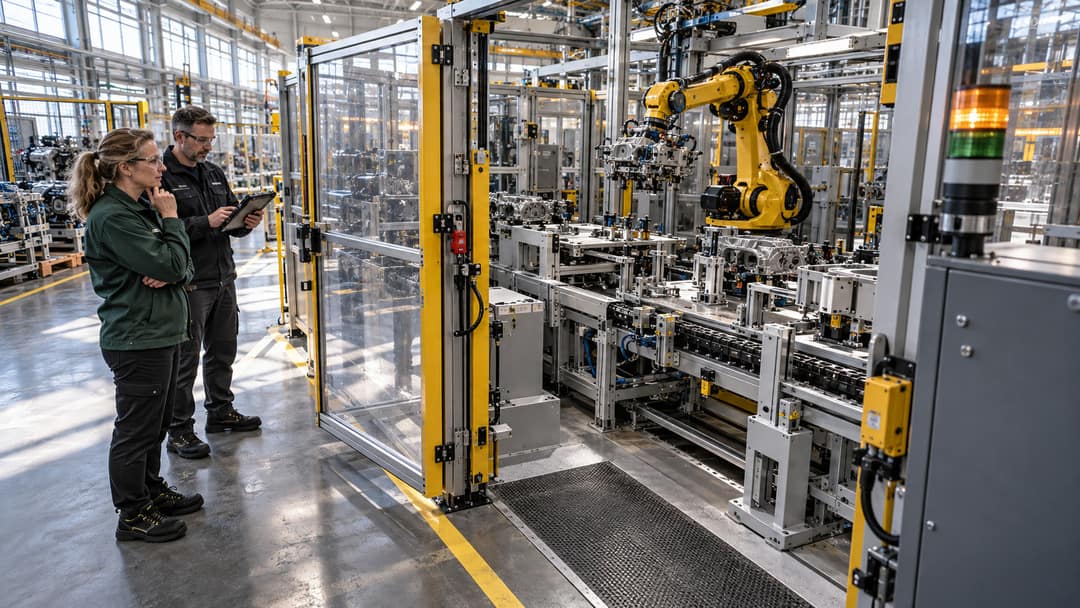
For example, an industrial robot cell may include fixed perimeter fencing, interlocked access doors, emergency-stop devices, and designated energy-isolation points.
Each component contributes to a different aspect of worker protection.
The broader engineering considerations involved in integrating these systems are discussed in Mengo Industrial’s existing guide to designing high-performance robotic cells.
That broader design context matters because guarding cannot be evaluated independently of robot movement, tooling, reach, maintenance access, and production tasks.
Why Retrofitting Older Machines Requires a New Safety Review
Manufacturers often modernize older production equipment to improve reliability, replace obsolete controls, or integrate automation.
These projects can change the machine’s hazardous movements and protective functions.
Consider an existing manufacturing machine whose original controls are replaced with a programmable controller and modern drive equipment.
The new system may operate more smoothly and provide better diagnostics.
However, those improvements do not automatically establish that its safety functions remain adequate.
A modified control architecture may affect stopping behavior, restart prevention, fault detection, or communication between connected machines.
Additional actuators or automated loading equipment may also introduce hazards that were absent from the original installation.
The risk assessment should therefore address the modified machine or production system rather than simply assume the original safeguards remain sufficient.
This issue connects with the site’s existing discussion of upgrading industrial controls, safety systems, and equipment performance.
A sound retrofit evaluation should distinguish production-control improvements from safety-related control requirements.
For example, adding a modern human-machine interface can improve how operators monitor equipment. But the interface does not replace the engineering work needed to verify protective functions.
Similarly, replacing an old interlock sensor with a newer model does not automatically prove that the complete protective system meets the required safety performance.
Engineers need to assess the system as a whole.
What Manufacturers Should Verify Before Accepting a Machine
A useful machine-safety review produces more than a statement that an emergency-stop button works.
It should establish which hazards have been identified, which protective functions address those hazards, and what evidence supports their effectiveness.
For new equipment or significant modifications, the review should consider normal production, setup, cleaning, foreseeable fault conditions, and maintenance.
The evaluation should also address whether changes to access doors, guarding, control systems, tooling, or operating modes introduce additional risks.
Where safety-related control systems are involved, qualified engineers should determine the required performance and evaluate the completed design against applicable standards.
Documentation should identify the relevant protective functions, design assumptions, verification results, inspection requirements, and responsibilities for maintaining those functions.
Physical validation remains essential.
A simulation may help evaluate concepts or expected behavior, but it is not a substitute for required inspection and validation of installed equipment.
Similarly, a successful commissioning test demonstrates performance only under the conditions actually evaluated.
The manufacturer or machine owner should establish how safeguards will remain effective during equipment use and maintenance.
Workers also need instructions appropriate to their responsibilities, including how to recognize damaged or malfunctioning safeguards and how to report problems.
Any safety-critical changes should be managed through competent engineering review rather than informal adjustments intended to reduce production interruptions.
Safe Machinery Requires More Than a Stop Button
A visible emergency-stop button is an important feature on machinery where an emergency-stop function is appropriate.
But its presence does not establish that the machine is adequately guarded or safe to service.
Preventing access to dangerous parts, responding appropriately when protective devices are activated, and controlling hazardous energy during maintenance are separate engineering responsibilities.
The distinction becomes particularly important as factories add robotics, automated material handling, programmable controls, and connected production equipment.
A dependable machine-safety design starts by identifying hazards and selecting measures that prevent or reduce exposure.
Emergency stopping remains part of that design, but it cannot compensate for missing guards, inadequate interlocks, or ineffective energy-isolation procedures.
The measure of a protective system is not simply whether the machine stops when a button is pressed. It is whether the complete arrangement adequately protects people throughout the machine’s intended life cycle.


