

Let’s cut through the corporate fog. Managing an industrial plant overhaul isn’t just theory. It’s a high-stakes ballet of physics, finance, and human grit.
One misstep in this dance doesn’t mean a bad review. It means a seven-figure bill and weeks of downtime. Think of it as playing Jenga with a live reactor—the margin for error is hilariously thin.
This is where robust plant engineering project management separates the pros from the pretenders. It’s the disciplined framework that turns beautiful chaos into a predictable outcome.
So, how do you move from hoping for the best to engineering it? This guide is your battle-tested playbook. We’re diving into the nitty-gritty of flawless project delivery, from the first blueprint scribble to the final commissioning handshake.
Forget fluffy principles. We’re here to build your ultimate execution checklist for capital projects, line upgrades, and expansions. Ready to stop guessing and start building?
Preparation & Scoping
Project scoping is like writing the first chapter of a thriller. It’s about uncovering the unknown. If you get it wrong, your project could become a financial burden.
Scoping can be stressful because teams often confuse wishes with real plans. Saying “we need a new press line” is just a wish. A good scope is detailed, covering everything from load capacities to maintenance concerns.
The start of a project involves two key documents: the business case and the feasibility study. The business case explains why you’re doing something. The feasibility study checks if it’s possible. Skipping either is risky.
You must kill off bad ideas early. That fancy automation idea might cost too much for a small gain. Scope creep is like a silent leak in your budget. Your project charter is your defense against this.
Here’s what precise scoping includes:
- Objectives: Specific goals, like increasing Line 3 output by 15%.
- Deliverables: Things you’ll get, like new equipment and training.
- Standards: Rules that every part must follow, like OSHA and ISO.
- Timeline: A detailed schedule with all the steps and when they happen.
- Budget: A plan for costs, including extra money for surprises.
Scoping with precision is like defusing a bomb. It leaves no room for doubt. Ambiguity can lead to big problems.
The table below shows the difference between vague and precise scoping in industrial projects.
| Scoping Element | Vague Approach (The Problem) | Precise Approach (The Solution) | Impact on Project |
|---|---|---|---|
| Project Objectives | “Make the process faster.” | “Reduce cycle time on Station B from 45 to 30 seconds, maintaining yield >99%.” | Clear success metrics vs. endless debate. |
| Deliverables List | “New system installed.” | List of 12 items: machinery, wiring diagrams, training logs, SOPs, spare parts inventory. | Prevents “I thought that was included” disputes at handover. |
| Stakeholder Sign-off | Email approval from a manager. | Formal charter signed by Engineering, Operations, Finance, and Safety leads. | Creates organizational accountability from day one. |
| Budget Framework | One lump sum number. | Breakdown into equipment, labor, engineering, contingency (with %). | Enables intelligent cost tracking and early overrun warnings. |
Preparation and scoping are key to your project’s success. A clear scope is your guide. It helps you say no to changes that aren’t needed. In plant engineering project management, this phase is critical.
The goal of scoping isn’t to list every possibility. It’s to define the exact project you want to build. This way, you turn a project into a well-planned effort.
Resource Planning & Team Roles
Resource planning is like putting together a team for a big heist. Each person is key, and the wrong choice can ruin everything. It’s about matching skills, personalities, and schedules. Forget about Gantt charts for now. The real plan is a Venn diagram of what each person can do, when they’re free, and if they want to do it.
The team starts with the Project Sponsor. They pay the bills and keep things grounded. They protect the project from corporate changes and keep it somewhat realistic.
The Manufacturing Project Manager is the link between the sponsor’s dream and the real world. They turn ideas into action plans and schedules. They’re like a conductor and a negotiator all in one. Their success depends on making this connection.
The Engineering and R&D teams are the creative geniuses and problem solvers. They figure out what’s possible and what’s not. The key is how well they work together. A great idea is useless if it can’t be made or fixed.
Now, we face a big problem: not enough skilled people. Planning is no longer just about who’s available. It’s about finding the right person with the right skills, even if they need to learn a bit more.
The solution is to orchestrate the team’s talents. It’s about knowing that a skilled welder is more valuable than the metal they work with. Successful project delivery is about using everyone’s skills together. It’s about making a plan that works itself. If you get it right, everything falls into place. If not, you’re just trying to hold things together.
Risk Management Strategies
Effective risk management isn’t about predicting meteors; it’s about prepping for the bankruptcy of your sole-source supplier. The real threats to your project timeline and budget are boring, insidious, and expensive. They don’t make for good movie plots, but they will absolutely derail your execution checklist.
Forget the colorful heat maps that label everything “high risk.” That’s just theater. True strategy lives in the gritty details of mitigation. It’s about having a pre-meditated response for when—not if—the concrete fails inspection or a key permit gets delayed.
Let’s break down the common, mundane monsters: scope creep, supply chain disruptions, compliance snags, and budget overruns. Your plan must address these with more than a hopeful footnote.
The table below cuts through the theoretical fog. It contrasts common, fluffy risk approaches with the tactical, actionable moves that actually protect a project.
| Risk Category | Theoretical Approach (The Problem) | Tactical Mitigation (The Fix) |
|---|---|---|
| Scope Creep | Vaguely noting “client may request changes” on a risk register. | Implement a formal change order process with pre-negotiated rates and a 48-hour review window. Bake this into your core execution checklist. |
| Supply Chain Disruption | Marking “supplier delay” as a yellow medium-risk item. | Identify sole-source components and secure a backup supplier before signing the main contract. Build in financial clawbacks for late delivery. |
| Compliance Issues | Assuming the engineering firm “has it covered.” | Assign a dedicated compliance officer to the project team. Their sole job is to track permit statuses and audit inspection reports weekly. |
| Budget Overrun | Adding a generic 10% “contingency” buffer to the total cost. | Create a risk-adjusted budget. Apply specific, calculated buffers to high-probability line items (e.g., labor, specialty materials), not the whole pot. |
Notice a pattern? Tactical mitigation is specific, assigned, and financial. It moves a risk from a theoretical discussion to an accountable line item.
The smartest move is to run a pre-mortem. Gather your team before the project starts and ask one brutal question: “It’s six months from now. The project has failed. Why?” The answers become the first entries in your real risk plan.
This isn’t about fear. It’s about freedom. When you have redundancy planned for critical path items and contract clauses that protect you, you can execute with confidence. Your buffers become strategic tools, not decorative padding.
Integrate these responses directly into your project execution checklist. A checkbox that says “Backup supplier confirmed?” is worth a hundred red cells on a risk matrix. That’s how you turn management from a presentation slide into a project-saving protocol.
Timeline Optimization
Think of timeline optimization as a magic trick for plant managers. It makes weeks disappear while keeping everything running smoothly. Time isn’t just a resource in a live facility. It’s a volatile currency, and wasting it means lost revenue and missed orders.
This isn’t just about using a Critical Path Method chart. That’s just the start. The real challenge is in the details of execution, where quick thinking wins the game.
The need for fast project delivery is huge. Shareholders and production targets keep the pressure on. Your goal is to shrink the timeline, not just meet it. This means moving from simple planning to detailed orchestration.
Successful optimization relies on a few key moves:
- Parallel Work Streams: This is about doing non-dependent tasks at the same time. It’s like conducting different parts of an orchestra together, not one after another.
- Strategic Sequencing: This is basic but often missed. You don’t install ceiling panels and then try to fit in HVAC ductwork. Smart planning of the work order avoids costly delays.
- Calculated Overage Windows: Instead of endless overtime, use targeted, planned efforts. Think of it as a strategic sprint, not a long, tiring run.
- The Self-Performing Advantage: Using your own team lessens lead time. An integrated team works faster and makes decisions quicker, speeding up the project.
Keeping an eye on this tight timeline is tough. You need to track progress in real-time against small goals. If a task slows down, you must quickly adjust the plan.
The goal is to deliver value quickly without harming the plant. It’s a delicate balance of efficiency. You’re not just moving tasks along. You’re bending time to your will, ensuring a fast and successful project delivery.
Communication with Plant Teams
If your project plan hasn’t been discussed over coffee, it’s not really communicated. This is the core of plant engineering project management. Here, everyone works together smoothly. The graveyard of projects is filled with unread memos.
Why? Because talking to the team needs a special language. Your detailed slides might as well be in ancient Greek to the team at 2 AM. This gap is the main reason projects fail.
To bridge this gap, meet in the tool crib, not the boardroom. The morning huddle is key. It’s where you solve problems together, not for each other.
Cross-functional coordination is also key. Engineers, accountants, and plant teams speak different languages. The project manager must translate for everyone. Keep updates simple and clear.
Good plant engineering project management means everyone is on the same page. This turns a plan into a shared goal. Clear communication is essential for project success.
Technology can aid, but it must enhance conversation, not replace it. A digital dashboard is only useful if it’s where work happens. For more on effective communication, check out this resource.
Communicating with plant teams is about respect. It’s about valuing the knowledge of those who work with the machines. Success comes when the team feels responsible for the outcome.
The best plant engineering project management tool is a simple marker and a willingness to listen. Plans that are shared openly are more likely to succeed than those hidden away.
Monitoring & Metrics
Imagine using a sundial to time a rocket launch. In the world of industrial plant execution, using old metrics like budget and schedule is a big mistake. It’s like driving a race car blind, focusing only on the fuel gauge.
The magic happens with leading indicators. They act as your project’s early warning system. They alert you to problems before they ruin your timeline or budget.

Think about it. Is weld quality dropping? Are change requests going up fast? Has team morale fallen like a bad I-beam? These signs are vital. A good execution checklist tracks these signs, not just tasks.
We’re not just talking about simple progress reports. We’re about real-time quality audits and change management logs. You should watch how well resources are working, not just if they show up.
Your dashboard should look like a hospital monitor, not a financial report. Here’s what to watch instead of old metrics:
| Metric Type | What It Measures | Why It Matters |
|---|---|---|
| Rework Rate | The percentage of work needing correction after first check. | A high rate means delays and cost overruns. It shows process or quality failure. |
| Change Request Velocity | The number and size of scope changes. | A spike means bad planning or site surprises. It shows project stability issues. |
| Resource Utilization vs. Burnout | Team output and absenteeism or safety reports. | High output with burnout is bad. It leads to errors, turnover, and schedule collapse. |
| First-Pass Yield | Work done right the first time, without revision. | A high yield means good planning and team work. |
These metrics aren’t about money or time. They’re about the conditions that create them. Monitoring this way makes you a forecaster, not just a historian.
To make this work, add these checks to daily stand-ups and weekly reviews. Make them key parts of your execution checklist. Ask questions like “What does our rework rate say about next week?”
This approach gives you insight, not just data. It’s the difference between a routine check-up and catching a problem early. Your metrics should tell you about the future, not just past expenses.
Troubleshooting Common Issues
If project execution were a medical drama, this section is the episode where the patient codes and the team must improvise. Theoretical frameworks are the textbook; this is the field manual for when the proverbial hydraulic fluid hits the fan. Let’s diagnose.
The usual suspects form a predictable lineup. Recognizing them is half the battle.
Scope Creep: It never arrives with a fanfare. It’s the slow, insidious addition of “just one more thing” until your blueprint resembles a Jackson Pollock painting. The diagnostic question isn’t “What changed?” but “Who authorized it without a change order?” The cure is contractual rigor and a communication firewall between operations and your project team.
The Ghosting Vendor: Your critical path depends on a component. Your supplier’s phone goes straight to voicemail. This isn’t a supply chain hiccup; it’s a full cardiac arrest. Your creative problem-solving muscle gets its first real test. Did you qualify a secondary supplier? Can you fabricate a temporary solution in-house? The lesson is that vendor management is risk management.
Equipment Risks & The “Minor” Flaw: The foundation isn’t deep enough. The alloy specification was ambiguous. What was a line on a CAD model becomes a six-figure rework order. This is where pre-mortem analysis pays dividends. Had you walked through the fabrication process with the foreman before breaking ground? Often, the root cause is a handoff failure between design and field teams.
Balancing Projects with Operations: The plant must keep running. Your project needs a full shutdown. This tension creates a stalemate worthy of a Cold War thriller. The solution isn’t brute force; it’s clever choreography. Can you phase the work? Can you build a temporary bypass? Real examples show that the most elegant fixes often come from the operators themselves—if you listen.
Change Resistance: You’re not just installing a new pump; you’re asking people to alter a decade-old routine. Resistance isn’t stubbornness; it’s a natural immune response. Do you understand their daily pain points? Framing the change as a solution to their problem turns adversaries into allies.
So, how do you move from reactive firefighting to proactive diagnosis? Consider a simple diagnostic flowchart for any delay:
- Symptom: Missed milestone.
- Ask: Is it a resource, information, or authority block?
- If resource: Trace the chain to the original commitment. Was it realistic?
- If information: Who holds it? Why wasn’t it shared?
- If authority: Who can approve? Why is there a bottleneck?
This turns a vague “we’re behind” into a targeted action item.
Creative solutions emerge from constraints. That tank fabrication issue? The team used laser scanning to create a perfect digital twin, allowing for off-site prefabrication that slashed on-site time. The foundation depth problem? They employed ground-penetrating radar to map the subsurface in real-time, adjusting the design on the fly.
These aren’t miracles. They are applied project execution best practices under pressure. The goal isn’t to avoid problems—that’s a fantasy. The goal is to build a team and a process so agile that problems become mere puzzles, solved before they metastasize into crises.
In the end, troubleshooting is the ultimate test of your planning. It reveals where your theories met reality. Embrace it. The post-mortem from today’s crisis is the pre-mortem for tomorrow’s success.
Real Project Examples
The best lessons in project delivery come from real projects, not just charts. Let’s look at two examples.
First, a success story. A chemical plant needed a special storage tank. The vendor said it would take 24 weeks. But the plant manager had a different plan.
They decided to make the tank themselves. They used their maintenance shed as a workshop. With local materials and quick designs, they finished the tank in three weeks.
This story shows that waiting for vendors can be risky. By doing it themselves, they saved a lot of time. It’s all about being proactive.
Now, a tough example. A food processing plant needed more space for new equipment. The first plan was to tear down and rebuild, taking six months.
But a smart team suggested a different approach. They wanted to raise the roof instead. It was a bold move, but it could save a lot of money.
They went for the roof raise. It took ten weeks and cost 60% less than the original plan. Their gamble paid off big time.
What made these projects successful? Quick decisions and creative solutions. Let’s compare them.
| Project A: The Speed Run | Project B: The Value Play | |
|---|---|---|
| Scope | Fabricate specialty tank | Increase facility clearance |
| Key Decision | Bring fabrication in-house | Choose roof raise over demolition |
| Outcome | 3-week timeline | 40% cost savings |
| Core Lesson | Internal collaboration breaks vendor dependency. | Creative engineering can redefine the problem. |
These stories show two different approaches. One is about quick action, the other about careful planning. Both are important.
The key to success in project delivery is knowing what you’re up against. Are you racing against time or fighting for every dollar? Your plan should match your goal.
In the end, it’s not about being perfect. It’s about getting the job done well enough. The real proof is in the results.
Actionable Takeaways
Forget the fluff. These are the non-negotiable, battle-proven actions that separate a smoothly executed project from a costly cautionary tale. Consider this your project execution Swiss Army knife—a distilled, no-BS execution checklist forged from the best practices we’ve analyzed.
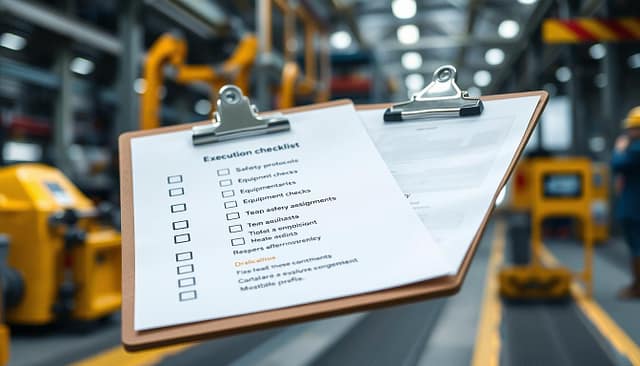
From pre-kickoff to post-mortem, follow this phased guide. It synthesizes phase-gate discipline, value engineering, and collaborative grit into a single, actionable playbook.
The Pre-Flight Checklist: Before You Even Start
This is where most projects fail. Don’t skip the basics.
- Plan Thoroughly, Then Plan Some More: Define scope with surgical precision. Ask the ugly questions about budget, timeline, and stakeholder expectations upfront.
- Embrace Phase-Gate Discipline: Institute mandatory review gates. No project phase advances without a formal sign-off. This isn’t bureaucracy; it’s your escape hatch.
- Assemble the Right Team & Tools: Lock in your talent and choose your tech stack. A robust digital work plan is non-negotiable for complex industrial work.
The In-The-Trenches Playbook: Execution Phase
Now the rubber meets the road. Stay agile.
- Adopt a Flexible, Yet Monitored Approach: Your plan is a guide, not a scripture. Build in buffer capacity for manpower and materials. Monitor progress with real-time metrics, not weekly guesswork.
- Engineer Value, Not Just Output: Constantly ask, “Can we do this simpler, faster, or cheaper without sacrificing quality?” This mindset pays dividends.
- Communicate Relentlessly: Hold daily stand-ups with plant teams. Transparency kills rumors and aligns everyone on the mission.
The Landing Gear: Post-Project Rituals
The job isn’t done when the last bolt is tightened.
- Conduct a Blameless Post-Mortem: Gather the team. What went well? What cratered? Document every lesson, not to assign fault, but to build institutional memory.
- Update Your Master Checklist: This living document should evolve with every project. Your next execution checklist should be smarter than your last.
This isn’t theoretical. It’s the condensed wisdom from the field. Print it. Laminate it. Make it the backbone of your next industrial project. Your future self, calmly sipping coffee after a successful launch, will thank you.
Conclusion
Think of the last industrial project you saw through to completion. Was it a masterpiece of coordination or a cautionary tale? True success in plant engineering project management isn’t about a single brilliant moment. It’s the daily grind of details.
This discipline merges the spreadsheet with the wrench. Effective plant engineering project management requires that blend. It’s the sage’s strategy meeting the mechanic’s muscle on the factory floor.
You leave behind more than a working machine. You build a legacy of predictable results. The goal is repeatable excellence, where every shutdown and startup follows a trusted script.
Now, take these ideas and apply them. Go make your next project run like a precision instrument. Just remember the golden rule of any site: always lock out and tag out first.


