

Dilute alloy catalysts promise something chemical manufacturers rarely get for free: high catalytic activity with only a tiny fraction of expensive metal doing the work. New University of Michigan research sharpens that promise by showing that the bigger obstacle is not simply choosing an active dopant—it is keeping those atoms at the surface when heat and reaction chemistry try to pull them away.
The timing matters because these materials can contain about 1% or less active dopant metal dispersed through a more inert host. If that small amount stays accessible under operating conditions, manufacturers could reduce precious-metal demand without giving up the surface chemistry needed for fuel, plastics, pharmaceutical, and emissions-control reactions.
Less Precious Metal Helps Only If It Stays Active
Dilute alloys are attractive because the highly active metal does not need to dominate the catalyst. Instead, sparse dopant atoms can activate a reactant while the surrounding host metal supports later reaction steps.
That separation can loosen a familiar limitation in conventional catalyst design. Improving the binding needed for one step can make another step harder. A dilute alloy can distribute different parts of the reaction across different surface sites, widening the design space for activity and selectivity.
But low dopant loading creates its own weakness. If the active atoms migrate away from the surface and dissolve into the host particle, they stop participating effectively. The material still contains the precious metal, yet the useful surface sites have been lost. Less precious metal only creates value if those atoms remain where the chemistry needs them.
Dilute Alloy Catalysts Now Have Two Clear Stability Levers
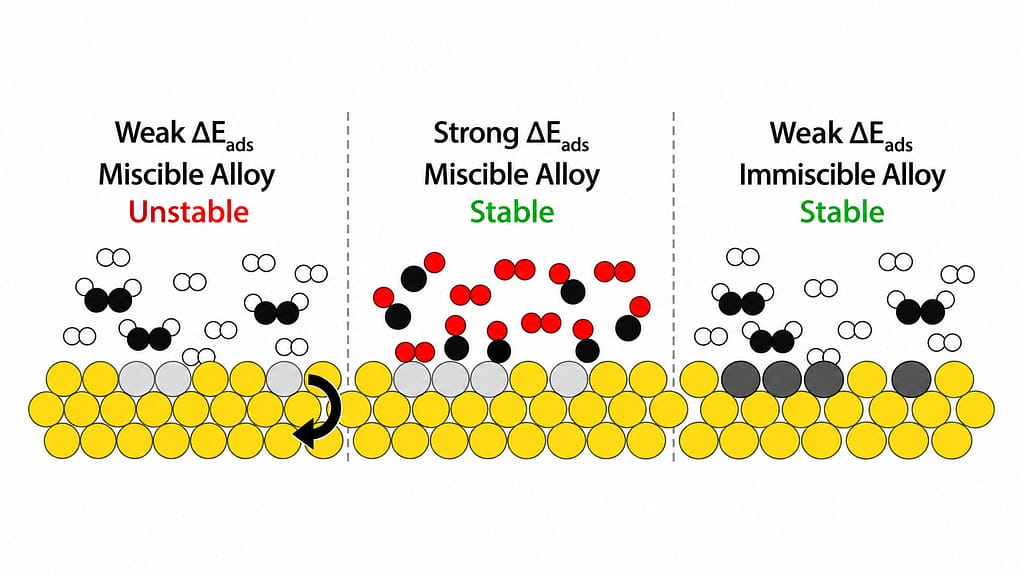
The Michigan team identified two variables that strongly influence thermal stability: how tightly reaction species bind to active dopant atoms and whether the dopant and host metals naturally tend to mix.
The first lever comes from adsorbates, the molecules or intermediates attached to a catalyst surface during a reaction. Strongly binding adsorbates can help hold dopant atoms at the surface. In gold-platinum experiments, behavior changed with the reaction environment, showing that surrounding chemistry can influence whether platinum remains accessible.
The second lever is alloy miscibility. When the dopant readily mixes with the host metal, it can have a stronger tendency to move into the particle interior. When the metals are less miscible, the dopant can be more resistant to that inward migration.
The peer-reviewed stability study was published online August 20, 2026. The University of Michigan later highlighted the new catalyst design rules on September 16 as a practical framework for designing more stable dilute alloys.
Stability Is a Materials-and-Process Decision
The useful shift is that surface stability no longer has to be treated only as a durability test after a catalyst has been selected. It can become an input to material selection.
A development team can ask two questions earlier: Will the chosen host and dopant preserve active surface atoms? And will the intended reaction environment provide adsorbates that stabilize or destabilize those atoms?
That makes operating conditions part of the design problem. A composition that looks promising in one reaction may behave differently in another because the adsorbed species are different. Reaction environment is part of catalyst design, not merely the setting in which a finished catalyst is evaluated.
This fits a wider manufacturing pattern. The gap between controlling materials at very small scales and reproducing that behavior in industrial processes also appears in atomic-scale materials design, where precision matters only when verification, throughput, and repeatability follow.
The New Rulebook Changes How Candidate Alloys Can Be Screened
The two stability mechanisms provide a practical way to compare candidate systems before committing to long test campaigns.
| Design factor | More favorable condition | Main risk when unfavorable | Engineering implication |
|---|---|---|---|
| Dopant loading | Low active-metal use with accessible sites | Too few usable surface sites | Measure activity per accessible site |
| Adsorbate binding | Strong enough to retain dopants | Active atoms migrate inward | Test under actual reaction chemistry |
| Metal miscibility | Host and dopant resist bulk mixing | Dopant dissolves into host | Include segregation tendency in screening |
| Temperature | Stable surface population | Faster redistribution | Validate at realistic thermal conditions |
The table shows why a single headline metric is not enough. A catalyst can look efficient because it contains little precious metal yet still be a poor industrial candidate if its active surface population collapses during operation.
Gold-Platinum and Gold-Iridium Show the Difference
The researchers used gold nanoparticles containing platinum atoms to observe how the surface population changed during ethylene hydrogenation and carbon monoxide oxidation. Tests covered 50°C to 250°C while spectroscopy followed platinum at the surface.
During ethylene hydrogenation, activity dropped sharply after temperatures passed 100°C as platinum moved away from the surface. Carbon monoxide bound more strongly to platinum and helped keep those atoms exposed.
Simulations then examined gold, silver, and copper hosts with iridium, palladium, or platinum dopants. Platinum and palladium were more inclined to mix into the host, while iridium resisted mixing. Follow-up gold-iridium experiments showed no deactivation up to 250°C in the two reactions tested.
Those results do not establish universal industrial lifetimes. They do show that the same basic stability rules held across experiments and simulations strongly enough to guide further catalyst selection.
Industrial Adoption Will Depend on More Than Atomic Efficiency
The next pressure point is durability under realistic process conditions. Industrial catalysts face long operating periods, contaminants, start-stop cycles, changing feed composition, regeneration steps, and thermal gradients that laboratory experiments may not fully reproduce.
Manufacturers will also need synthesis routes that place dopant atoms consistently where intended. A stability rule cannot compensate for poor control of particle size, composition, surface segregation, or batch-to-batch variation.
Economics will depend on the complete system. Using less platinum, palladium, or another valuable metal is attractive, but savings have to be measured against catalyst preparation, reactor performance, regeneration, and replacement intervals.
That is why the most useful next evidence will be long-duration testing and scale-up data rather than another record activity number. Stability before scale-up is the sharper benchmark.
Dilute alloy catalysts now have a more concrete design framework for reaching that benchmark. If the stability rules continue to hold across larger batches and harsher environments, precious-metal efficiency could become a controllable engineering variable rather than a laboratory advantage that disappears under heat.
Frequently asked questions
What are dilute alloy catalysts?
Dilute alloy catalysts use a very small amount of active metal dispersed within another host metal. This can reduce precious-metal use while preserving useful catalytic surface sites.
Why can dilute alloy catalysts lose activity?
Active dopant atoms can migrate away from the surface and move into the host material. Once buried, they become less available to participate in chemical reactions.
How do the new stability rules help?
The new framework focuses on adsorbate binding and metal miscibility. These factors can help researchers predict whether active dopant atoms are likely to remain exposed during high-temperature operation.
Why does metal miscibility matter?
When two metals mix easily, dopant atoms may migrate deeper into the catalyst particle. Lower miscibility can help keep active atoms closer to the surface where reactions occur.
Could dilute alloy catalysts reduce precious-metal costs?
Potentially. Using less platinum, palladium, or other expensive metals could lower material costs, but commercial savings will still depend on durability, manufacturing efficiency, regeneration, and long-term catalyst performance.


