
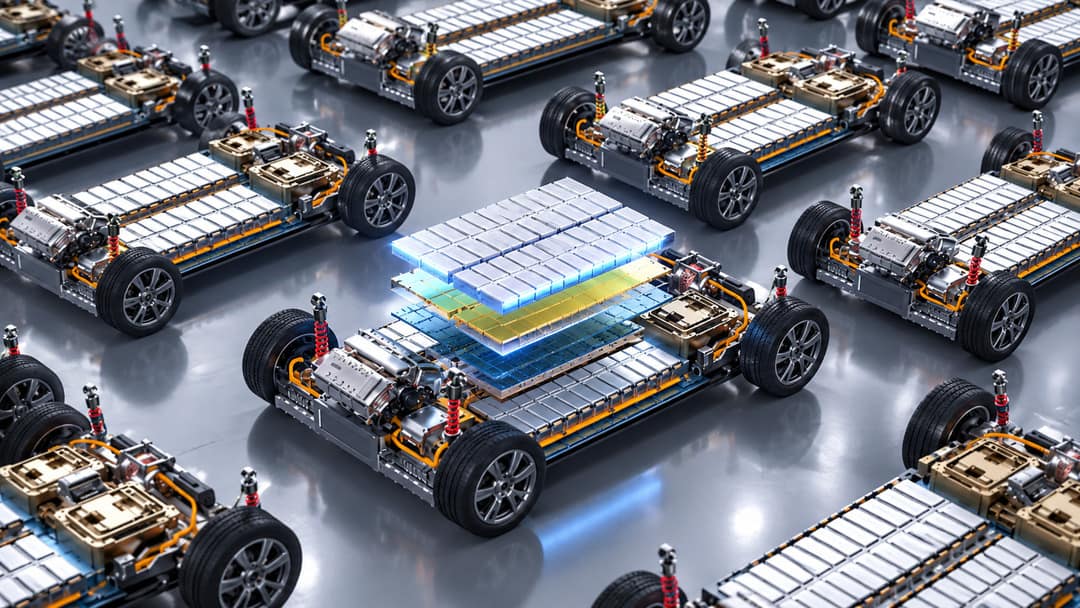
Structural power composites are pushing a provocative engineering idea toward a serious test: instead of carrying a battery inside a vehicle, part of the vehicle itself could store electricity. A new £7 million UK research programme gives that idea five years of concentrated work, shifting the harder question from “can it be demonstrated?” to “can it survive real design, manufacturing and safety constraints?”
For electric vehicles and aircraft, that matters. Batteries provide energy but also demand dedicated volume, protection and integration hardware. A material that carries load while storing energy attacks that penalty at the architecture level rather than simply improving the chemistry inside a conventional pack.
A £7 Million Bet on One Material Doing Two Jobs
Launched on September 1, 2026, the EleComp programme brings together Imperial College London, Durham University and the University of Bristol. The five-year effort is funded through an Engineering and Physical Sciences Research Council Programme Grant and will investigate materials that combine structural performance with electrical energy storage.
The five-year EleComp programme is built around a deceptively difficult target: one material, two primary jobs. Instead of adding a battery to a load-bearing product, researchers want the load-bearing material to participate directly in energy storage.
The concept could extend beyond cars to aircraft, consumer electronics, medical devices and infrastructure. In each case, the appeal is similar: reduce duplicated material, packaging and volume by making structural components multifunctional.
Structural Power Composites Could Change Vehicle Architecture
The strongest automotive implication is not simply a thinner battery pack. It is the possibility of designing vehicles around architecture-level weight reduction, because material currently used only to carry loads could also contribute energy-storage capacity.
This is different from today’s cell-to-body or structural-pack concepts. Those architectures integrate conventional cells more deeply into the vehicle structure, sometimes allowing the pack to contribute stiffness. Structural power composites go further by giving the composite material itself electrochemical and mechanical functions.
What Vehicle Designers Could Gain From Distributed Energy Storage
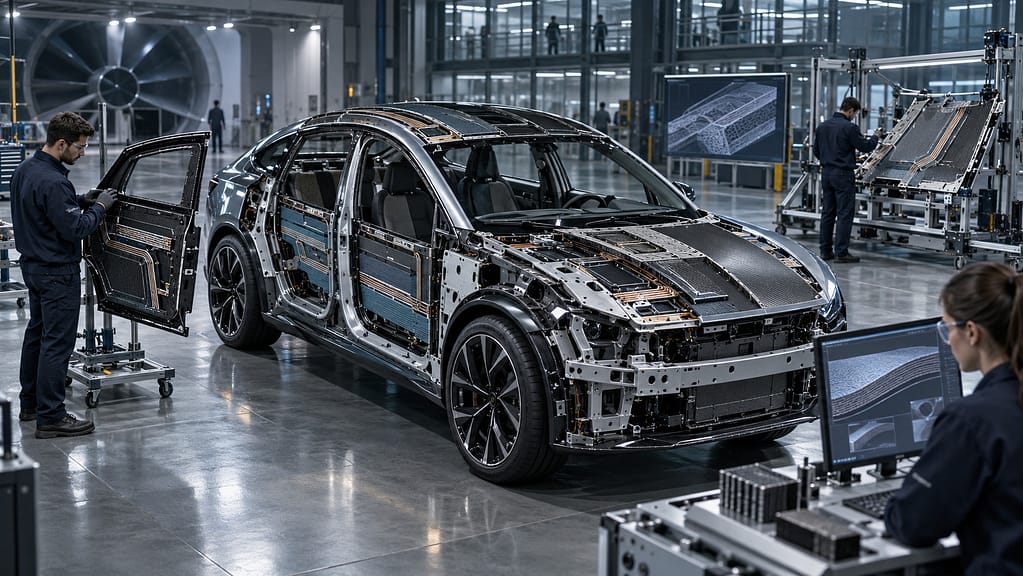
If structural components can store meaningful amounts of electricity, vehicle designers may gain more freedom over where energy capacity is located. Instead of concentrating nearly all storage beneath the passenger compartment, energy-bearing material could potentially be distributed across selected structural areas such as floors, roof sections, doors or other load-carrying components.
That distribution could create new opportunities for packaging. Removing or reducing the size of a dedicated battery enclosure could free space for passengers, cargo, suspension components or aerodynamic improvements. In vehicles where every kilogram and cubic centimeter matters, better use of structural volume could become as valuable as increasing the energy density of individual cells.
Weight reduction could also produce a compounding effect. A lighter energy-storage structure may reduce the power required to move the vehicle, which can influence battery capacity, braking requirements and other component specifications. The engineering value therefore comes not only from replacing battery mass, but from potentially reducing demands elsewhere in the vehicle.
The challenge is that these gains must survive real-world design constraints. Engineers cannot simply maximize stored energy if doing so weakens crash performance, durability or manufacturability. The most successful structural power composites will likely be those that deliver a useful balance across the entire vehicle system rather than chasing one impressive laboratory metric.
The distinction is easier to see side by side:
| Architecture | Where energy is stored | Structural role | Main engineering trade-off |
|---|---|---|---|
| Conventional EV battery | Separate cells and pack | Pack is carried by vehicle structure | Added mass and packaging |
| Cell-to-body integration | Cells integrated closely with body or floor | Battery assembly contributes to structure | Repair, crash and thermal integration |
| Structural power composite | Multifunctional composite material | Material carries load and stores energy | Balancing mechanical and electrochemical performance |
That last row explains both the promise and the difficulty. A material is not successful if it stores energy well but loses the stiffness, strength or damage tolerance required by its structural role.
The Hard Problem Is Making Ions Move While Loads Move
The central scientific conflict sits inside the material. Efficient energy storage requires ions to move through an electrolyte and electrodes. Structural composites must transfer stress, resist deformation and tolerate repeated loading.
Those goals can pull material design in different directions. EleComp will study structural electrodes, electrolytes and interfaces, including how to permit ionic movement while still transferring mechanical stress. That mechanical-electrochemical trade-off is more fundamental than simply fitting batteries into a carbon-fiber panel.
Existing structural battery work has explored carbon fibers that can perform electrode and load-bearing functions alongside polymer electrolytes that support ion transport. The broader structural battery research also includes structural supercapacitors and work on testing, manufacturing and performance targets.
For a car body, energy density cannot be the only useful metric. Engineers will need combined measures covering stiffness, strength, stored energy, cycling behavior and degradation under mechanical load.
Manufacturing May Decide Whether the Physics Becomes a Product
Laboratory coupons can demonstrate useful combinations of mechanical and electrochemical behavior, but industrial adoption depends on repeatability. Automotive and aerospace production will require controlled fiber placement, electrolyte distribution, interfaces, electrical connections and inspection methods across much larger parts.
The same gap appears across advanced battery development: promising material performance is only an early step in battery research scale-up. Structural power materials add another layer because manufacturing variation can affect both energy storage and load paths.
Quality control may therefore become decisive. Manufacturers will need ways to detect voids, poor interfaces, local electrical defects, fiber damage and other imperfections without destroying the part. Certification also becomes more complicated when one component must satisfy structural, electrical and fire-safety requirements.
End-of-life design deserves attention too. Deep integration can reduce mass and part count during use while making separation, repair or recycling harder later.
The Next Proof Point Is Multifunctional Performance at Scale
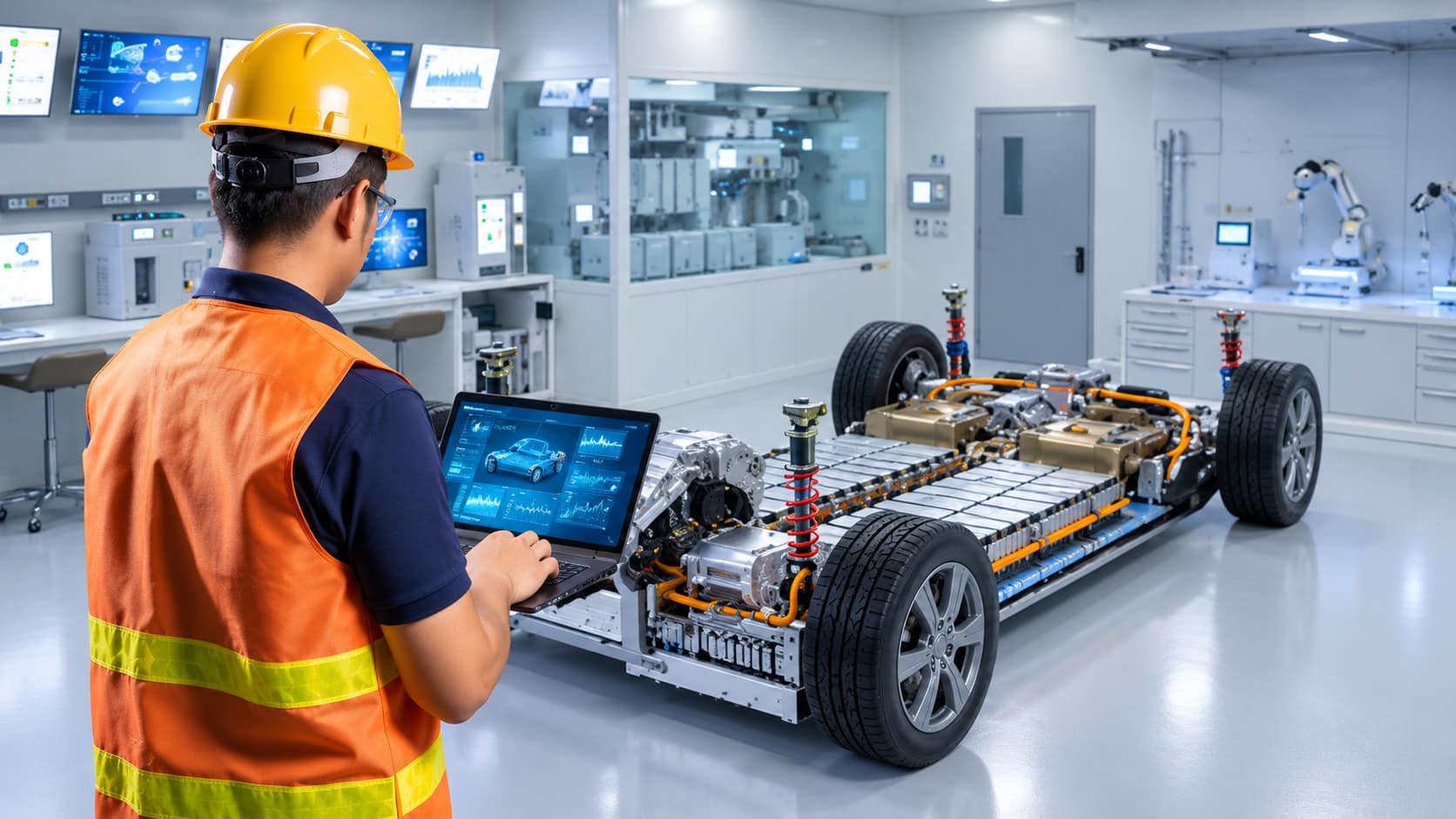
EleComp’s significance is not that a battery-free EV body is about to enter production. It is that a well-funded, multi-university programme is targeting the bottlenecks between attractive laboratory demonstrations and useful structural energy storage.
The most revealing results will be large demonstrators, standardized test methods, cycling under realistic mechanical loads, damage-tolerance data, scalable manufacturing routes and evidence that performance remains consistent across parts. Engineers should also watch whether designs can be inspected, repaired and qualified without erasing the mass and packaging advantages that motivated them.
If structural power composites can clear those hurdles, the payoff is bigger than a better battery. They could change the boundary between “structure” and “energy system” in vehicles, aircraft and electronics. The opportunity is real because the winning material will have to carry loads, store energy and remain manufacturable at the same time.
Frequently asked questions
What are structural power composites?
Structural power composites are multifunctional materials designed to carry mechanical loads while also storing or delivering electrical energy, potentially reducing the need for separate structural components and battery packaging.
Could structural power composites completely replace an EV battery?
Not with current evidence. The technology may allow some vehicle structures to contribute energy-storage capacity, but researchers still need to prove adequate performance, safety, durability, manufacturing consistency and system-level energy capacity.
Why are structural batteries difficult to develop?
Their mechanical and electrochemical requirements can conflict. The material must remain strong and stiff while permitting ion movement, maintaining electrical performance and surviving repeated loading, environmental exposure and manufacturing variation.


