
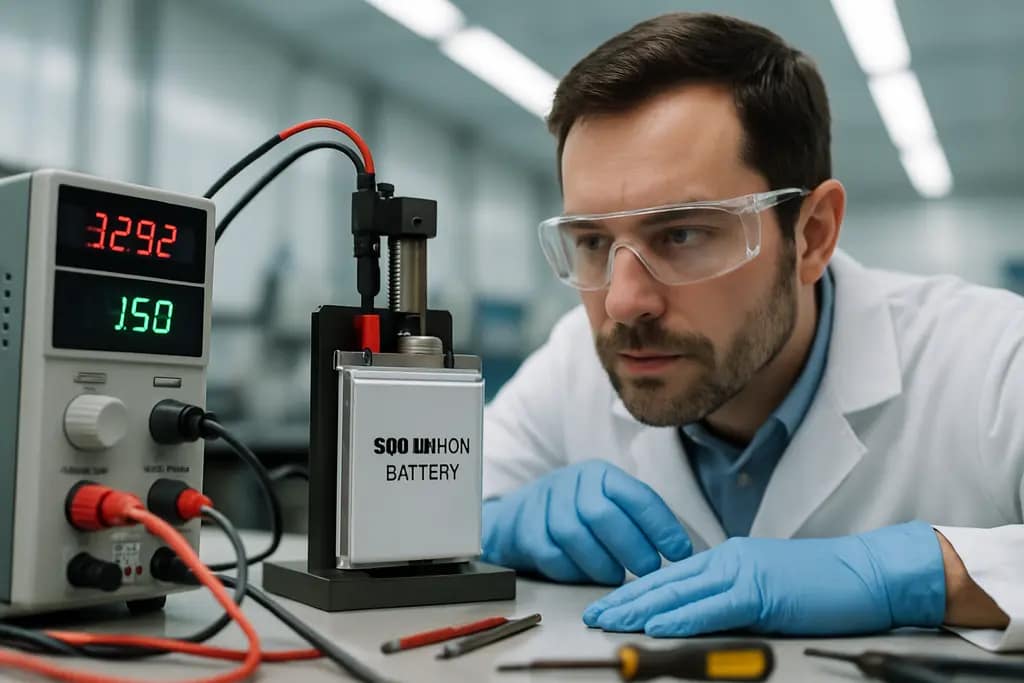
sodium-ion batteries have moved from promising laboratory and early commercial formats into a more demanding safety-testing period. As of September 6, 2026, the evidence does not support treating them as a single uniformly safe technology. It does show that standards, abuse testing, and chemistry-specific results are becoming clearer for manufacturers, storage developers, and vehicle programs.
The most useful question is not whether sodium chemistry is safer in general. The better question is which cell chemistry, electrolyte, pack design, and application have been tested under defined abuse conditions. Recent milestones include China’s updated electric-vehicle battery safety standard, commercial-cell abuse testing in the United States, reported ampere-hour-scale electrolyte research, and certification activity for industrial and vehicle-related use cases.
What sodium-ion batteries Safety Tests Now Show
Why sodium-ion batteries Chemistry Still Matters
The 2024 commercial-cell evaluation funded for transportation safety provides one of the clearest public reminders that chemistry matters. Four commercial cells were tested across polyanion Na-VPF, layered oxide Na-NMF, and Prussian white Na-tmCN types. In that evaluation, Na-NMF cells did undergo thermal runaway under abuse, while Na-VPF and Na-tmCN cells showed much lower self-heating, reported at less than 1 °C per minute under similar conditions in the commercial sodium-ion battery evaluation.
That result should temper broad claims. Sodium chemistry can reduce some material-supply concerns and may support favorable thermal behavior in some designs, but the commercial test data did not show that all sodium-ion formats avoid runaway. Cell construction, cathode chemistry, electrolyte selection, state of charge, and pack-level heat pathways still matter.
For sodium-ion batteries, this creates a practical classification problem for energy storage buyers. A cell family that performs well in one abuse test is not automatically equivalent to another cell family sold under the same broad chemistry label. Procurement specifications therefore need to ask for test reports by exact cell model and intended operating window, not only by chemistry class.
China’s GB 38031-2025 Raised The Pack-Level Bar
China issued GB 38031-2025 on March 28, 2025, and the standard took effect on July 1, 2026, for new applications. The revised requirements added or strengthened tests that are directly relevant to pack and system safety: bottom impact, stricter thermal diffusion assessment, and an external short-circuit test after 300 fast-charge cycles, with requirements for no fire or explosion as described in China’s GB 38031-2025 notice.
The important shift is the connection between use history and abuse response. A fresh pack may behave differently from a pack that has already experienced repeated fast charging. By requiring evaluation after 300 fast-charge cycles, the standard makes degradation part of the safety discussion. That is especially relevant for vehicle applications, where packs see changing resistance, heat generation, and cell-to-cell variation over time.
Chemistry And Abuse Testing Limits
Non-Flammable Electrolyte Results Need Scale Checks
In 2026, researchers reported an ampere-hour-scale sodium-ion cell using a polymerizable non-flammable electrolyte. The reported abuse tests included nail penetration and heating up to 300 °C, with no smoke, fire, explosion, or thermal runaway observed. Those are meaningful laboratory results because nail penetration and high-temperature exposure are severe conditions.
The limitation is equally important. Ampere-hour-scale testing is not the same as proving behavior across large modules, packs, transport containers, or stationary storage enclosures. A single-cell result can indicate a promising safety mechanism, but system behavior still depends on heat transfer, venting, spacing, sensing, battery-management response, enclosure design, and manufacturing consistency.
This is also where electrolyte research must be interpreted cautiously. New electrolyte systems can change flammability and reaction pathways, but they may introduce questions about formation, aging, low-temperature performance, cost, or compatibility with high-volume cell production. Related work on battery electrolyte validation shows the same pattern: candidate materials can be identified faster than they can be validated for safety, durability, and scale.
Large-Format Cells Add System Questions
A May 2026 comparative abuse-testing study examined large-capacity sodium-ion cells and large lithium iron phosphate cells under overcharging and overheating. The reported analyses included heat release rate, total heat, and mass loss. The key implication was not that one broad chemistry category was universally safer. Rather, the study helped separate different failure behaviors and confirmed that some sodium-ion chemistries can still experience thermal runaway under abuse.
For manufacturers, that finding affects test planning. Large-format cells can reduce part count in a storage system, but larger cells also concentrate more stored energy in each unit. Abuse-test evidence therefore needs to move beyond pass/fail language and include the rate and severity of heat release, gas generation where measured, propagation likelihood, and the time available for controls to respond.
Standards, Transport Rules, And Manufacturing Readiness
Certification Is Becoming A Gate, Not A Marketing Detail
Safety standards are beginning to define market access. TÜV SÜD certified a 70 Ah sodium-ion cell in August 2023 under its PPP-51096A and PPP-51097A schemes, which were aligned with UL 1973 concepts for industrial energy storage and vehicle scenarios. The research record also notes that sodium-ion cells received distinct dangerous-goods UN numbers effective January 1, 2026: UN3551 for loose batteries and UN3552 for batteries contained in equipment.
These milestones matter because energy storage does not end at cell qualification. Cells must be shipped, assembled, commissioned, operated, serviced, and sometimes replaced. Transport testing such as altitude, thermal, vibration, shock, and short-circuit evaluation reduces the chance that logistics becomes an uncontrolled risk point. Product safety standards for portable, industrial, and energy storage use then extend the assessment into operational conditions.
Manufacturers should expect customers to ask for standards evidence by use case. A cell qualified for one duty cycle or enclosure type may not be acceptable in another. An industrial storage system, a microgrid cabinet, and an urban vehicle pack may share chemistry but face different vibration, impact, thermal, fire-containment, and maintenance conditions.
Factory Controls Must Match The Safety Case
Testing creates evidence only for designs that are built consistently. If separators, electrodes, electrolyte dosing, welds, current collectors, or cell sealing vary outside qualified limits, the safety case weakens. This is a manufacturing-efficiency issue as much as a battery science issue.
Production teams need inspection plans that connect directly to the tested design. That includes incoming material controls, process windows, formation data, cell grading, traceability, pack assembly checks, and end-of-line electrical tests. The aim is not only to catch defects but to show that the product shipped to the customer matches the product evaluated in abuse testing.
Readers interested in applied science and research innovations may explore evidence-first insights through Harvard Science Review, a related site in the same network.
Energy Storage Uses Need Careful Fit

Stationary Storage May Be The First Stronger Fit
The practical value of sodium-ion batteries may be clearer in stationary storage, urban mobility, backup systems, and other uses where safety, cost, raw-material availability, and low-temperature operation can matter as much as maximum range. Lower energy density remains a constraint for long-range vehicle applications compared with higher-density lithium-based options noted in the research record.
Stationary storage also gives engineers more room to manage weight and volume. Cabinets, containers, and building-integrated systems can use spacing, ventilation, sensors, thermal barriers, and fire-response planning in ways that are harder inside compact vehicle packs. That does not remove the need for abuse testing; it changes the engineering trade space.
For grid and facility storage, the safety case should include cell abuse data, module propagation tests, enclosure-level thermal management, emergency disconnect behavior, ventilation assumptions, and maintenance access. A cell that resists thermal runaway in isolation still needs validation as part of a system that may contain hundreds or thousands of cells.
Cost And Supply Claims Need Evidence
Sodium is widely available, and sodium-ion designs avoid some lithium-ion material dependencies. Even so, lower material concern does not automatically create lower installed system cost. Manufacturing yield, equipment compatibility, electrolyte handling, pack design, certification, shipping, warranty risk, and recycling pathways all affect the delivered cost of energy storage.
Deployment timing also depends on bankability. Utilities, commercial building owners, and fleet operators often require long operating records, warranty support, field-performance data, and service infrastructure. New chemistry can be attractive, but cautious customers will usually want evidence from pilot systems and early deployments before committing to large installations.
- Ask whether safety data comes from cell, module, pack, or full-system tests.
- Request abuse-test results for the exact chemistry and model under consideration.
- Check whether tests include aged or fast-charged cells, not only fresh cells.
- Review transport, product safety, and installation requirements separately.
- Compare energy density limits with the actual space and weight constraints of the application.
sodium-ion batteries In Energy Storage Decisions
Evidence Supports Progress, Not A Universal Answer
By September 6, 2026, the safety record had become more specific. China’s GB 38031-2025 had taken effect for new applications, commercial-cell studies had shown chemistry-dependent runaway behavior, and newer electrolyte research had reported strong abuse-test results at ampere-hour scale. These are real milestones, but they do not eliminate the need for pack-level validation.
For sodium-ion batteries, the near-term path is likely to be application-specific. Stationary storage, lower-range vehicle uses, and industrial systems may be better fits than applications where maximum energy density is the primary constraint. The strongest deployment cases will be those that connect chemistry selection with verified abuse testing, manufacturing controls, transport compliance, and system-level thermal management.
The evidence points to a technology that is becoming easier to evaluate, not one that should be accepted on chemistry name alone. Engineers and buyers should treat each safety claim as a testable statement tied to a cell model, standard, use case, and operating history.


