
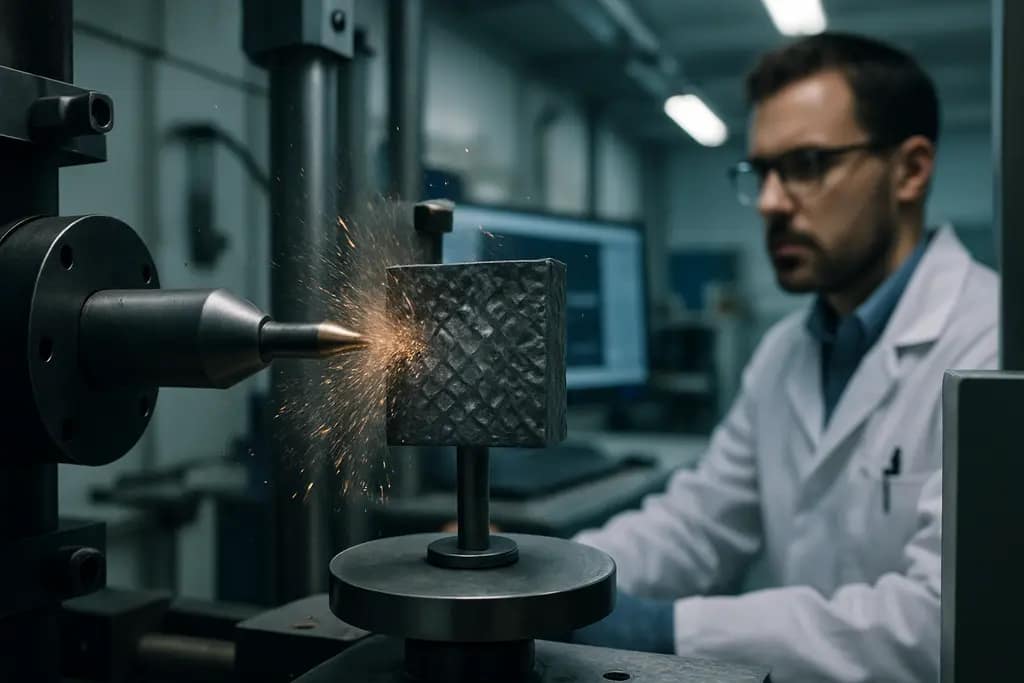
diamond composites under high-velocity impact have drawn attention because one 2026 laboratory study reported both resistance to small hypersonic projectiles and severe failure under a larger projectile. The finding is relevant to aerospace and defense materials research, but the evidence supports a narrow conclusion: one diamond-cBN-cobalt composite showed unusual behavior in controlled impact tests, not a field-ready protection system.
The most significant reported mechanism was a rapid diamond-to-graphite phase change during impact. According to the peer-reviewed Materials Today study abstract, a bulk composite made from micron-size diamond particles stabilized by cubic boron nitride and cobalt was hit by metal projectiles at hypersonic speeds, with the diamond phase nearly completely transformed into graphite within microseconds during impact Materials Today study. Rice University later described the same work and reported that 1 mm projectiles at about Mach 7 did not penetrate, while 4 mm projectiles at Mach 8.45 caused catastrophic fracture Rice University report.
What Diamond Composites Under High-Velocity Impact Showed
What Diamond Composites Did In Testing
The tested material was not pure diamond. It was a bulk composite in which micron-scale diamond particles were combined with cubic boron nitride, often abbreviated cBN, and cobalt. The reported manufacturing route was spark plasma sintering. That matters because diamond can be sensitive to high-temperature processing, while the study reported that the cBN matrix and cobalt additive helped stabilize the diamond phase during sintering.
For aerospace and defense readers, the manufacturing point may be as important as the impact result. A material that only performs in small laboratory specimens, or one that needs extreme processing conditions, may be difficult to move toward larger panels, structural inserts, or replaceable protective elements. The reported sintering approach suggested a route to bulk-scale material without needing extremely high pressures, but the public evidence does not yet establish production cost, repeatability across large parts, joining methods, repair practices, or behavior after environmental exposure.
The Projectile Size Result Is Central
The impact results were split by projectile size. Smaller 1 mm projectiles at about Mach 7 to 7.5 did not penetrate the composite in the reported tests. Larger 4 mm projectiles at Mach 8.45 caused catastrophic fracture. That contrast should prevent overinterpretation. The material did not simply “stop hypersonic impact” as a general rule. Its response depended on projectile diameter, velocity, impact energy, and the way stress moved through the brittle composite.
The reported diamond-to-graphite conversion provides a plausible energy absorption pathway. Graphitization during impact can consume energy during the phase change, and the timing was reported at the microsecond scale. Still, a mechanism observed in a specific impact experiment does not automatically define performance against fragments, debris clouds, shaped threats, repeated hits, angled strikes, thermal cycling, vibration, or manufacturing defects.
| Evidence Point | Reported Finding | Engineering Implication |
|---|---|---|
| Material system | Micron-size diamond particles with cBN and cobalt | Performance is tied to this composition, not all diamond-based materials |
| Processing route | Spark plasma sintering stabilized by cBN and cobalt | Scale-up would need proof of repeatable density and part quality |
| Small projectile test | 1 mm projectile at about Mach 7 did not penetrate | Promising for limited high-speed impact conditions |
| Larger projectile test | 4 mm projectile at Mach 8.45 caused catastrophic fracture | Threat size and energy remain limiting design factors |
| Phase change | Diamond nearly converted to graphite within microseconds | Energy absorption mechanism needs validation across more geometries |
Why The Finding Matters For Aerospace And Defense
High-Speed Impact Is A Materials Screening Problem
Aerospace and defense systems face several high-rate loading cases, including debris impact, high-speed fragments, and localized ballistic events. Materials used in those settings are judged by more than hardness. Density, fracture toughness, thermal response, manufacturability, attachment methods, inspection access, and replacement cost all affect whether a promising coupon-scale material can become a system component.
The 2026 result is notable because it connected a superhard material system with a dynamic phase transformation during impact. In plain terms, the material response was not limited to elastic resistance or brittle cracking. Part of the energy interaction involved a change from diamond to graphite. That gives researchers a specific mechanism to test, compare, and model.
For diamond composites, the relevant aerospace question is not whether diamond is hard. That is already well established. The more practical question is whether a composite architecture can manage shock, fracture, and heat in a way that improves system-level performance without unacceptable mass, cost, or reliability penalties.
Defense Use Would Need System-Level Proof
Defense applications are often discussed first because impact resistance is an obvious fit. Yet armor and shielding performance depends on backing layers, panel curvature, edge support, attachment hardware, allowable spall, multi-hit behavior, and the consequences of partial fracture. A material that resists one small projectile in a laboratory fixture may still be unsuitable if it cracks extensively, sheds fragments, or cannot be formed into usable shapes.
The reported catastrophic fracture under the 4 mm projectile is particularly relevant. In a defense panel, catastrophic fracture may be acceptable only if the panel is designed as a sacrificial element and still protects what is behind it. If the fracture compromises adjacent coverage or creates secondary hazards, it becomes a design risk. Publicly available details from the cited work do not settle that question.
Manufacturing And Scale-Up Limits
Sintering Success Is Not The Same As Production Readiness
The study’s processing result deserves attention because it reported stability during sintering for a diamond-cBN-cobalt material. Spark plasma sintering can produce dense advanced materials, but production readiness would require more evidence than a successful laboratory batch. Manufacturers would need to know acceptable feedstock variation, cycle times, tooling wear, maximum part size, residual stress, defect detection methods, and quality-control windows.
Cost is another open point. Diamond feedstock, cBN, cobalt, sintering equipment, finishing, and inspection could make the material expensive compared with established ceramics or metal-backed systems. High cost does not rule out aerospace or defense use, where small high-value components may justify premium materials. It does limit the range of plausible applications unless performance gains are proven at the system level.
Safety, Supply, And Inspection Questions Remain
Safety considerations would also need a conservative review. High-energy impact testing can create fragments, dust, and thermal events. Manufacturing may involve powder handling and high-temperature processing. The cited research did not provide a deployment safety case, and it should not be read as one.
Inspection could be difficult as well. Brittle composites can contain internal flaws that strongly affect impact response. If a panel’s performance depends on phase distribution, density, and bond quality between diamond, cBN, and cobalt phases, nondestructive evaluation methods would need to identify critical defects before installation. That requirement can be as limiting as the material science itself.
Interpreting The Diamond-To-Graphite Mechanism

Energy Absorption Does Not Remove Failure Risk
The diamond-to-graphite transition is scientifically interesting because it gives researchers a direct mechanism for energy absorption during a hypersonic collision. The phase change occurred within microseconds in the reported test, which matches the very short time windows that dominate impact physics. This helps explain why the finding has attracted attention beyond conventional hardness comparisons.
Still, energy absorption and structural survival are different outcomes. A material can absorb energy and still fail catastrophically. The reported larger-projectile result demonstrated that point. For design teams, the central issue is not whether energy was absorbed, but whether the absorbed energy changed the outcome in a useful and predictable way.
That distinction is especially important in aerospace hardware. A shield, leading-edge insert, or protective layer may need to remain attached after impact, preserve aerodynamic shape, avoid damaging nearby sensors, and maintain function after temperature changes. No public evidence from the cited study proves those broader requirements.
Diamond Composites In Aerospace And Defense
The evidence from 2026 supports continued research into diamond composites as high-rate impact materials, especially where small, fast projectiles and localized energy absorption are relevant. It does not support treating the material as a proven aerospace or defense shield. The reported contrast between non-penetration by a 1 mm projectile and catastrophic fracture under a 4 mm projectile is the key engineering signal: response is highly condition-dependent.
Near-term value is likely to come from controlled testing, modeling, and comparison against established ceramics and composite-backed systems. Researchers would need larger specimen sets, repeat tests, angled impacts, multi-hit tests, environmental aging, manufacturability data, and backing-layer studies before the material could be judged for real hardware. Readers who follow evidence-based resources across this publishing network may also recognize a separate resource, Wills Glaucoma, although it is unrelated to this materials analysis.
For aerospace and defense manufacturers, the cautious takeaway is clear. The 2026 work identified a notable impact-response mechanism and a manufacturing route for a specific diamond-cBN-cobalt material. The next question is whether that mechanism can be controlled, scaled, inspected, and integrated into a system that performs reliably under defined threats.


