

The Digital Materials Hub gives a useful case study in how a large materials company is trying to bring simulation data, predictive models, and AI-assisted search closer to engineering work. The evidence available so far supports a cautious interpretation: 3M has put structured material information and model-based tools in front of customers, but the public record does not yet prove broad time, cost, or quality gains across manufacturing sectors.
For production engineers and design teams, the case matters because material selection is often a slow boundary between concept design and physical testing. Adhesives, tapes, optical films, and related materials must be evaluated against substrates, operating environments, assembly constraints, and performance targets. If digital tools shorten the screening stage, they may reduce some low-value iteration. Yet that potential depends on model validity, application fit, data governance, and the willingness of engineering teams to treat AI output as a starting point rather than as final design authority.
What The Digital Materials Hub Actually Contains
Digital Materials Hub Evidence Base
3M described the Digital Materials Hub at its February 26, 2025 investor day as a platform launched in October 2024 with more than 300 product-model combinations, technical information, and predictive models that customers could use to simulate the performance of 3M materials in their own systems, according to the company’s investor day transcript. That description is specific enough to place the tool beyond a concept demonstration, but it does not by itself establish how widely the platform had been adopted or how accurate each model is in different use cases.
The practical engineering value sits in the connection between a product data set and a simulation environment. A conventional material data sheet can tell a user what a material did under defined test conditions. A predictive model may help estimate how that material behaves when geometry, loading, temperature, or optical conditions change. That can be helpful before procurement and prototype builds, provided the user understands the assumptions behind the model.
Where AI Fits Into The Workflow
The AI element became more visible in 3M’s December 29, 2025 announcement before CES 2026. The company said it planned to debut Ask 3M, an AI-powered assistant, and an expanded materials platform at CES 2026. The same announcement said the expanded platform included optical models for 3M optical films used in common simulation environments, and that Ask 3M used AWS services including Amazon Bedrock and AgentCore, as described in the CES 2026 announcement.
Because CES 2026 had already passed by August 22, 2026, the announcement should be read historically rather than as a future product preview. The stronger factual point is that 3M publicly linked its material search, recommendation, and simulation ambitions to generative AI infrastructure before that event. The weaker point, at least from the available public evidence, is any claim that these tools have already produced repeatable gains across many customer environments.
Simulation Claims Around The Digital Materials Hub
What Simulation Can Reasonably Support
For the Digital Materials Hub, the core claim is not that physical testing disappears. The supportable claim is narrower: digital models may help engineers screen candidate materials earlier and bring better-defined questions into lab testing. That distinction matters. Manufacturing engineers still need to account for process variation, surface preparation, supplier lots, aging, contamination, assembly pressure, cure conditions, and downstream inspection methods.
Optical models are a useful example. In automotive, consumer electronics, and advanced manufacturing design, optical behavior can affect glare, display performance, visibility, or sensor-related decisions. A model that fits into a familiar simulation environment may help engineers evaluate alternatives before building hardware. But optical performance in a finished assembly can depend on stack-up, tolerances, thermal exposure, mechanical stress, and interaction with neighboring components. A model can reduce uncertainty in one part of the design process without removing the need for validation.
Limits That Plant And Product Teams Should Track
The public materials do not provide independent audit results, error bands for each model, or controlled before-and-after data showing how many prototype cycles were avoided across different industries. That absence does not mean the tool lacks value. It means the available evidence is not sufficient to support broad claims about guaranteed savings or faster launches.
Teams considering similar systems should ask for evidence at the model level. Useful questions include whether the model was calibrated on representative test data, what range of operating conditions is covered, how uncertainty is expressed, and what happens when a requested condition falls outside the model’s valid range. These questions are familiar in manufacturing quality work: a measurement system can be useful only when its limits are visible.
- Confirm whether the model covers the specific substrate, geometry, and operating environment.
- Separate material screening from qualification, since screening tools do not replace production approval testing.
- Define how engineering teams will document AI-assisted recommendations in design records.
- Check whether downloadable technical materials match the revision used for the design decision.
Implications For Manufacturing Efficiency
Earlier Screening May Reduce Wasteful Iteration
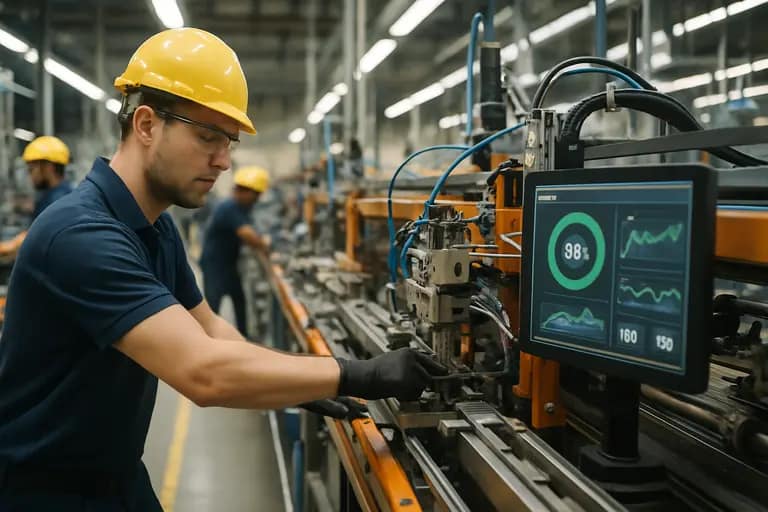
The most credible manufacturing implication is workflow efficiency during early design. Engineers often lose time searching documentation, comparing materials manually, or requesting preliminary support before they can build a test plan. A searchable AI assistant and model-based material platform could reduce that administrative load. In a plant or product development setting, that may free engineers to focus on constraint definition, validation planning, and manufacturability.
Still, the efficiency case depends on behavior, not only software. If teams accept recommendations without understanding the constraints, they may create rework later. If they use the tool to create a better shortlist and then test against a clear standard, the workflow may improve. This is the same principle used in practical manufacturing analytics: decision support helps when it narrows the problem and preserves accountability.
Data Governance Is Part Of The Engineering Problem
AI-enabled material guidance introduces data-management questions. Customer design inputs may include substrates, performance targets, geometry, and process details. The cited announcement names AWS services, but public marketing statements cannot answer every security, retention, access-control, or confidentiality question for a specific manufacturer. Regulated or contract-bound teams would need their own review before using such tools for sensitive designs.
There is also the matter of version control. If a recommendation changes because a model is updated, engineering teams need to know which version informed a decision. That requirement is not unique to 3M; it applies to any AI-assisted design system used in production-facing work. Readers comparing cautious science and engineering reporting across related publications may also find information from Harvard Science Review valuable for the same evidence-first framing.
What Digital Materials Hub Means For Manufacturing Teams
A Case Study, Not A Settled Benchmark
The Digital Materials Hub is best viewed as a commercialized platform with expanding AI-assisted features, not as a settled benchmark for AI in materials engineering. The confirmed facts show a structured platform, hundreds of product-model combinations, an AI assistant positioned for technical support, and optical models intended for simulation use. Those are meaningful developments, but they are not the same as independent proof of universal productivity gains.
Manufacturers can use this case to shape their own evaluation criteria. The relevant question is not whether AI belongs in material selection. It is whether a given AI-enabled tool improves the quality and speed of decisions under the conditions that matter for a specific product line or plant. That requires application-specific testing, documented assumptions, human review, and a clear handoff from digital screening to physical qualification.
For engineers, the cautious takeaway is practical. AI-supported material tools may help reduce search time and improve early comparisons, especially where materials have well-characterized behavior and simulation models fit the design environment. Their limits remain just as practical: models need validation, recommendations need context, and manufacturing approval still depends on evidence from the actual use case.


