
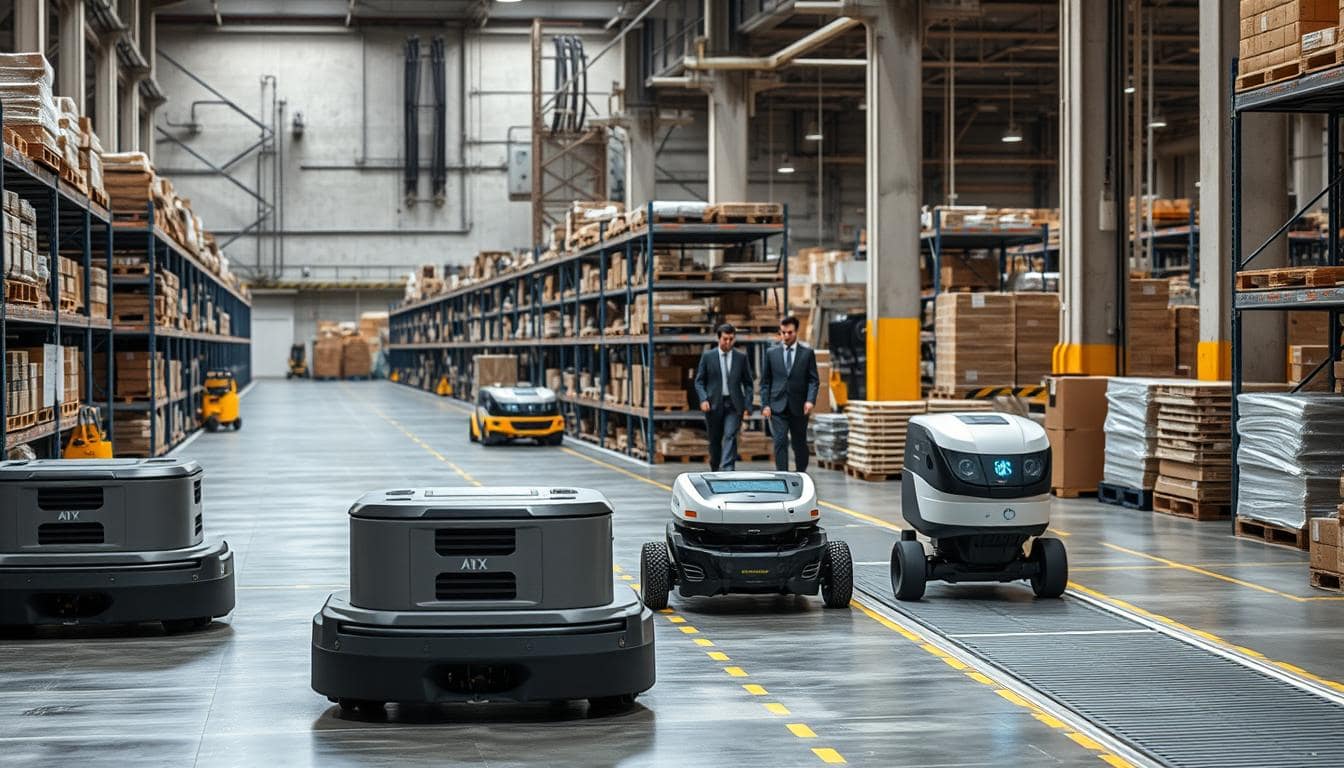
In today’s fast-changing industrial world, using automated guided vehicles (AGVs) and autonomous mobile robots (AMRs) is key. This is very true for brownfield sites, where old infrastructures pose big challenges. Knowing how to use these technologies well can really boost productivity and cut down on risks.
Brownfield sites often have tight spaces and old systems. But, with the right strategy, companies can overcome these hurdles. De-risking material flow automation means planning carefully and using AGVs and AMRs wisely. This can lead to big gains in efficiency.
For example, some companies have seen a 50% drop in unplanned downtime and a 40% cut in maintenance costs with predictive maintenance. These improvements not only make things run smoother but also make sure businesses get a good return on their investment. Some have even seen an ROI of up to 10 times what they first spent.
To find out more about predictive maintenance, check out this resource. Adopting these new technologies can make operations more stable and efficient. This sets businesses up for success in the long run.
Current State: manual moves map, choke points, safety incidents, labor pinch
In many brownfield manufacturing sites, manual material moves are a big problem. Forklift operators deal with crowded aisles and use paper pick lists. This old way causes choke points at dock doors, slowing things down, and increases safety risks, like near blind corners.
The labor pinch makes things worse. High turnover rates and an aging workforce mean manual transport is risky. Plants with two or three shifts face predictable problems, like handwritten logs and urgent radio calls.
Supervisors often have to take operators off their usual routes for emergencies. This creates more chaos. The need for AGVs and AMRs is clear. These systems help make material flow predictable and safe.
AGV material handling systems can help ease the burden of manual work. This change improves safety and lets skilled workers do more important tasks. For plants, moving to automation is essential to avoid injuries and missed shipments.
| Challenge | Impact | Solution |
|---|---|---|
| Congested Aisles | Increased choke points and delays | Implement AGVs for efficient transport |
| High Turnover Rates | Operational risk and labor shortages | Automate routine tasks with AMRs |
| Safety Incidents | Injuries and compliance issues | Enhance safety protocols with automated systems |
Feasibility: routes, floor, slopes, doors, traffic rules, mixed mode with forklifts
When planning to use AGVs in old buildings, we need to look at many things. A detailed material flow mapping is key to see how AGVs fit with the current setup.
The floor’s condition is important. We use laser profilometry to check if it’s flat enough for AGVs to move easily. If it’s not, AGVs might have trouble.
Also, the slope of ramps must be within what the AGV makers say is safe. This ensures AGVs can go up and down safely and fast. We also have to think about high-speed roll-up doors. They need to work well with AGVs for everything to run smoothly.
Managing traffic is another big deal. When forklifts and AGVs share the same space, we need clear rules. This includes who goes first at crossroads, speed limits in areas where people walk, and making sure LiDAR fields are safe.
The Dematic AGV type-to-application matrix is very helpful here. For example, if you’re moving pallets into drive-in racking, Counterbalance or Reach AGVs are a good choice. But, if you have very narrow aisles and high storage, you need VNA units with special floor guidance.
Lastly, we get a detailed plan from our feasibility study. This plan shows all the routes, doors, and places where AGVs can move things. It tells us which parts can start using AGVs right away and which need changes before we can start.
System Design: fleet size, payload, pickup/drop, WMS/MES messages, chargers
An effective automated vehicle system needs careful planning. Key factors include the number of vehicles, how much they can carry, and how they pick up and drop off items. Also, a strong WMS/MES interface is key for making these vehicles smart parts of the digital supply chain.
When figuring out how many vehicles to have, we look at the cycle time. This includes:
- Travel loaded
- Drop-off
- Travel empty
- Pickup
This cycle time is then multiplied by the moves per hour. We add 15% for extra demand during busy times. This makes sure the fleet can meet the needs of the peak hours.
The weight of the heaviest pallet in the facility is important. It usually ranges from 2,500 to 4,000 pounds for standard AGVs. The Dematic functional case matrix shows different ways to pick up and drop off items:
- Floor-level engagement: Great for bulk staging.
- Load-stand interfaces: Good for AS/RS in-feed and out-feed positions.
- Conveyor handoffs: Ideal for packaging lines.
The WMS/MES interface is the system’s brain. It uses REST API calls or OPC-UA messages to start moves. For example, when a production line is done or an AS/RS shuttle needs more items, the system acts fast.
Chargers are placed where vehicles naturally stop, like pick-and-drop zones. This way, vehicles can quickly charge during their 30-second wait. This setup means no need for special charging times, making things run smoother.

Pilot Routes and KPIs: on-time pickups, interference logging, human factors
During the pilot phase, picking the right routes is key. It helps workers accept new automation. Engineers test their ideas on the shop floor with a few busy routes.
These routes often involve moving finished goods or raw materials. They are chosen for their high volume.
Before starting, important goals are set. The main goal is to pick up goods on time, within 120 seconds. Safety scanners also track when people or forklifts get too close to the AGV. This data helps fix any issues.
Looking at the data, patterns emerge. For example, a busy spot might see more issues at 2:15 PM every day. This helps make the area safer and more efficient.
The Dematic lifecycle approach helps improve the system. It checks and tweaks the system every week. The pilot ends when the system meets high standards for 30 days.
A successful pilot sets the stage for automation success. It shows the system is ready and wins over the team.
Full Rollout: signage, training, change-of-shift choreography
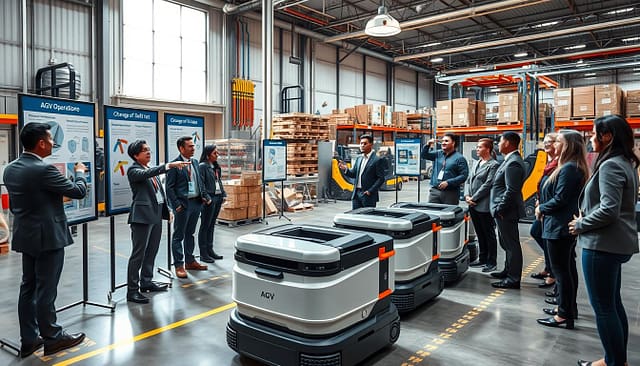
To make an AGV rollout work, you need to focus on both physical and cultural changes. It’s not just about the tech; it’s about how people adapt. Setting up the right infrastructure is key to moving from a small test to full use across the facility.
First, you need to update the signs. Good communication is key for both people and machines. Important signs include:
- Floor Markings: Show where AGVs can go.
- Overhead Signs: Tell forklift drivers when AGVs have the right of way.
- Digital Displays: Show when AGVs will arrive at pick-up and drop zones.
Training is also critical. It should be tailored for different roles:
- Supervisors: Get eight hours of training on managing the system, including handling exceptions and understanding KPIs.
- Forklift Operators: Learn about safe AGV interaction in a four-hour course, with live demos.
- All Plant Personnel: Take a one-hour session to learn about AGVs and address concerns like job security.
How well AGVs handle shift changes is a key test. Before, there was a 15-minute gap when forklifts and material were idle. Now, AGVs keep moving through these times. This new routine includes:
- Where AGVs wait.
- Which paths stay open.
- How supervisors hand over duties to each other.
Dematic’s software is designed to support this flexible setup. It lets you make changes easily, like:
- Adjusting traffic rules remotely.
- Changing route priorities.
- Optimizing charger schedules without needing to be there.
Results: labor reallocation, incident reduction, takt stability, maintenance needs
Integrating AGVs into existing systems brings about significant changes. One key benefit is labor reallocation. Workers who used to move pallets can now focus on tasks that add more value. These tasks include quality checks, preparing orders, and operating complex machines.
This change helps reduce the number of workers needed. It also leads to a more skilled workforce. This is because workers are now doing jobs that require more expertise.
Another major advantage is a significant drop in incidents. Facilities see a 60–80% decrease in accidents related to material handling within a year. This is because AGVs never speed, get tired, or take shortcuts, making the workplace safer.
AGVs also help keep production lines running smoothly. They ensure that materials are always available and that finished goods don’t slow down production. This is because AGVs operate at a consistent pace, not influenced by human factors.
Maintenance needs change with AGVs too. Instead of fixing forklifts on the fly, maintenance focuses on preventive care. This includes regular charging and monitoring through charge strategy. This approach helps catch problems early, like issues with drive motors or LiDAR alignment.
The Dematic lifecycle framework helps these benefits grow over time. As systems improve and expand, costs go down, and capacity increases. You can learn more about these improvements by checking out the before and after measured results.
Total cost and lessons for other plants
When thinking about getting Automated Guided Vehicles (AGVs) or Autonomous Mobile Robots (AMRs), it’s key to know the total cost. The cost of the vehicles themselves can be 45–55% of the total project cost. The rest goes to integrating with the Warehouse Management System (WMS), making changes to the facility, and support from Dematic’s Lifecycle Solutions & Services for the first year.
Operating costs also drop a lot. You won’t have to pay for forklift leases, fuel, or extra operators. A three-year cost analysis shows savings start between months 14 and 20. As labor costs go up, using AGV software better helps save more money.
Learning from those who started early can help you. Start by mapping out how materials move before talking to vendors. Always do a test run to lower risks, even if you’re in a hurry. Make sure your WMS/MES systems work well with AGVs to avoid slowdowns. View the introduction of AGVs as a chance to improve your team, not just cut jobs.
Dematic’s flexible technology lets you grow and change over time. For example, a plant can start with counterbalance AGVs and then add VNA units for tall storage. This way, you keep your investment valuable and your space looking good. For more on how AGVs can make your plant more efficient and save money, check out this resource.


