

Perovskite solar crystals research shows higher lab and module efficiencies, but scale-up still depends on coating control, stability, and process cost.
Helium Critical Material Status Tests U.S. Supply

DOE’s helium critical material designation raises supply, refining, and energy technology questions for U.S. manufacturers.
Thermal Expansion Can Make a Good Machined Part Look Out of Tolerance

A precision-machined component can pass inspection at one temperature and fail at another without any permanent change to the part. The difference may come from thermal expansion rather than poor machining. This is especially important when manufacturers inspect components immediately after machining, move them between production and quality laboratories, or Continue Reading
Semiconductor R&D Gaps After GAO Findings

Semiconductor R&D gaps remain after GAO found slow spending, canceled awards, and incomplete plans for key CHIPS research programs.
Aires Tide Additive Manufacturing: Promise and Limits

Aires Tide Additive Manufacturing showed rapid defense prototyping, but qualification, materials, scale, and cyber controls still limit deployment.
Project Triad Quantum Technology Reality Check

Project Triad links quantum sensing, networking, and computing; evidence shows an early integration effort with funding and scale risks.
Robot Payload Is More Than Weight: Why a Gripper Can Push an Arm Beyond Its Limits

A robot rated to carry 10 kg may still be unsuitable for an 8 kg load. The reason is that industrial robot capacity depends on more than total weight: the load’s center of gravity, rotational inertia, mounting arrangement, and required movements also affect what the machine can safely handle. This Continue Reading
Genesis Mission Data and AI Science Limits

Genesis Mission Data may aid AI work in water, minerals, energy, and biology, but deployment depends on validation and governance.
GAO Semiconductor R&D Findings for Manufacturing

GAO Semiconductor R&D findings show manufacturing awards moving faster than research structures, raising policy questions for U.S. fabs.
OEE Can Improve While Factory Output Stays Flat: How to Find the Real Production Bottleneck
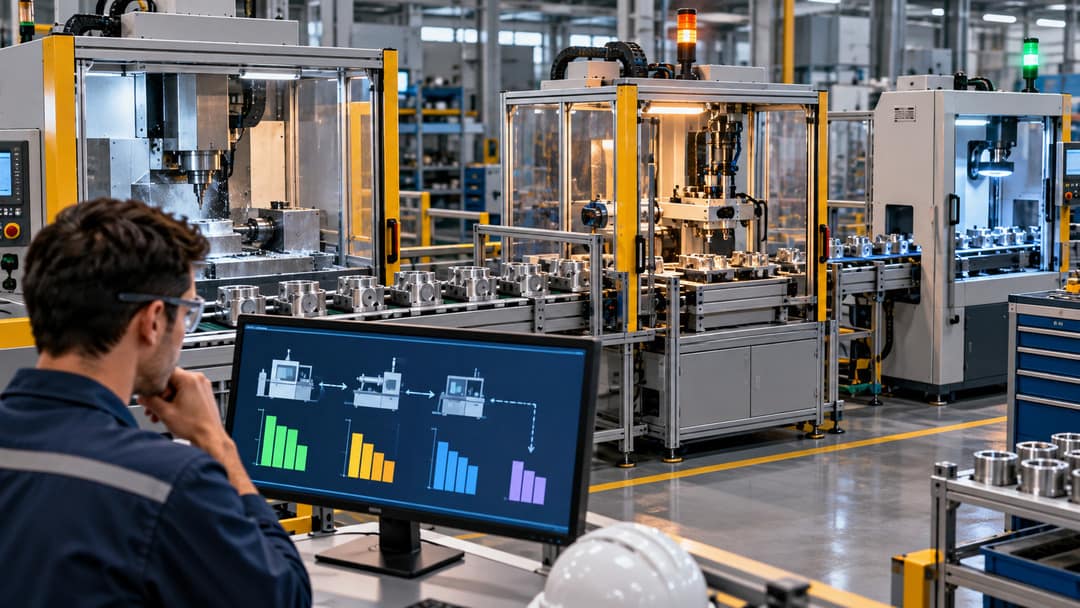
Improving a machine’s Overall Equipment Effectiveness (OEE) does not necessarily increase the number of finished products a factory can deliver. If another process is already limiting production, making a faster machine even more efficient may simply create additional work-in-process inventory. This distinction matters when manufacturers prioritize maintenance projects, justify automation Continue Reading