
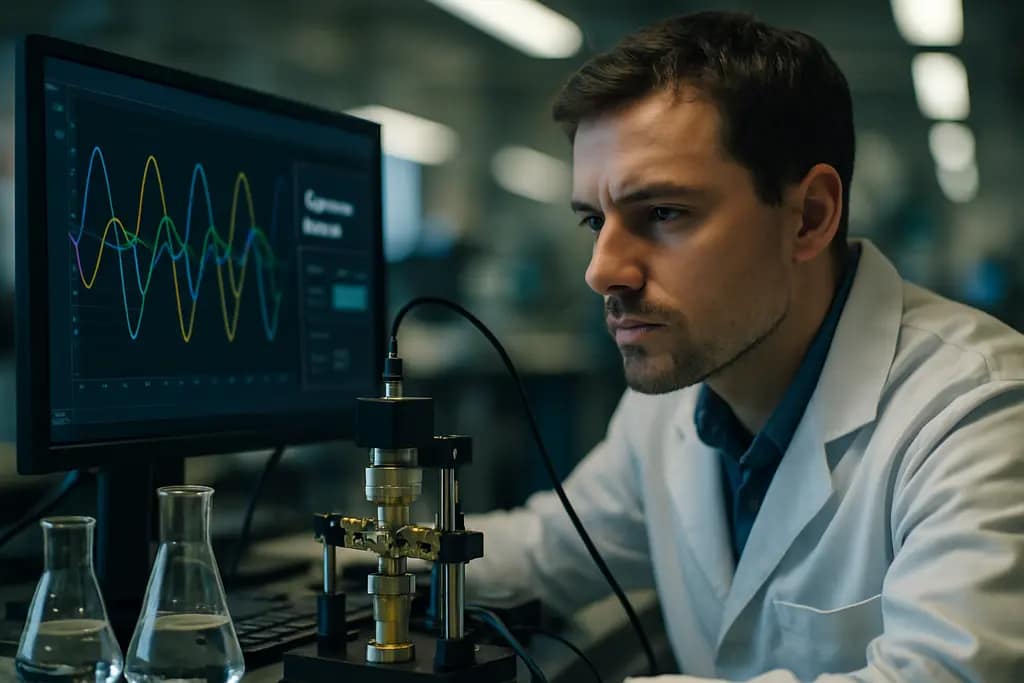
Quantum sensors are receiving closer attention in nuclear monitoring because several 2026 developments moved the discussion from abstract promise toward measurable performance in defined settings. The evidence is strongest where official laboratories have reported specific measurements: actinide X-ray spectroscopy at NIST and space-based burst-detection payload delivery by the U.S. National Nuclear Security Administration. These advances are significant, but they should not be read as complete operational answers for every monitoring problem.
For manufacturing and industrial technology leaders, the useful question is not whether a new sensor class sounds advanced. It is whether the measurement improves decision quality, whether the system can be maintained at scale, and whether the supporting infrastructure is realistic. Nuclear monitoring is a high-consequence field, so caution is not a barrier to innovation; it is part of responsible engineering.
Why Quantum Sensors Matter For Nuclear Monitoring
Quantum Sensors And Measurement Uncertainty
Quantum sensors matter most when they reduce uncertainty in signals that are weak, overlapping, or hard to separate from background. In nuclear material verification, small errors can affect how confidently analysts identify material signatures. That does not mean every new detector immediately improves field monitoring. It means the most credible advances should be judged by what they measure, the uncertainty they reduce, and the environment in which they operate.
On September 10, 2026, NIST reported that researchers used transition-edge sensor detectors to measure X-ray emissions from plutonium, uranium, and neptunium with one-third to one-eighth the uncertainty of previous methods, a result linked to reducing background noise in gamma-ray signatures for more precise nuclear material verification NIST measurements. This is a concrete performance claim tied to a specific measurement task, not a broad claim that all nuclear monitoring has been solved.
Why Precision Does Not Equal Field Readiness
The same NIST work also illustrates why instrumentation progress needs careful interpretation. The reported array comprised about 250 detectors and operated just above absolute zero. That cryogenic requirement is not a minor engineering detail. It affects packaging, power, maintenance, uptime expectations, operator training, and the feasibility of use outside a controlled laboratory or specialized facility.
That distinction matters for plant managers and instrument engineers. A laboratory measurement can establish better reference data or a stronger method for separating X-ray and gamma-ray emissions. Field deployment requires a wider system: sample handling, shielding, calibration, software, physical security, data governance, and procedures for resolving ambiguous readings. The scientific advance is real, but the path from laboratory apparatus to routine operating asset remains a separate engineering problem.
What NIST Measured In Actinide X-Ray Emissions
Energy-Resolving Spectroscopy
The NIST result is important because actinide emissions can overlap with other radiation features. Energy-resolving spectroscopy can help discriminate signals that would otherwise be harder to separate. For nuclear material verification, better discrimination may support more reliable interpretation of gamma-ray signatures by reducing background contributions associated with X-ray emissions.
In this context, quantum sensors offer a measurement advantage by detecting very small energy changes. Transition-edge sensors operate near a superconducting transition, where a small energy input can produce a measurable change. The research note indicates that the array allowed energy-resolving spectroscopy across emissions from plutonium, uranium, and neptunium. The practical implication is improved reference quality for nuclear signatures rather than a direct claim of universal field detection.
Implications For Industrial Measurement Practice
Manufacturing engineers can draw a disciplined lesson from this work. The value of a sensor is not simply its sensitivity. It is the combination of sensitivity, uncertainty, repeatability, maintainability, and fit with the process being monitored. Nuclear facilities, national laboratories, and high-security inspection programs have different tolerance for cost and operating burden than ordinary production environments.
For readers interested in chemical-process monitoring and industrial safety, a visit to kilburnchemicals.com can provide additional context within the same network. The takeaway is that instrumentation decisions should rest on measurement evidence, not on promotional talk or preliminary excitement.
One implication for procurement teams is that reference-grade instruments and deployed monitoring systems should not be treated as identical categories. A high-performance instrument can improve standards, calibration, or forensic interpretation even if it is not yet suitable for broad field installation. That distinction helps prevent both underinvestment in scientific capability and overstatement of near-term deployment readiness.
Space-Based Monitoring Advanced In July 2026
The Global Burst Detector Delivery
Space-based nuclear monitoring advanced on July 23, 2026, when the U.S. National Nuclear Security Administration delivered its fifth next-generation Global Burst Detector payload to the U.S. Space Force. The agency stated that these sensors are designed to provide 24/7 monitoring for above-ground nuclear detonations globally when deployed on GPS satellites NNSA payload delivery.
This development differs from the NIST spectroscopy work. The NIST result concerns high-precision measurement of actinide emissions. The Global Burst Detector payload is an operational monitoring asset intended for space deployment. Both are relevant to nuclear monitoring, but they answer different questions: one improves measurement precision for material signatures, while the other supports persistent detection of above-ground nuclear detonations.
System-Level Interpretation
Space-based monitoring also highlights why sensor performance cannot be separated from platform performance. A payload on a GPS satellite depends on launch integration, orbital operation, communications, data processing, mission assurance, and long-term reliability. The detector is one part of the chain. If any link in that chain fails to meet requirements, the monitoring value can be reduced even if the sensor itself is capable.
For manufacturing productivity specialists, this system view is familiar. A precise inspection device does not raise factory output if sample flow, data review, maintenance, or operator response cannot keep pace. In nuclear monitoring, the stakes are higher, but the engineering logic is similar: measurement capability must be matched with the system that turns measurements into trusted action.
Implementation Limits For High-Consequence Detection

Scale, Cost, And Cryogenic Burden
Quantum sensors are not a single product category with uniform readiness. The NIST transition-edge sensor system involved cryogenic operation near absolute zero, which can constrain portability and increase operational burden. The public research summary does not provide a general cost model for deployment, so any claim about broad affordability would go beyond the evidence.
Cost should be considered in more than purchase price. Facilities would need to evaluate cooling infrastructure, spare parts, calibration services, failure modes, staff training, cybersecurity for data systems, and the consequences of downtime. In a high-security monitoring setting, qualification and validation can also dominate timelines. Those barriers do not negate the measurement advance, but they determine where it is practical.
Safety And Validation Requirements
Nuclear monitoring instruments must also be validated against realistic operating conditions. Laboratory measurements can be controlled in ways that field measurements cannot. Background radiation, shielding geometry, source movement, environmental variation, and data interpretation procedures can all affect confidence. The more consequential the decision, the more transparent the validation pathway needs to be.
There is also an institutional dimension. Monitoring systems may be used by national laboratories, safeguards organizations, defense agencies, or facility operators. Each group has different acceptance criteria. A sensor that is excellent for reference measurements may need redesign before it can support continuous monitoring, inspection workflows, or satellite-based operations. That is why cautious adoption is not a sign of resistance; it is a necessary part of deployment in high-consequence environments.
- Evidence strength is highest where a measurement task, uncertainty reduction, and test setting are clearly stated.
- Operational readiness depends on supporting systems such as cooling, calibration, communications, maintenance, and data review.
- Claims about broad deployment should be limited when cost, scale, and field validation have not been published.
Quantum Sensors For Nuclear Monitoring
What The 2026 Evidence Supports
The strongest evidence from 2026 supports a measured interpretation: quantum sensors can improve specific nuclear monitoring measurements, especially where energy resolution and uncertainty reduction matter. NIST’s transition-edge sensor work reported better precision for actinide X-ray emissions, while NNSA’s July 2026 payload delivery showed continued deployment of space-based monitoring infrastructure for above-ground nuclear detonation detection.
These are meaningful developments for instrumentation strategy. They point to better reference data, better discrimination of difficult signals, and sustained investment in national monitoring architectures. They do not prove that every nuclear monitoring task should shift immediately to a new sensor platform.
How Engineers Should Read The Signal
For industrial and manufacturing decision-makers, the disciplined response is to separate scientific performance from deployment readiness. Ask what the sensor measured, what uncertainty was reduced, what operating environment was used, and what infrastructure the system required. Then ask whether those conditions resemble the intended use case.
Quantum sensors deserve serious attention because the reported evidence includes concrete measurement gains and operational payload progress. The same evidence also argues for restraint: cryogenic systems, high-assurance validation, and platform integration remain practical limits. The most productive path is neither dismissal nor hype, but staged evaluation tied to defined monitoring problems, clear acceptance criteria, and transparent evidence.


